There is something almost unfair about making a survival movie with a dog at its center. You can tell me the plane is going down, the wilderness is trying to kill everyone, and the main character has spent decades dealing with the psychological wreckage of war — fine. I can handle that. But put a battered German Shepherd beside Brad Pitt and suddenly I am far more emotionally invested in whether the dog makes it home.
That is exactly the trick Heart of the Beast pulls. Directed by David Ayer and starring Brad Pitt as former Army Special Forces veteran James Belmont, the film throws a retired military operator and his wounded combat dog, Odin, into the Alaskan wilderness after a catastrophic plane crash. From there, it becomes a brutal fight against freezing temperatures, starvation, predators, injuries and memories that refuse to stay buried.
And yes, the movie looks suspiciously realistic.
That has led to the question popping up everywhere: Is Heart of the Beast based on a true story?
Where Was Heart of the Beast Filmed? Complete Guide to the Filming Locations
So, Is Heart of the Beast a True Story?
No. Not in the traditional sense.
Heart of the Beast is a fictional story. James Belmont is not a real decorated Special Forces veteran whose plane crashed somewhere in Alaska, and Odin is not a famous military dog whose survival was turned into a Hollywood screenplay.
That distinction matters because the film does something clever. It takes fictional characters and drops them into situations that are entirely believable. The military background, the relationship between a handler and his dog, combat trauma, wilderness survival and the use of prosthetics for injured working animals all have real-world foundations.
So if you were hoping to discover the actual veteran behind the movie, there isn’t one. There is no single true event that the screenplay simply copied.
But that doesn’t mean the story came from nowhere.
The Real-Life Military K9 Story Behind the Fiction
This is where Heart of the Beast gets much more interesting than its basic survival-movie setup suggests.
Military working dogs have served alongside American troops for generations. These animals aren’t simply trained pets wearing tactical gear for the camera. They can detect explosives, track people, locate wounded soldiers and enter situations where sending a human first would be madness.
The relationship between a handler and a military dog can also become extraordinarily close. A soldier may spend years training, deploying and living alongside the same animal. After enough time, the dog isn’t just another piece of equipment. It’s a partner.
That’s the emotional foundation Cameron Alexander’s screenplay uses for James and Odin.
Odin isn’t there just to make the poster more appealing. His presence gives James someone to protect, someone who depends on him, and, perhaps most importantly, someone who understands him without needing a single word.
That works surprisingly well because James is clearly carrying a lot of psychological baggage. The wilderness is dangerous, but his memories may be just as difficult to escape.
Odin’s Injuries Make the Movie Feel Even More Real
One of the more unusual details is Odin himself.
The German Shepherd has suffered serious injuries during his military service and requires prosthetic modifications, including a prosthetic leg and damaged teeth. It is the sort of detail that could easily have turned into cheap emotional manipulation. Instead, it makes the character feel like a veteran in his own right.
And this isn’t some completely invented Hollywood concept. Veterinary medicine has advanced dramatically, and injured working animals can receive prosthetic limbs, reconstructive procedures and long-term rehabilitation.
That’s one reason the movie’s premise feels plausible even when the actual story isn’t.
| Element | Fictional or Real? |
|---|---|
| James Belmont | Fictional |
| Odin’s specific backstory | Fictional |
| Military working dogs | Real |
| Veterinary prosthetics | Real |
| Veterans forming lifelong bonds with service dogs | Real |
| The Alaskan plane crash depicted in the movie | Fictional |
Why People Keep Assuming the Movie Really Happened
I completely understand the confusion.
David Ayer has built a career around making violence, military environments and damaged characters feel uncomfortably tangible. His films rarely have the polished, safe atmosphere of a conventional studio action movie. There is dirt. There is exhaustion. People look like they haven’t slept in three days. Guns feel heavy. Violence hurts.
That approach is particularly effective here because Heart of the Beast isn’t asking you to believe in some superhero-level survivalist. James is highly trained, but he is also vulnerable. He gets tired. He gets hurt. He makes mistakes.
Then you have Odin, a real dog, moving through those environments beside Brad Pitt.
Suddenly the whole thing feels less like a movie and more like somebody found footage from an absolutely terrible week in the wilderness.
Brad Pitt and Uber: The Dog Behind Odin
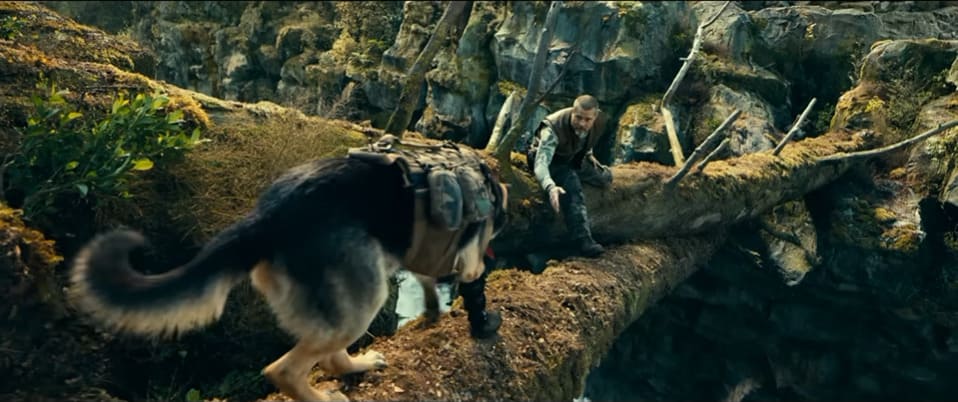
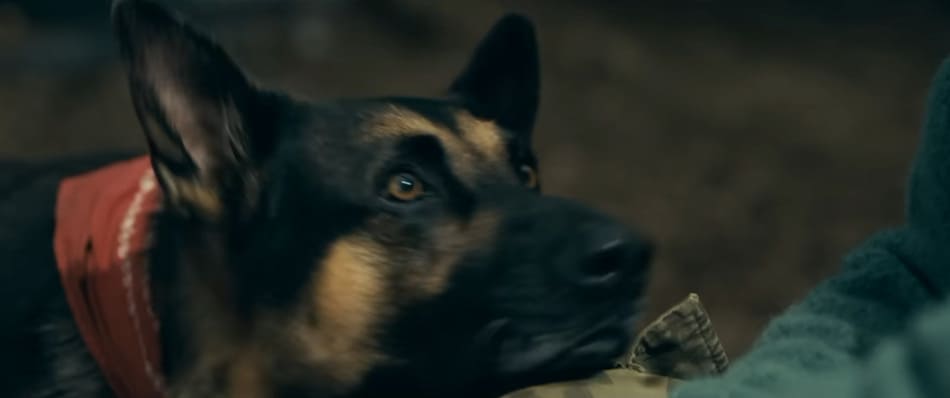
Here’s another reason the film sells its reality so effectively: Odin is portrayed by a real German Shepherd named Uber.
Uber isn’t simply a digital creation assembled by a visual-effects team. He is a trained dog with experience outside the film set, including mountain rescue work. That gives the scenes between Pitt and the animal a physical authenticity that CGI would struggle to reproduce.
And honestly, you can feel the difference.
There is a particular awkwardness and unpredictability that comes from working with a real animal. A dog doesn’t hit its mark because the script says it should. It looks where it wants. It reacts to sounds. It gets distracted. It decides that something happening off-camera is suddenly much more interesting.
Those little imperfections are exactly what make the relationship between James and Odin convincing.
Pitt has reportedly spoken about how important Uber became during production, with the dog effectively becoming one of the most important performers on set. The movie was filmed in New Zealand, whose rugged South Island landscapes were used to create the film’s harsh Alaskan setting.
And that location choice pays off. The mountains don’t look like a convenient movie set. They look enormous, cold and completely indifferent to whether these two characters survive.
Military Dogs Are More Than a Hollywood Plot Device
There is plenty of real history behind the movie’s portrayal of military dogs.
American military forces have used working dogs in various roles for more than a century. Modern military and special-operations dogs can be trained for tracking, detection, protection and other specialized missions.
One of the best-known examples is Cairo, the Belgian Malinois who participated in the 2011 operation against Osama bin Laden. Cairo became a symbol of how seriously elite military units can treat their canine partners.
That history gives Heart of the Beast something more substantial than the usual “man and dog against nature” formula. James and Odin aren’t simply buddies who happen to get stranded together. Their relationship has been forged through training, danger and years of dependence.
That distinction is important.
If Odin were simply James’s family dog, some of the story’s emotional beats would feel manufactured. Because he’s a retired combat animal who has already been through hell alongside James, their survival becomes an extension of everything they’ve experienced together.
The PTSD Angle Actually Gives the Story Some Weight
This is probably the part of the movie I find more compelling than the predator encounters.
James isn’t only fighting wolves, bears and the cold. He’s fighting what he brought home from military service.
That gives Odin a second purpose. The dog is a practical survival partner, but he also represents James’s connection to the life he used to have. Their relationship becomes a way for the film to explore trauma without turning every scene into an exposition dump.
I’m not going to pretend the movie suddenly becomes a perfect psychological study. It doesn’t. Hollywood survival thrillers still need dramatic confrontations and spectacular moments. But the underlying idea works because the bond between veterans and working animals is grounded in reality.
And Yes, Everyone Wants to Know: Does Odin Die?
Let’s address the question that probably matters more to dog owners than whether the screenplay has historical accuracy.
No, Odin does not die.
That reassurance became a surprisingly big topic among viewers and online communities. Anyone who has watched enough animal-centered movies knows the fear: the dog gets injured, the music becomes suspiciously emotional, and suddenly you’re wondering whether you actually agreed to watch this movie.
Heart of the Beast understands that anxiety.
The production has publicly reassured audiences about Odin’s fate, allowing viewers to focus on the survival story instead of spending two hours preparing themselves for emotional devastation.
Frankly, I appreciate that. There are plenty of movies willing to weaponize an animal’s death for cheap tears. Heart of the Beast doesn’t need that trick. The relationship between James and Odin already carries enough emotional weight.
Is Heart of the Beast Worth Watching If You Want a True Story?
If you’re specifically looking for a true-life military survival story, this isn’t it. Don’t go into Heart of the Beast expecting a dramatization of one veteran’s actual experience.
If what you want is a fictional thriller built from believable military details, however, the situation is very different.
- The main characters are fictional.
- The military K9 background has real-world foundations.
- The emotional bond between handler and dog reflects real military relationships.
- Prosthetic treatment for injured working dogs is based on real veterinary technology.
- The survival scenario itself is fictionalized for the movie.
For me, that’s a much more interesting proposition than simply slapping “based on a true story” across the poster.
The movie doesn’t need to have actually happened to feel truthful.
That’s ultimately where Heart of the Beast earns its credibility. The crash, James Belmont and Odin’s specific journey are inventions. The loyalty, military trauma, dependence and sheer stubbornness required to survive are not.
And if David Ayer manages to keep that balance without turning the film into another predictable Hollywood tearjerker, this could be one of those survival movies that sticks around in people’s heads longer than expected.
Just don’t make the mistake of calling it a true story. It’s fiction wearing very convincing boots.