There are horror movies where the monster is scary because you can barely see it. Then there are movies like The Last House, where the real nightmare is realizing that the thing outside might be far more intelligent than you ever imagined.
Louis Leterrier’s 2026 Netflix survival thriller takes a pretty familiar setup — a family trapped inside their own home while something monstrous controls the world outside — and stretches it into something much stranger. Greta Lee’s Ann and Wagner Moura’s Jason spend years trying to keep their family alive while an endless rainstorm turns Seattle into an almost unrecognizable wasteland. Food disappears. Infrastructure collapses. Hope becomes harder to maintain.
And then there are the creatures.
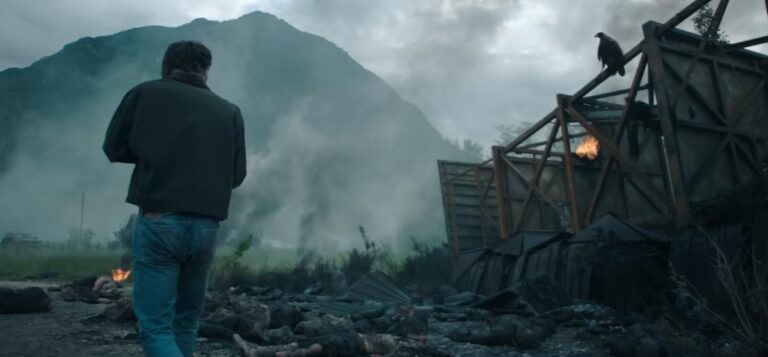
For most of The Last House, they are less like conventional movie monsters and more like moving pieces of a nightmare. You see a gigantic shadow through a window. Something enormous passes through the rain. A strange shape appears in the distance before vanishing behind the curtain of water.
By the time the movie finally shows us what is actually walking around outside, the question has changed. It is no longer simply “What are the monsters?” The much more interesting question is whether we ever understood them in the first place.
What Do the Creatures in The Last House Look Like?
The creature design is easily one of the film’s strongest ideas. Leterrier wisely avoids turning the monsters into generic CGI animals. They look ancient, aquatic and vaguely humanoid, but there is something fundamentally wrong about their proportions that makes them difficult to process as ordinary living beings.
They tower over humans, with enormous bodies covered in slick, constantly wet skin. Their lower bodies are dominated by thick tentacle-like appendages that allow them to move through flooded streets and ruined neighborhoods. Rather than behaving like an octopus crawling along the ground, however, they can use these appendages almost like legs, giving them a disturbing upright silhouette.
Their heads are even stranger. Multiple tendrils and sensory structures surround their faces, creating an obvious Lovecraftian influence without simply turning them into giant versions of Cthulhu. That distinction matters. These aren’t presented as supernatural demons from another dimension. Everything about their biology suggests that they belong to the same planet as humanity — just a part of the planet humans never properly understood.
One particularly nasty detail is the fluid that constantly drips from their bodies. It initially looks like ordinary water, but the movie eventually reveals that contact with it can cause objects to freeze almost instantly. It’s one of those visual details that makes the creatures feel less like animals and more like walking environmental anomalies.
The Rain Is More Than Just a Storm
This is where The Last House gets much more interesting than a standard creature feature.
The rain isn’t simply the setting. It is essentially another character.
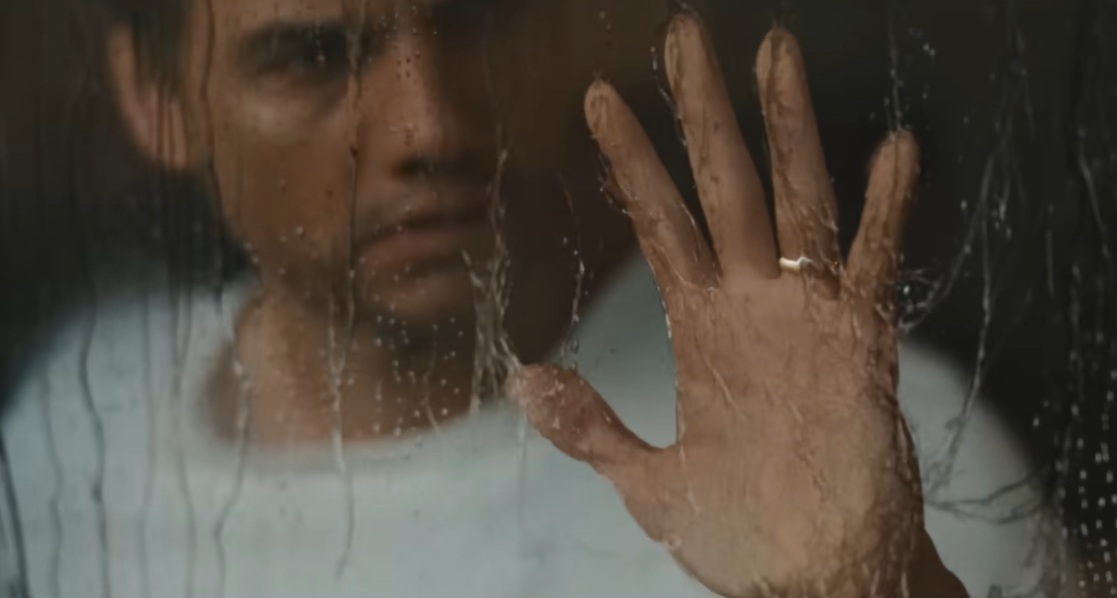
Throughout the film, water behaves in ways that shouldn’t be physically possible. It shifts direction. It gathers in deliberate patterns. It appears to react to movement. Eventually, the family realizes that the creatures can manipulate water on an almost unbelievable scale.
The houses aren’t physically barricaded by concrete walls or some invisible force field. Instead, the surrounding water becomes a living barrier. The creatures can manipulate rainfall and moisture to create seals around buildings, effectively turning ordinary homes into prisons.
That explains one of the movie’s central frustrations. Ann and Jason keep looking for a physical solution to a problem that isn’t really physical.
They want to break the door.
They want to escape through a window.
They want to fight whatever is outside.
But the entire environment is working against them.
The creatures’ apparent hydrokinesis also explains why the family’s little survival farm is ultimately so vulnerable. The Delgado family spends years turning their house into a miniature ecosystem, carefully growing food and preserving clean water. Then one encounter with a creature destroys that fragile balance almost immediately.
When Ann encounters one of the monsters during a desperate search for medicine and shoots at it, the consequences are brutal. The creature doesn’t simply chase her back to the house. It attacks the family’s infrastructure, flooding their carefully maintained world with saltwater and destroying crops that took years to cultivate.
That’s a much nastier punishment than simply killing someone.
The movie is essentially saying that survival isn’t only about keeping people alive. It’s about maintaining the environment that allows those people to continue living.
Are The Last House Monsters Aliens?
This is probably the biggest lore question surrounding the movie, and personally, the deep-sea interpretation makes far more sense than the alien theory.
Early in the story, the characters naturally assume the worst. A government experiment, an extraterrestrial invasion, some kind of biological weapon — humans tend to reach for explanations that put us at the center of the story.
The movie quietly pushes back against that instinct.
The opening reference to Arthur C. Clarke and the idea that Earth might be better described as an ocean than a planet establishes the film’s real direction almost immediately. Humanity has mapped only a fraction of the world’s deepest marine environments. There are enormous regions beneath the surface that remain almost completely unknown.
So what if something evolved down there?
Not aliens. Not demons. Not supernatural invaders.
Something native to Earth that simply existed outside humanity’s awareness.
That’s a much creepier idea.
The creatures can be interpreted as an ancient deep-sea species that has survived in environments humans could never reach. As the oceans become increasingly hostile because of pollution, climate change and ecological destruction, these beings eventually move toward the surface.
The endless rain then takes on another meaning. It isn’t just weather. It’s the transformation of the planet into an environment where the creatures can thrive.
In other words, humanity isn’t necessarily being invaded.
We may simply be losing control of a world we always assumed belonged to us.
Why Do the Creatures Attack Humans?
This is where the movie’s ending becomes controversial, because the creatures spend most of the story looking like terrifying predators.
People die.
Homes are destroyed.
The family is trapped for five years.
So when the final act suddenly asks us to believe these beings are capable of communication and restraint, it’s understandable that some viewers feel the movie hasn’t completely earned the turn.
But there’s another interpretation that I think works surprisingly well.
The creatures aren’t necessarily peaceful. They’re reactive.
Almost every encounter between humans and the monsters begins with fear. Someone grabs a weapon. Someone fires a gun. Someone tries to escape or attack. The creatures respond with overwhelming force because, from their perspective, humans may look like an aggressive species occupying territory they consider their own.
That doesn’t make the deaths disappear or magically transform the monsters into heroes. It simply changes the relationship between the two species.
| Creature Trait | What It Suggests |
|---|---|
| Hydrokinesis | The creatures can manipulate water on a massive scale. |
| Deep-freezing fluid | Their biology is radically different from known terrestrial animals. |
| Acoustic communication | They appear capable of complex communication. |
| Reactive aggression | Violence from humans produces violent retaliation. |
| Environmental adaptation | The creatures appear perfectly suited to the flooded world. |
Ruth Is the Character Who Actually Understands Them
The smartest part of the ending is that Jason isn’t the one who figures everything out.
Ruth does.
While her parents spend five years thinking about food, weapons, walls and escape routes, Ruth spends those same years watching. She reads stories about sea monsters. She studies the silhouettes outside. She notices patterns that the adults are too terrified to recognize.
That’s an important distinction.
The adults are constantly trying to survive the creatures. Ruth is trying to understand them.
When the family finally manages to trap one of the enormous beings, Jason is ready to kill it. From his perspective, it is the logical decision. They have suffered for years. Their home has been destroyed. Their children are in danger. Killing the creature might be the only way to force the doors open.
Ruth sees something different.
She asks her father to stop.
Jason listens.
That tiny decision completely changes the ending.
Instead of killing the creature, Jason releases it. The monster responds with a strange, low-frequency vocalization, and the water surrounding the house begins to disappear.
Suddenly, the family is free.
The Ending Explained: Why Don’t the Monsters Kill Them?
The final scene is deliberately strange. Ann, Jason and the children walk outside after spending five years trapped indoors, only to discover that they’re surrounded by an enormous group of the creatures.
And nothing happens.
The monsters don’t attack.
They simply watch.
For some viewers, this feels like a huge leap. After spending so much time establishing the creatures as horrifying threats, the movie suddenly asks us to accept that one act of mercy can completely change the relationship between humans and these beings.
But thematically, I think that’s exactly what the film is attempting.
The creatures have never really behaved like traditional horror villains. They’re not chasing the family because they enjoy killing people. They’re defending territory, responding to aggression and controlling an environment that humans don’t understand.
Once Jason stops treating the creature as an enemy, the creature stops treating him as one.
Whether that’s scientifically convincing is another matter entirely. As a piece of environmental storytelling, though, it works.
The family’s eventual escape aboard the abandoned fishing vessel reinforces the idea. They aren’t conquering the flooded world. They aren’t defeating the creatures. They’re leaving their old assumptions behind and entering a world they no longer control.
The decision to rename the vessel Cassidy, after the family dog who died during the five-year lockdown, gives the ending an unexpectedly personal emotional beat. After all the enormous creature mythology, the movie suddenly reminds us that survival is also about the small losses that accumulate along the way.
Then Ruth broadcasts a message over the radio.
A faint voice answers.
“Hello?”
Cut to black.
What The Last House Is Really Saying About Humanity
The house itself might be the most important symbol in the entire movie.
For five years, the Delgados treat it as their fortress. Every broken window, blocked doorway and reinforced wall represents another attempt to maintain control. They grow food inside it, store water inside it and turn it into a miniature version of the civilization that existed before the rain.
But eventually the house fails.
Its foundation erodes. The structure collapses toward the muddy ground beneath it. The supposedly permanent shelter proves temporary.
That feels intentional.
The Last House isn’t really interested in telling us that humans are weak and monsters are strong. It’s questioning the assumption that humans have an automatic right to dominate every environment they occupy.
The creatures represent a world that humanity never bothered to understand. The rain represents ecological change that can’t simply be stopped with a locked door. And Ruth represents the possibility that curiosity might accomplish something that violence never could.
The Last House Movie Review (2026): Is This Netflix Sci-Fi Horror Worth the Watch?
The Last House Creature Lore at a Glance
- Appearance: Enormous aquatic humanoids with tentacle-like lower bodies, slick skin and Lovecraftian facial structures.
- Abilities: Extraordinary control over water, including the ability to manipulate rainfall, seal buildings and flood structures.
- Origin: The strongest interpretation is that they are an ancient terrestrial deep-sea species rather than extraterrestrials.
- Behavior: Highly intelligent, reactive and seemingly capable of communication and emotional recognition.
- Purpose: Their arrival may represent an ecological transformation rather than a conventional invasion.
My Take on the Rain Monsters
I completely understand why some people aren’t buying the ending. The movie spends so much time convincing us that these things are unstoppable nightmares that the final act almost feels like it belongs to another film.
Still, I wouldn’t call the creatures a simple deus ex machina.
The clues are there, even if they’re buried under five years of fear and survival horror. The creatures behave intelligently. Their attacks are often responses to human actions. Ruth’s fascination with them is established before the final confrontation. And the film keeps returning to the idea that humanity knows far less about the natural world than it likes to believe.
For me, that’s what makes the monsters memorable.
They’re not just giant tentacle creatures wandering through a flooded Seattle. They’re the physical embodiment of everything outside humanity’s control. You can’t negotiate with a storm by shooting at it. You can’t rebuild an ecosystem with a hammer. And you certainly can’t understand another intelligent species if you’ve already decided that it is a monster.
Whether The Last House completely sticks the landing is debatable. I suspect fans are going to argue about that ending for a long time. But the rain monsters themselves are far more interesting than another disposable Netflix horror villain. They’re frightening precisely because the film leaves just enough unanswered questions to make us wonder what else might still be hiding beneath the water.
And that final radio transmission? That little “Hello?” may be the biggest clue of all. If the family really has found other survivors, then the creatures aren’t the only mystery left behind. If someone — or something — is answering from the other side of that flooded world, the story of The Last House may have only just begun.