There are science-fiction endings that leave you stunned, and then there are endings that make you sit there thinking, Wait… did they really go there?
The 2026 movie adaptation of Project Hail Mary falls firmly into the second category.
Phil Lord and Christopher Miller’s take on Andy Weir’s beloved novel is ambitious, surprisingly emotional, and—at its best—exactly the kind of big-screen science fiction Hollywood has been missing. Ryan Gosling’s Ryland Grace is still the reluctant scientist dragged into an impossible mission, while Rocky remains the movie’s secret weapon: strange, funny, deeply moving, and somehow capable of becoming the most lovable alien in a blockbuster without being turned into a generic CGI mascot.
But the ending is where the movie makes its biggest gamble.
The final scenes don’t simply answer whether humanity survives. They ask a much more personal question: What does “home” actually mean to Grace after everything he has been through?
And honestly, I loved that idea.
I also think the movie pushes some of its emotional symbolism a little too hard. The artificial beach, the classroom, the restored Hail Mary waiting above Erid—it is beautiful, but occasionally feels dangerously close to the filmmakers putting a giant neon sign over the message.
Still, the core of the ending works.
Here is what happens, why Grace ends up on Erid, what the strange biodome really represents, and what that final decision says about the man he has become.
Grace’s Real Sacrifice Happens Before Erid
The emotional climax technically begins before Grace ever reaches Rocky’s homeworld.

After discovering that Taumoeba can consume the Xenonite used to protect Eridian technology, Grace realizes that Rocky’s journey home is in serious danger. The solution he has worked so hard to create could actually destroy the very ship carrying Rocky back to his civilization.
Grace has a choice.
He can continue toward Earth and finally go home.
Or he can turn around.
For the old Ryland Grace, this should not even be a question. He has spent much of his life avoiding responsibility when the consequences become uncomfortable. Even becoming part of Project Hail Mary required extraordinary pressure from Eva Stratt.
But Grace turns the ship around anyway.
That decision is the real ending of his character arc.
He doesn’t do it because humanity orders him to. He doesn’t do it because Stratt threatens him. He does it because Rocky is his friend.
Grace effectively gives up his guaranteed route home to save someone from another world. The man who started the story terrified of dying alone in space voluntarily accepts a future in which he may never see Earth again.
And that is much more powerful than simply calling him a hero.
So Why Does Grace End Up Living on Erid?
Years later, Grace is living on Erid, Rocky’s homeworld.
And this is where the movie goes completely wild visually.
Erid is almost comically hostile to a human being. Its atmosphere is enormously dense, its gravity is around twice Earth’s, and temperatures are close to the boiling point of water. The environment is dark because the atmosphere blocks conventional visibility, while the Eridians themselves evolved without relying on sight.
For Rocky, this is home.
For Grace, it would be lethal.
So the Eridians do something extraordinary: they build him a human-compatible habitat.
The important thing about the biodome is that it isn’t merely a fancy house.
It represents an entire civilization effectively saying:
“You saved us. Now we will build you a place where you can live.”
And the movie makes that idea almost aggressively beautiful.
Inside the dome, Grace gets breathable air, controlled temperatures, familiar atmospheric conditions and, most memorably, an artificial landscape that resembles Earth.
There is water.
There is sand.
There is a beach.
There is even the sensation of an open sky, despite the fact that the real world outside is nothing like Earth.
Why Is Rocky Wearing a Suit?
This is one of those details that actually deserves attention because the visual contrast is clever.
When Grace walks around his artificial beach wearing ordinary clothes, Rocky is still enclosed in a protective Xenonite suit.
Why?
Because Grace’s environment is just as alien to Rocky as Erid is to Grace.
The biodome is maintained for human biology. Its atmospheric pressure, temperature and gas mixture are designed around what Grace needs. For an Eridian, that environment is effectively hostile.
So Rocky needs his own protection.
The movie uses their suits to reinforce something the entire story has been building toward: neither species is naturally suited to the other’s world.
They have to create a third environment where both can coexist.
That is a surprisingly elegant metaphor for the entire relationship between Grace and Rocky.
The Artificial Beach Is More Than Fan Service
I have mixed feelings about the beach sequence.
Visually? Gorgeous.

Subtle? Not exactly.
Grace walking barefoot across manufactured sand on a planet sixteen light-years from Earth is practically the film screaming, LOOK HOW FAR THIS MAN HAS COME.
But there is something genuinely moving about it.
The beach is artificial. Every detail has been engineered.
The water isn’t natural.
The atmosphere isn’t natural.
The temperature isn’t natural.
The entire landscape exists because an alien civilization studied Grace’s biology and decided that the best way to thank him was to recreate a tiny piece of the world he lost.
That is an extraordinary expression of friendship.
Grace once believed he had sacrificed Earth forever. Instead, the Eridians bring a piece of Earth to him.
And then comes the handful of sand.
Grace picks it up and lets it run through his fingers.
On the surface, it’s a quiet little moment. But it carries a ridiculous amount of emotional weight. This man was supposed to die in space. Instead, he’s standing on another world, touching something deliberately created for him by an alien civilization.
The mission was supposed to be about saving Earth. It accidentally gave Grace a new life.
That is the part of the ending I genuinely love.
The Classroom Scene Is the Perfect Payoff
Then the movie delivers its most important image.
Grace teaches.
Again.
That’s it. That’s the entire point.
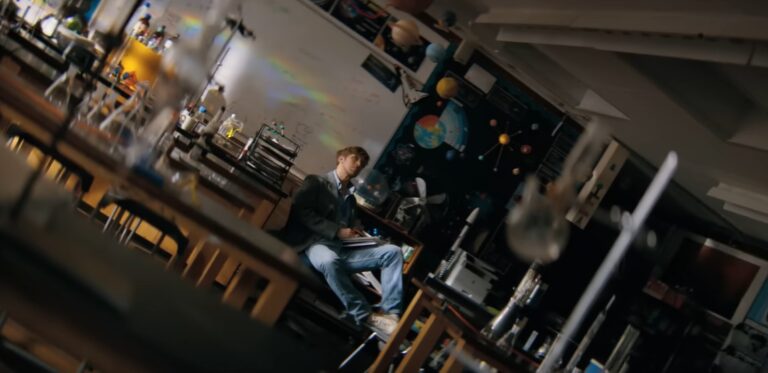
Before Project Hail Mary turned him into an interstellar problem-solver, Grace was a teacher. He wasn’t particularly interested in academic politics or becoming a scientific celebrity. He liked explaining things to kids.
And now he is doing exactly that again—except his students are young Eridians.
The communication problem makes the scene even more fascinating. Grace cannot simply stand in front of an alien classroom and lecture them in English. Their communication system is fundamentally different, and the movie uses musical and sound-based technology to bridge that gap.
It’s clever because the movie doesn’t suddenly pretend humans and Eridians have magically become identical.
They still have to translate, adapt and learn from each other.
That was always the strongest idea in Project Hail Mary, and the ending finally makes it personal.
Grace isn’t just surviving on Erid.
He has found something to do there.
He has become a teacher again.
And, frankly, that lands harder than another giant space battle ever could.
The Earth Epilogue Changes the Emotional Equation
The movie’s biggest departure from the novel comes with its return to Earth.
Instead of leaving humanity’s fate largely in the background, the film gives us a direct look at what happened after Grace and Rocky completed their mission.
Earth survives.
The Astrophage crisis is brought under control, the planet begins recovering, and the information delivered through the automated probes gives humanity the means to understand what Grace and Rocky accomplished.
And then we see Eva Stratt.
This is where the film becomes openly sentimental.
Stratt receives evidence that Grace and Rocky succeeded. The man she was willing to sacrifice for the survival of billions is alive—and not merely alive. He’s apparently happy.
That detail matters.
Because Stratt’s decisions throughout the story are brutal. She treats Grace as a resource in an equation where the numbers are more important than individual lives.
The epilogue doesn’t erase the morality of those choices.
But it gives her something the novel largely refuses to give her: closure.
She gets to see that Grace didn’t die alone.
She gets proof that the mission worked.
And she gets to see that the person she sent away found a life on the other side of the universe.
I won’t pretend this addition is necessary. It isn’t.
But emotionally, I understand exactly why the filmmakers wanted it.
Does Grace Ever Return to Earth?
This is probably the most interesting question the ending leaves unanswered.
The Hail Mary is repaired.
It’s refueled.
It is capable of making the journey back toward Sol.
So Grace technically has a way home.
And yet he doesn’t immediately take it.
That choice is crucial.
Earth is still his birthplace. It’s where his memories began. It’s where his career began. It’s where the crisis started.
But Erid is where Grace has built a new life.
He has Rocky.
He has students.
He has purpose.
He has people who don’t see him as a failed scientist or a reluctant hero. To them, he’s the person who saved their civilization.
The movie refuses to tell us whether Grace will eventually leave.
I think that’s the right decision.
If Grace simply flew back to Earth in the final minutes, the entire emotional transformation would feel strangely incomplete. His sacrifice would become a detour rather than a genuine change in his life.
Leaving the ship waiting above him creates something much more interesting.
Grace can go home whenever he wants. He simply doesn’t know if Earth is home anymore.
What the Ending Really Means
For all its astrophysics, Xenonite, Astrophage and alien engineering, Project Hail Mary ultimately isn’t a story about technology.
It’s about connection.
Grace and Rocky have almost nothing in common. They look different, communicate differently, breathe different atmospheres and come from completely incompatible ecosystems.
Yet they figure it out.
Not through magic.
Not through destiny.
Through patience, experimentation, trust and an absurd amount of scientific problem-solving.
That’s why Rocky works so well as a character. The friendship doesn’t require either of them to become human—or Eridian.
They meet in the middle.
And Grace’s final life on Erid reflects that same philosophy.
He doesn’t need Erid to become Earth.
The Eridians don’t need to become humans.
They simply build enough of a bridge for two completely different worlds to share something.
Project Hail Mary Movie Ending Explained: Does Ryland Grace Ever Return to Earth?
| Element | What It Represents |
|---|---|
| The Biodome | The Eridians’ gratitude and willingness to adapt |
| The Artificial Beach | Grace’s connection to Earth and his new home |
| Rocky’s Suit | The biological divide between their species |
| The Classroom | Grace rediscovering his true purpose |
| The Hail Mary | The possibility of returning to his old life |
| The Earth Epilogue | Humanity surviving without Grace physically present |
My Take on the Ending
I’m torn—and that’s a good thing.
The ending is beautifully optimistic, and I think modern sci-fi could use more of that. I’m tired of stories that assume every sacrifice has to end in misery and every heroic choice needs to be punished.
Grace saves Earth.
He saves Rocky.
Rocky helps save Grace.
And instead of rewarding him with a parade, the universe gives him something much smaller: a classroom, a friend and a place where he belongs.
That’s lovely.
But some of the movie’s final imagery is almost too polished. The artificial beach, the emotional Earth reunion, the classroom and the waiting spaceship all underline the same message from slightly different angles.
The film doesn’t trust the audience quite enough to simply feel it.
Still, I’d rather have that problem than the opposite.
The final image of Grace teaching alien children is what stays with me. Not the spaceship. Not the Astrophage. Not even the survival of Earth.
The teacher survives.
That is the real miracle.
Ryland Grace began the story convinced that he was a coward who had somehow ended up in the biggest scientific crisis in human history. He finishes it as something much more interesting: a man who finally chose what mattered to him without someone else making the decision for him.
Maybe he’ll return to Earth.
Maybe he’ll spend the rest of his life on Erid.
The movie doesn’t need to tell us.
For once, the unanswered question isn’t frustrating.
It’s the point.