There are movies that use a clever title because it sounds memorable. Then there are movies that make you rethink the title after the credits.
Don’t Say Good Luck belongs firmly in the second category.
Released on Netflix on August 14, 2026, Julia Hart’s coming-of-age musical dramedy initially looks like a familiar high-school story: theater auditions, teenage romance, jealous rivals, rehearsals, friendships under pressure, and one ambitious student desperate to prove she belongs onstage. Then the movie quietly pulls the floor out from underneath all of it.
Sophie Birenbaum, played by Sunny Sandler, gets the role she desperately wants in her school’s production of Waitress. It should be the happiest period of her teenage life. Instead, almost immediately, she discovers that her mother’s terminal cancer has returned.
That contrast is what gives Don’t Say Good Luck its bite.
And yes, the title comes from theater superstition. But treating it as nothing more than a joke about actors refusing to hear the words “good luck” misses what the movie is actually doing. The phrase becomes a private language between Sophie and her mother, and eventually something much sadder: a way for both of them to talk around the possibility of losing each other.
Why Is the Movie Called Don’t Say Good Luck?
The answer starts with one of theater’s oldest rules: don’t wish an actor “good luck” before a performance.

The traditional alternative is “break a leg.” The exact origin of the expression is disputed, but the theatrical superstition is well established. Saying the supposedly unlucky thing is believed to protect the performer from the very bad luck you’re trying to avoid.
For Sophie, this isn’t some obscure piece of trivia. She’s a genuine theater kid. The superstition is part of her world, and her mother Elizabeth knows it.
That’s where the film finds its best recurring joke.
Elizabeth will tease Sophie about an upcoming performance or audition, and Sophie immediately knows where the conversation is going. The forbidden phrase hangs over them like a family inside joke. Elizabeth can’t simply say “good luck,” because Sophie won’t allow it.
At first, it’s genuinely funny.
Then it starts hurting.
And that’s exactly why it works.
The Running Bit That Becomes Much More Than a Joke
One of the smartest choices in Don’t Say Good Luck is refusing to abandon the title joke once the story gets serious.
Usually, a running gag like this would exist to establish character and then disappear when the plot turns dramatic. Hart does the opposite. She keeps bringing the idea back until the audience starts hearing something completely different in it.
Sophie and Elizabeth aren’t just talking about theater.
They’re talking about hope.
Elizabeth wants her daughter to succeed. Sophie wants her mother to be there to see it. Both understand that the future isn’t guaranteed, but neither wants to say that out loud.
So they hide behind the rules of theater.
No “good luck.”
Just “break a leg.”
There’s something almost heartbreaking about that distinction. “Good luck” suggests that circumstances can save you. “Break a leg” is absurd, theatrical, and deliberately indirect. It gives Sophie and Elizabeth a way to remain playful when reality has become anything but playful.
The joke becomes their emotional armor.
Sophie Gets Everything She Wants — at the Worst Possible Time
The film’s central irony is brutally simple.
Sophie finally gets her big break.
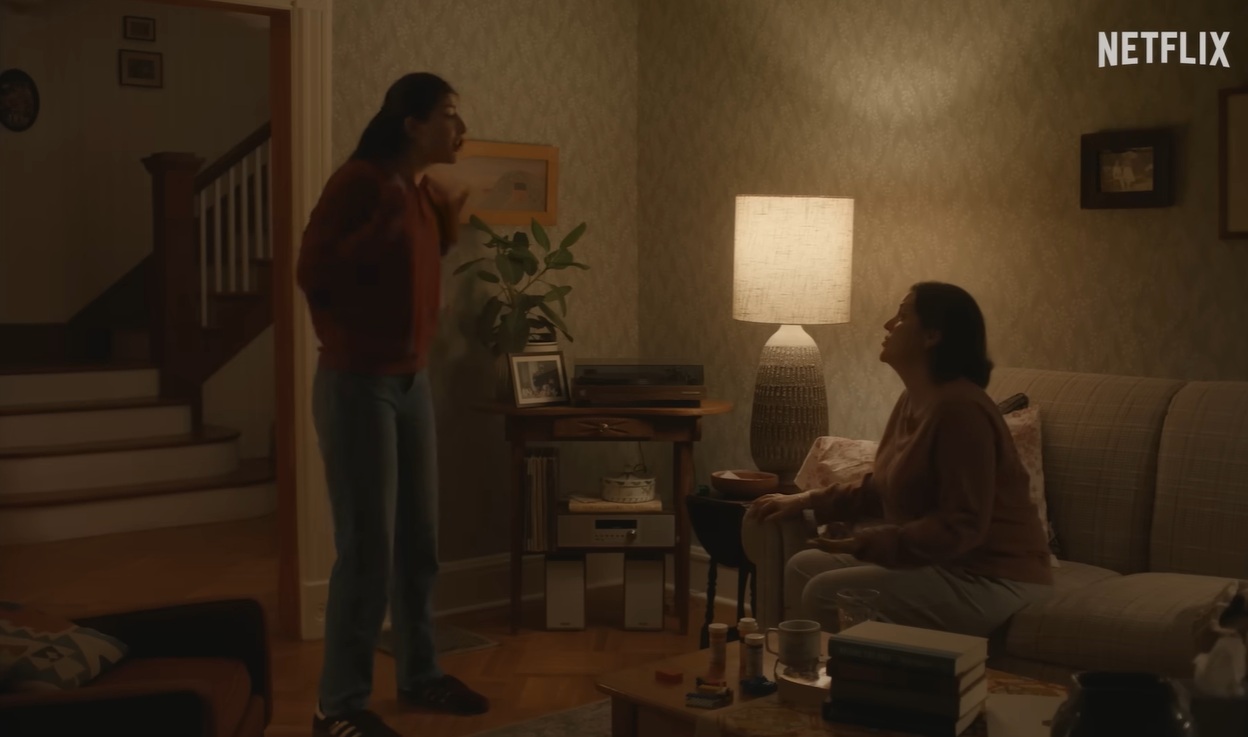
She lands the lead role of Jenna in Waitress, a major opportunity that validates all the time she’s spent singing, rehearsing, auditioning, and dreaming about being taken seriously.
And then she goes home.
Her mother is sick.
Suddenly the two biggest events in Sophie’s life are happening simultaneously: one is the beginning of something, and the other may be the beginning of an ending.
That tension is where Sunny Sandler has the most difficult work to do, and thankfully, she doesn’t play Sophie as permanently miserable. That would have made the character exhausting and the movie far less believable.
Sophie still gets excited.
She still gets embarrassed.
She still falls for Jack.
She still argues with Carolyn.
She still worries about Mallory.
She still wants to perform.
That’s the point. Grief doesn’t cancel adolescence. You can be terrified about your mother and still be thrilled about a musical. You can cry in the bathroom and then obsess over whether your crush likes you.
The movie understands that contradiction unusually well.
The Theater Story Works Because It Isn’t Really About Theater
The production of Waitress gives Sophie somewhere to put all the feelings she can’t process at home.
Her rehearsals become a temporary escape. The stage offers rules, choreography, music, lighting and a script — things that real life doesn’t provide.
That’s especially important because Sophie’s family is dealing with a situation where there are no clean answers.
A musical has an opening, a middle and an ending.
Cancer doesn’t care about narrative structure.
That difference hangs over the entire movie.
Sophie can rehearse a scene until every movement is perfect. She can memorize every lyric. She can control her entrance and her exit.
She can’t control what happens to her mother.
And that is where the title becomes much darker than it first appears.
The Movie’s Most Effective Trick: It Refuses to Turn Everyone Into a Stereotype
I was particularly relieved that Don’t Say Good Luck doesn’t turn into another predictable “popular girl versus awkward theater girl” story.
Mallory, Sophie’s rival, could easily have been written as the standard teenage antagonist — talented, arrogant and cruel for no reason other than to give the protagonist someone to defeat.
Instead, the film gives her enough vulnerability to make the rivalry feel recognizable rather than cartoonish.
The same goes for Carolyn.
Her friendship with Sophie changes as Carolyn develops her own interests and starts exploring a life that doesn’t revolve around Sophie’s problems. The movie could have manufactured a giant confrontation here. Instead, it allows the friendship to become messy in a much more believable way.
That’s one of the reasons the emotional scenes land.
The characters aren’t waiting around for Sophie to have a crisis so they can deliver perfect speeches.
They’re teenagers.
They get things wrong.
They get distracted.
They hurt each other accidentally.
They come back.
That feels far more honest.
What the Film Gets Right About Living With Terminal Illness
The domestic storyline is where Don’t Say Good Luck becomes considerably more ambitious than its premise suggests.
Elizabeth’s illness isn’t used as a convenient plot device to make Sophie sad. The film is much more interested in the strange normality of living with impending loss.
There are still meals.
There are still rehearsals.
There are still jokes.
There are still arguments over ordinary things.
And that’s what makes the situation painful.
Sophie doesn’t spend every second thinking about death. She tries not to think about it at all.
The film captures that through quieter moments, including sequences where Sophie puts on her headphones and retreats into music. For a few minutes, the outside world disappears.
But it always comes back.
That’s the cruelty of the story: the ordinary world continues even when your personal world is falling apart.
The Ending Is Where the Title Finally Clicks
The final act is easily the part most likely to divide viewers.
By opening night, Elizabeth’s condition has deteriorated to the point that she can’t attend Sophie’s performance. For Sophie, that is devastating. Her mother has been part of the private language surrounding her theater dreams from the beginning.
Now the person she most wants in the audience can’t be there.
The film’s solution is not a miracle.
Thank God.
Instead, Sophie and the cast bring the performance to Elizabeth.
They recreate elements of the family’s beloved “Crane House” environment and transform the home into a makeshift stage. It isn’t glamorous. It isn’t perfect. It isn’t the triumphant Hollywood finale where illness suddenly disappears.
It’s better than that.
It’s intimate.
Sophie eventually sings directly to her mother while wearing Elizabeth’s old maternity dress. The image is loaded without feeling excessively explained: Sophie is performing for the woman who gave her a life, while wearing something associated with the beginning of her own.
That scene doesn’t pretend theater can save Elizabeth.
It can’t.
But theater can give Sophie a way to say things she doesn’t know how to say normally.
And suddenly the title makes perfect sense.
Don’t Say Good Luck Is Really About the Illusion of Control
| Film Element | Surface Meaning | Deeper Meaning |
|---|---|---|
| “Don’t say good luck” | Theater superstition | Fear of tempting fate |
| “Break a leg” | Traditional theater phrase | A private language between mother and daughter |
| Sophie’s lead role | Teenage achievement | A dream arriving at the worst possible moment |
| The stage | Escape from reality | A place where Sophie can express grief |
| Elizabeth missing opening night | Family tragedy | The limits of control |
| Bringing the show home | A theatrical gesture | Love replacing the impossible miracle |
The movie’s title isn’t saying that luck doesn’t exist.
It’s saying luck was never going to be enough.
Sophie can’t bargain with fate. Elizabeth can’t protect her daughter from pain. A successful audition can’t compensate for an illness, and a standing ovation can’t make someone immortal.
But love can still do something.
It can show up.
It can carry the stage into someone’s living room.
It can turn a joke you’ve repeated a hundred times into something you’ll remember for the rest of your life.
The Real-Life Story Behind the Movie Makes It Hit Harder
The emotional authenticity also has a specific source.
The screenplay draws from novelist Laura Hankin’s own experiences as a teenager. Like Sophie, Hankin was deeply involved in high-school theater and experienced the strange collision of teenage ambition with a parent’s serious illness.
That background helps explain why the film’s theater scenes feel more specific than generic “teen musical movie” material.
The details feel lived-in.
The excitement feels genuine.
So does the dread.
And that combination is precisely what Don’t Say Good Luck needs. Without it, the movie could easily have collapsed into sentimental melodrama.
It doesn’t.
At least, not often.
My Take: The Movie Is Better When It Stops Trying to Be Inspirational
I’ll admit I went into this expecting a fairly straightforward Netflix coming-of-age film with a sad family subplot.
That’s not what I got.
The movie occasionally pushes hard on its emotional buttons, and there are moments when the sentimentality comes dangerously close to overwhelming the quieter storytelling. A few of the supporting-character arcs also feel like they belong to a slightly different movie.
But when Hart trusts the characters instead of the message, Don’t Say Good Luck is genuinely moving.
The best scenes aren’t the ones screaming, “This is heartbreaking.”
They’re the tiny ones.
A joke about saying “good luck.”
A mother watching her daughter rehearse.
A teenager pretending everything is fine.
A friendship changing without either person quite knowing how to stop it.
Those details are where the movie earns its tears.
And Sunny Sandler deserves credit for not turning Sophie into a perpetual tragedy machine. Her performance works because Sophie remains a teenager first. She is selfish sometimes. She’s funny sometimes. She’s excited about boys and theater and her friends while something enormous is happening at home.
That’s uncomfortable.
It’s also real.
Is Don’t Say Good Luck Available in 4K HDR on Netflix? Full 2026 Streaming Guide
Final Verdict
Don’t Say Good Luck uses a deceptively silly theater superstition as the emotional key to a story about love, fear, ambition and the impossibility of controlling what happens next.
The title begins as a joke.
Then it becomes a family ritual.
Then it becomes a coping mechanism.
By the end, it feels almost like a prayer — except Sophie and Elizabeth know better than to pretend that saying the right words can change the outcome.
That’s why the title sticks with you.
You can say “good luck.”
You can say “break a leg.”
You can rehearse until every note is perfect.
You can build a stage inside your own home.
Sometimes none of it changes what is coming.
But that doesn’t make the performance meaningless.
It makes showing up for it even more important.