There are some movies that make you cry because the script clearly knows exactly which emotional buttons to push. Then there are movies like Don’t Say Good Luck, where the tears come from something much less polished: the uncomfortable feeling that what you are watching could have happened to someone you know.
Netflix’s new coming-of-age drama, released on August 14, 2026, has clearly hit that nerve. Led by Sunny Sandler, Melanie Lynskey, and Max Greenfield, the film follows Sophie Birenbaum, a high school sophomore who gets the role she has been dreaming about in her school’s production of Waitress. It should be one of the happiest moments of her teenage life.
Instead, Sophie’s family is hit with devastating news. Her mother, Elizabeth, has terminal cancer, and the illness has returned aggressively.
From there, Don’t Say Good Luck becomes much more than a movie about a school musical. It is about what happens when something exciting and life-changing occurs at exactly the wrong moment. Sophie is supposed to be celebrating, rehearsing, making memories and worrying about teenage problems. At home, however, her family is preparing for the possibility of losing her mother.
And that emotional contradiction is exactly what makes the film feel so personal.
But after watching it, plenty of viewers have been asking the same question: Is Don’t Say Good Luck based on a true story, or is it adapted from a book?
The short answer is: neither, at least not literally.
The film is an original fictional story, but its emotional foundation comes from something very real that happened to screenwriter Laura Hankin.
So, Is Don’t Say Good Luck Based on a True Story?
Not in the traditional sense.
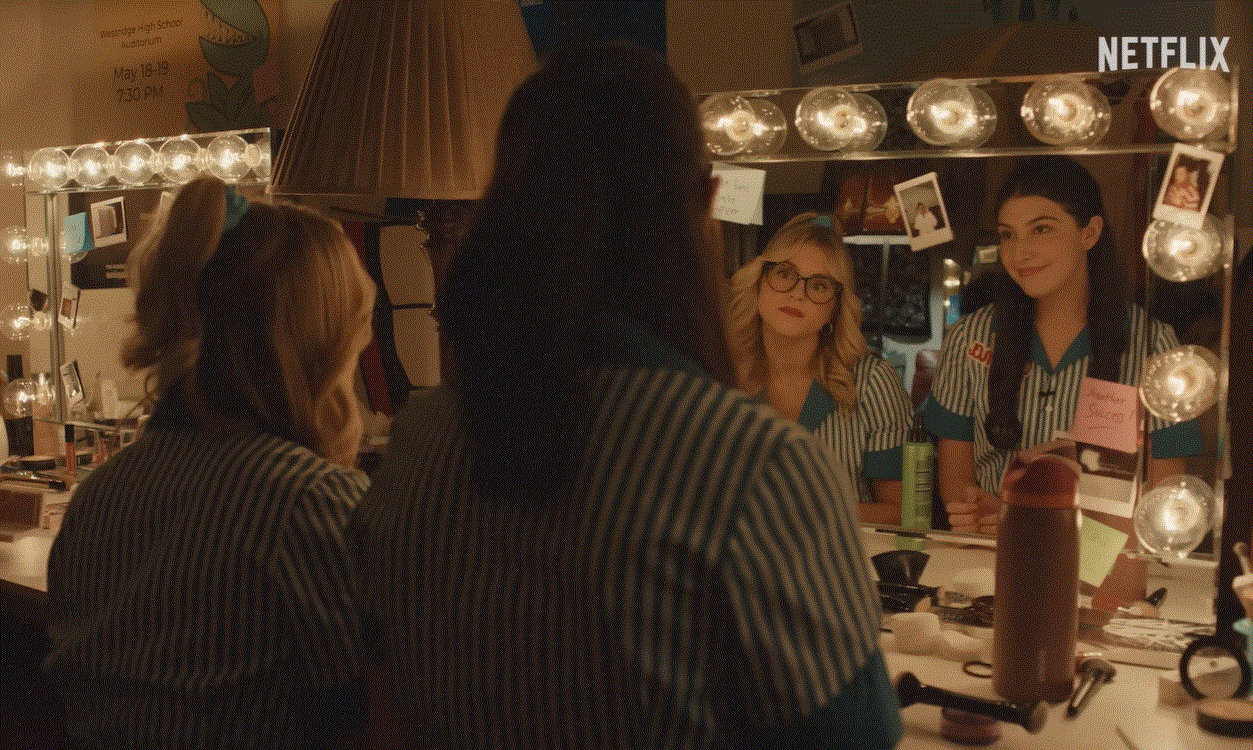
There isn’t a novel called Don’t Say Good Luck that the movie was adapted from, and Sophie Birenbaum isn’t a real person whose entire life story was transferred to the screen.
What makes the situation more interesting is that writer Laura Hankin drew heavily from her own teenage experience.
Like Sophie, Hankin was involved in high school theater. During her teenage years, she landed a major role in a school musical. At almost exactly the same period when she should have been enjoying that experience, her mother was dealing with terminal cancer.
That parallel is the emotional DNA of the movie.
The filmmakers changed the names, characters, circumstances and timeline to build a fictional story that works as a feature film. But the central contradiction — being a teenager experiencing an exciting moment while simultaneously watching a parent become seriously ill — came from Hankin’s own life.
And honestly, knowing that makes several scenes hit differently.
Sophie isn’t written like a teenager who suddenly becomes a perfect little adult because tragedy enters her life. She is still a teenager. She can be selfish, excited, confused, embarrassed, angry and happy, sometimes within the same afternoon.
That messiness is one of the strongest things about the movie.
Laura Hankin Turned a Painful Memory Into Fiction
Hankin’s personal connection to the story explains why the movie doesn’t feel like a conventional “teen girl learns an important life lesson” drama.
There is no neat emotional progression where Sophie simply accepts what is happening and becomes wiser overnight.
Instead, the film spends time with the strange guilt that can come with happiness during a family crisis.
Sophie gets the part she wants. She should be thrilled. But can she really celebrate when her mother is getting worse?
That question hangs over almost everything she does.
And it is a surprisingly complicated feeling. When someone close to you is seriously ill, life doesn’t stop behaving normally. Your friends still send jokes. School still happens. People still have birthdays. You can still laugh at something stupid.
You might even have the best day you’ve had in months.
Then you remember what is happening at home.
Don’t Say Good Luck understands that grief isn’t always dramatic. Sometimes it is sitting backstage before a performance and wondering whether your mother will be there. Sometimes it is feeling guilty because you had fun. Sometimes it is desperately wanting one ordinary teenage experience while knowing that your family’s reality is anything but ordinary.
That is where Hankin’s real-life experience gives the screenplay its strongest emotional weight.
Why Do People Think the Movie Is Based on a Book?
The confusion is actually pretty understandable.
Laura Hankin is already known as a novelist, so viewers who recognize her name may naturally assume that Don’t Say Good Luck is another adaptation of one of her books.
There is also the Sunny Sandler connection.
Sunny Sandler became especially recognizable to Netflix audiences after appearing in You Are So Not Invited to My Bat Mitzvah, a coming-of-age movie based on Fiona Rosenbloom’s YA novel. Put another Netflix teen movie, a young female protagonist and a familiar Sandler family connection together, and it isn’t surprising that some viewers assumed Don’t Say Good Luck must have started as a YA book too.
It didn’t.
There is no published novel serving as the source material for the movie.
| Question | Answer |
|---|---|
| Is the movie based on a book? | No |
| Is Sophie Birenbaum a real person? | No, she is fictional |
| Is the story inspired by real events? | Yes, particularly Laura Hankin’s teenage experience |
| Is the family based directly on Hankin’s family? | Not literally; the film fictionalizes the characters and circumstances |
| When was the movie released? | August 14, 2026, on Netflix |
The Waitress Connection Is More Important Than It Looks
One of my favorite details in Don’t Say Good Luck is the decision to make Waitress the musical Sophie performs.
At first, it could seem like a simple way to give the characters something to rehearse. But the choice is much more deliberate.
The Broadway musical Waitress, with music and lyrics by Sara Bareilles, follows Jenna, a woman trapped in an unhappy and abusive situation who finds an outlet through her creativity and baking.
That makes the musical a surprisingly good mirror for Sophie’s story.
Sophie is also dealing with a reality she cannot simply escape. Her mother is sick, her family is changing and she has very little control over what happens next. Yet when she steps onto the stage, she gets to inhabit another person’s story.
For a few hours, she can be someone else.
That’s one of the things theater can do particularly well. It doesn’t necessarily make the real problem disappear. Sometimes it simply gives you somewhere to put the feelings you don’t know how to handle.
The filmmakers reportedly recognized that connection when developing the project and incorporated Waitress into the story as a thematic counterpoint to Sophie’s own situation.
It works because the musical isn’t just decoration. It becomes part of how Sophie processes what is happening to her family.
The Cast Makes the Story Feel Even More Personal
Sunny Sandler has the difficult job of carrying a character who is constantly caught between two emotional worlds, and the performance works because Sophie doesn’t feel artificially mature.
Melanie Lynskey brings a completely different energy to Elizabeth. Her performance avoids turning the mother into a symbolic “terminally ill parent.” She remains a person with her own personality, relationships and emotional reactions.
That matters.
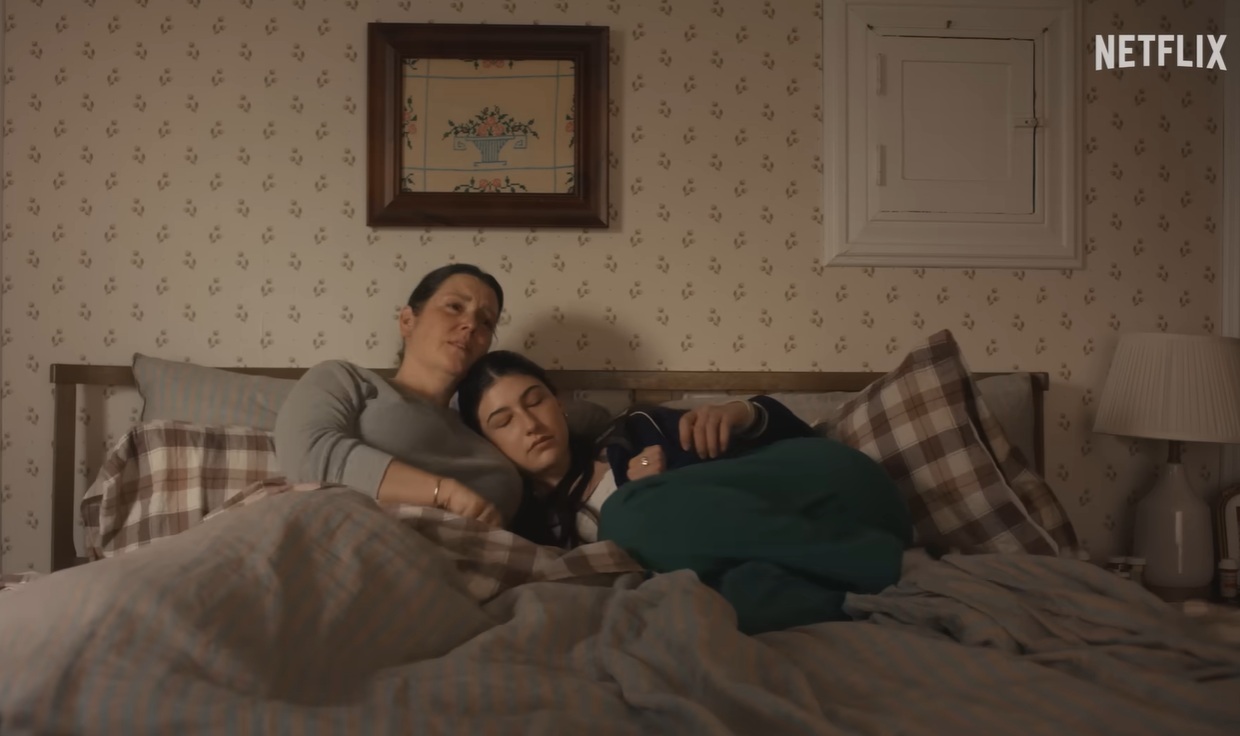
The movie isn’t simply asking us to feel sorry for Sophie because her mother is dying. It is showing what illness does to an entire family.
Max Greenfield’s Ted, Sophie’s father, represents another version of that emotional struggle. He has to function as a parent while dealing with his own fear and grief. Steve Buscemi’s Dale and Bebe Neuwirth’s Linda add yet more perspectives, showing how differently family members can react when everyone knows something terrible may be coming.
That ensemble approach gives the movie more texture than a standard tearjerker.
Don’t Say Good Luck Title Meaning & Running Bit Explained: Netflix’s 2026 Movie Deconstructed
The Teen Storyline Isn’t Just Filler
Another thing I appreciated is that Sophie doesn’t suddenly stop being a teenager because her mother is sick.
Her friendship with Carolyn, played by Scarlett Estevez, continues to matter. Carolyn has her own personal struggles and questions about identity, and the film allows those issues to exist alongside Sophie’s family crisis.
That’s actually how adolescence works.
Your world can be falling apart while your best friend is worrying about a completely different problem. Neither thing becomes less important simply because the other is more serious.
The film gets a lot of mileage out of that idea.
Instead of making every supporting character exist solely to help Sophie process grief, Don’t Say Good Luck gives them lives of their own. That makes the family and school environment feel much more believable.
A Fictional Movie With a Very Real Emotional Core
So, no — Don’t Say Good Luck isn’t a true story in the conventional Hollywood sense.
It isn’t a biography, it isn’t based on a novel, and Sophie Birenbaum isn’t a real teenage girl whose story was documented and adapted for Netflix.
But saying that the film is “completely fictional” would also miss the most interesting part.
The emotional experience at the center of the movie is rooted in Laura Hankin’s real adolescence.
She knew what it was like to be a teenager chasing a theater dream while dealing with her mother’s terminal illness. Years later, that painful period became the starting point for a fictional screenplay about Sophie.
And I think that explains why the movie feels different from a lot of polished coming-of-age dramas.
The details may belong to Sophie. The family may be fictional. The musical performances are part of the movie’s constructed world.
But the strange combination of excitement, guilt, fear, love and denial feels lived-in.
That’s ultimately what stayed with me after watching Don’t Say Good Luck. It isn’t really asking whether Sophie can “overcome” grief. Life doesn’t work that way.
Sometimes you simply keep going.
You rehearse the scene.
You argue with your parents.
You laugh with your friends.
You get onstage.
You go home.
And somehow, even while something heartbreaking is happening, there are still moments of genuine happiness.
For me, that’s the reason the film works. Its story is fictional, but the emotions underneath it aren’t.
And if the movie leaves you wondering whether the tears were supposed to hurt this much, knowing where Laura Hankin found the story makes the answer pretty obvious.