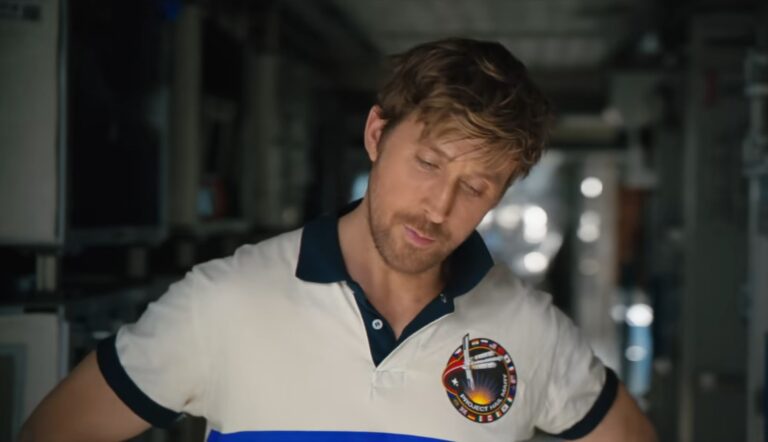
There is something genuinely fascinating about the way Project Hail Mary reached streaming. Not because Amazon MGM Studios invented an entirely new distribution model, but because the studio suddenly remembered something Hollywood has been steadily forgetting: a big science-fiction movie can actually benefit from being treated like a big movie.
Andy Weir’s novel always had the ingredients for a spectacular adaptation. A lonely astronaut, a desperate scientific mystery, impossible odds, and one of the most charming alien characters imaginable. But none of that guaranteed a theatrical hit. With a reported production budget of around $248 million, Project Hail Mary needed far more than a respectable opening weekend. It needed audiences to show up, talk about it, and keep coming back.
Thankfully for Amazon MGM Studios, that is exactly what happened.
Directed by Phil Lord and Christopher Miller and led by Ryan Gosling as Ryland Grace, with Sandra Hüller also playing a major role, the movie arrived in theaters on March 20, 2026. What followed was a surprisingly old-fashioned success story: strong reviews, enthusiastic audience reactions, premium-format demand, and a box office run that simply refused to collapse.
And that success completely changed the conversation about when Project Hail Mary would be available on streaming.
Project Hail Mary Was Never Treated Like a Disposable Streaming Movie
The theatrical release began with its world premiere in London on March 9, 2026, before the film expanded into a major international theatrical rollout. In the United States, Amazon MGM Studios pushed the movie heavily into IMAX and other premium large-format screens.
That decision turned out to be extremely important.

Project Hail Mary opened to approximately $80.5 million domestically, an impressive result for an original science-fiction property that was carrying a massive production price tag. More importantly, the movie did not behave like the kind of expensive blockbuster that explodes during its opening weekend and then disappears.
Audiences kept recommending it.
The film passed roughly $655 million worldwide by the middle of April and eventually reached approximately $684.3 million globally. For Amazon MGM Studios, that was more than just a nice number on a financial report. It demonstrated that the company had a theatrical property capable of competing on the same playing field as traditional Hollywood blockbusters.
And frankly, this is where Amazon’s strategy became much more interesting.
A weaker theatrical performance would have made an early streaming release almost inevitable. Instead, the box office success gave Amazon a reason to wait.
Amazon MGM Studios Extended the Theatrical Window
This is the part that deserves more attention than it usually gets.
The modern streaming era has trained audiences to expect movies to appear at home remarkably quickly. A 45-day theatrical window has become a familiar benchmark, and viewers have become increasingly comfortable simply waiting.
Project Hail Mary did not follow that script.
As ticket sales remained strong, Amazon MGM Studios extended the movie’s theatrical exclusivity rather than rushing it toward digital platforms. Christopher Miller publicly acknowledged the decision in April, signaling that the studio was willing to let the film continue earning money in theaters.
That might sound obvious, but it actually represents a meaningful change in thinking.
Why pull a movie from theaters while people are still buying tickets?
Amazon also arranged an additional one-week return to IMAX 70mm and premium large-format screens. That was an aggressive move, but it made sense. If audiences were still willing to pay for the theatrical experience, the studio had little reason to shut the door early.
The result was a theatrical window lasting more than 50 days before the movie entered commercial digital distribution.
For a modern Amazon MGM release, that felt unusually confident.
And I liked it.
Too many studios seem terrified that audiences will stop caring if a movie isn’t available at home immediately. Project Hail Mary proved the opposite can happen when the film itself gives people a reason to leave the house.
When Did Project Hail Mary Release Digitally?
After its extended theatrical run, Project Hail Mary arrived on PVOD and premium digital storefronts on May 12, 2026.
That was approximately 53 days after the March 20 theatrical premiere.
The movie became available through several major digital platforms, including Prime Video, Apple TV Store, Fandango at Home, Google Play, and YouTube.
The reported pricing was:
| Digital Option | Price |
|---|---|
| Digital Purchase | $12.99 |
| 48-Hour Rental | $5.99 |
This was the point where the film became accessible to people who either missed it in theaters or simply preferred watching from home.
Yet even here, Project Hail Mary refused to behave like a movie that had finished its commercial life.
It reportedly remained highly competitive on digital transaction charts for weeks, while the theatrical release was still active in hundreds of locations. That overlap is particularly interesting because it shows how different distribution windows can now coexist rather than simply replacing one another overnight.
Theaters were still selling tickets.
Digital retailers were still selling rentals and purchases.
Amazon had effectively created several revenue streams around the same movie without immediately cannibalizing the entire theatrical audience.
The MGM+ Streaming Release Was the Strange Part
Then came the move that generated the most curiosity.
Instead of taking Project Hail Mary directly from PVOD to Prime Video, Amazon MGM Studios placed the movie on MGM+ first.
The MGM+ streaming release date was June 18, 2026, exactly 90 days after the theatrical debut.

For subscribers, this represented the first major subscription-streaming opportunity to watch the movie without paying an additional rental or purchase fee.
The strategy is easy to understand from Amazon’s perspective. MGM+ is a smaller service compared with Prime Video, so a major science-fiction blockbuster gives Amazon something extremely valuable: a reason for people to subscribe.
And this is where I have mixed feelings.
From a business standpoint, it is clever.
From a viewer’s standpoint, it is slightly irritating.
If you’ve already paid for Prime and you’re waiting for Amazon’s biggest sci-fi movie of the year, being told that you need another subscription first isn’t exactly thrilling. It creates an unnecessary layer between the audience and the movie.
Still, Amazon wasn’t finished.
Project Hail Mary Finally Arrived on Prime Video
The big streaming date was July 3, 2026.
That was when Project Hail Mary officially became available on Amazon Prime Video, roughly 105 days after its original theatrical release.
The timing was particularly smart. Launching the film over the Fourth of July weekend gave Amazon an enormous potential audience at exactly the moment when people were looking for something substantial to watch at home.
The full release progression looked like this:
- March 20, 2026 — Theatrical release
- May 12, 2026 — PVOD and digital purchase/rental
- June 18, 2026 — MGM+ streaming debut
- July 3, 2026 — Prime Video release
- August 11, 2026 — Physical media release
- October 13, 2026 — Premium SteelBook collector edition
That is a remarkably long commercial journey for a modern movie.
And honestly, I think Amazon got the most important part right: it allowed every window to have its own purpose.
Physical Media Isn’t Being Forgotten Either
For collectors, Amazon MGM Studios is keeping the movie alive beyond streaming.
DVD, Blu-ray, and 4K Ultra HD editions are scheduled for August 11, 2026. The physical release is expected to include behind-the-scenes material, deleted scenes, commentary from Phil Lord and Christopher Miller, and featurettes examining the production and the technical work behind Rocky.
That last part matters.
Rocky isn’t simply another digital character dropped into a science-fiction movie. The alien’s personality and vocal performance are central to the emotional identity of Project Hail Mary. Giving the character’s creation additional attention in the home-media extras is exactly the sort of thing collectors actually want.
Then comes the more expensive option.
A three-disc SteelBook collector edition is scheduled for October 13, 2026, giving physical-media enthusiasts another reason not to rely entirely on streaming.
And after years of studios treating physical media like an afterthought, I’m genuinely glad to see a blockbuster receive this kind of treatment.
Where to Watch Project Hail Mary (2026 Movie): Full Streaming Guide, Release Dates, and Free Options
How Project Hail Mary Compares With Amazon’s Other Movies
The distribution strategy becomes even more revealing when compared with Amazon’s streaming-focused productions.
Movies such as Red One and the Road House remake were positioned much closer to the streaming-first model. Their theatrical presence was not built around the same long-term blockbuster strategy.
Project Hail Mary was different from day one.
Amazon MGM Studios treated it as a premium theatrical event. The film moved through a deliberate chain of windows:
Theatrical → Premium Formats → PVOD → MGM+ → Prime Video → Physical Media
That sequence is almost refreshing.
Instead of treating theatrical release as a brief marketing exercise before dumping the movie onto a streaming service, Amazon allowed the film to generate value at each stage.
The reported $684.3 million worldwide box office makes the strategy difficult to argue against.
The Project Hail Mary Streaming Strategy Actually Makes Sense
I’m still not convinced every part of Amazon’s rollout was perfect. The MGM+ detour is likely to frustrate Prime subscribers, and the sheer number of release windows can make the process feel unnecessarily complicated.
But the larger experiment worked.
Project Hail Mary demonstrated that audiences are still willing to pay for a theatrical experience when a movie feels worth seeing on a huge screen. It also showed that a successful theatrical run doesn’t have to kill streaming demand. The film managed to move from theaters to digital purchases, then to MGM+, and finally to Prime Video without abandoning the audience that discovered it along the way.
That is the part Amazon should pay attention to.
The real lesson isn’t that every blockbuster should receive a 105-day streaming window. It is that release timing should respond to audience demand rather than follow an inflexible corporate calendar.
When people are still buying tickets, keep selling tickets.
When digital viewers are ready, sell digital copies.
When subscription streaming needs a major attraction, use the movie there.
And when collectors want a physical edition, give them one worth owning.
For Project Hail Mary, that approach turned what could have been another expensive sci-fi experiment into one of Amazon MGM Studios’ biggest theatrical victories.
Whether Amazon repeats the formula remains to be seen. But after watching this particular movie travel such a long road from IMAX screens to Prime Video, I have to admit something: the old theatrical-first model looked pretty good this time.