
Elize: Shadows of a Woman is the kind of movie that refuses to let you sit comfortably with what you are watching. You may start it expecting a polished true-crime drama about the infamous Marcos Matsunaga murder case. By the time the credits roll, you are left with something much more unsettling: a film about identity, ownership, class, marriage, humiliation, and the terrifying moment when a person who has spent years being controlled finally decides to take control back.
That is what makes the 2026 Netflix psychological thriller so fascinating to me. It is not necessarily interested in making Elize Matsunaga a hero. Nor does it turn Marcos into a simple cartoon villain. Instead, Elize: Shadows of a Woman builds an oppressive psychological environment where almost every relationship feels transactional, every room seems to have invisible walls, and the central question becomes increasingly difficult to escape: what happens to a person after years of being treated as an object?
Directed by Felipe Vellas and written by Raphael Montes and Mariana Torres, the 93-minute Brazilian drama approaches the real-life tragedy less like a traditional crime retelling and more like a fractured psychological portrait. The film is full of images that seem simple at first but become much darker once you start connecting them. The title, the hunting imagery, the luxurious apartment, the cold color palette, and even the dismemberment itself all become pieces of the same disturbing metaphor.
And personally, I think the film works best when it stops trying to explain Elize and simply makes us feel how completely her world has collapsed.
What Does “Shadows of a Woman” Actually Mean?
The title is not subtle, but it is far more layered than it initially appears. The “shadow” in Elize: Shadows of a Woman represents the parts of Elize that she is forced to hide in order to survive inside the life she has entered.

Before becoming the wealthy wife of Marcos Matsunaga, Elize has a past that the world around her constantly reminds her to be ashamed of. She is expected to erase the escort, the poor girl, the outsider, and the woman with her own history. In their place, she is supposed to become something more acceptable: a beautiful, obedient, wealthy man’s wife.
That transformation is one of the film’s most disturbing ideas. Elize does not simply move from one life into another. She is expected to delete the first version of herself.
And the more she tries to perform the role of the perfect wife, the more obvious it becomes that her former identity has not disappeared. It has merely been pushed into the darkness.
That is where the movie’s shadow metaphor becomes genuinely interesting. The rage, fear, jealousy, humiliation, survival instincts, and resentment that Elize cannot openly express continue growing beneath the surface. The woman everyone sees is increasingly different from the person trapped inside her.
By the time the film reaches its central act of violence, the question is no longer whether Elize has a hidden side. The question is whether that hidden side has become the only part of her that is still capable of acting.
The Film’s Real Horror Is the Loss of Identity
One of the strongest elements of Lorena Comparato’s performance is the way she presents Elize as three different people at once.
- The woman from a poor background who knows how to survive.
- The escort whose body has been turned into a commodity.
- The wealthy wife who is expected to behave as though her past never existed.
These versions of Elize constantly collide with one another. The movie does not present her transformation into a wife as a happy escape from poverty. Instead, it asks whether she has simply traded one form of ownership for another.
That is where Marcos becomes such a powerful presence in the story. His wealth gives him the ability to frame the relationship as generosity. He can claim that he rescued Elize from her former life. But the film keeps quietly questioning what “rescue” actually means when the person who saves you also expects complete control over your future.
Marcos does not merely want a wife. He wants a version of Elize that belongs exclusively to him.
That distinction is crucial.
The film repeatedly suggests that Elize is not allowed to simply exist as herself. She must be attractive, loyal, grateful, available, discreet, and completely disconnected from the identity she had before Marcos. Her entire life becomes a performance designed to reassure a powerful man that he owns the world around him.
And the more convincing that performance becomes, the more psychologically destructive it is.
The Hunting Scene Explains the Entire Movie
The hunting sequence is one of those moments that may seem strangely disconnected from the main story if you are watching casually. For me, it is one of the clearest metaphors in the entire film.
Elize spends much of the story as prey.
She is watched. She is monitored. She is questioned. She is psychologically cornered. Her past is used against her, her movements are scrutinized, and her relationship becomes increasingly defined by suspicion and control.
But the hunting imagery introduces another possibility. A person who has spent enough time being hunted may eventually learn how the hunter thinks.
That does not make the transformation noble. It makes it frightening.
The movie slowly reverses the relationship between victim and predator. The woman who has spent years being treated like something that can be captured, purchased, protected, and controlled begins to understand the mechanics of control herself.
When the weapon is finally turned against Marcos, the hunting metaphor reaches its ugliest conclusion. The prey has learned the language of the predator.
And I think that is much more disturbing than a simple “revenge” interpretation. Elize: Shadows of a Woman is not suggesting that violence magically liberates her. It shows something much darker: the environment that destroys a person can also teach them how to destroy.
The Apartment Is a Luxury Prison
The couple’s luxurious home is one of the movie’s most important locations. On the surface, it represents everything Elize was supposedly searching for: money, comfort, security, status, and protection from the poverty of her past.
But the apartment gradually stops feeling like a home.
It becomes a prison with expensive furniture.
The clean walls, controlled lighting, empty spaces, and carefully designed interiors create an almost clinical atmosphere. There is very little warmth in the environment. The more beautiful the apartment looks, the more trapped Elize appears to be inside it.
This is where the film’s class commentary becomes particularly sharp. Marcos has money, connections, social status, and the confidence of someone who has never had to question whether the system will protect him. Elize enters that world from the outside, and the film makes it clear that she is never completely allowed to forget where she came from.
She can wear the clothes. She can live in the apartment. She can become the wife.
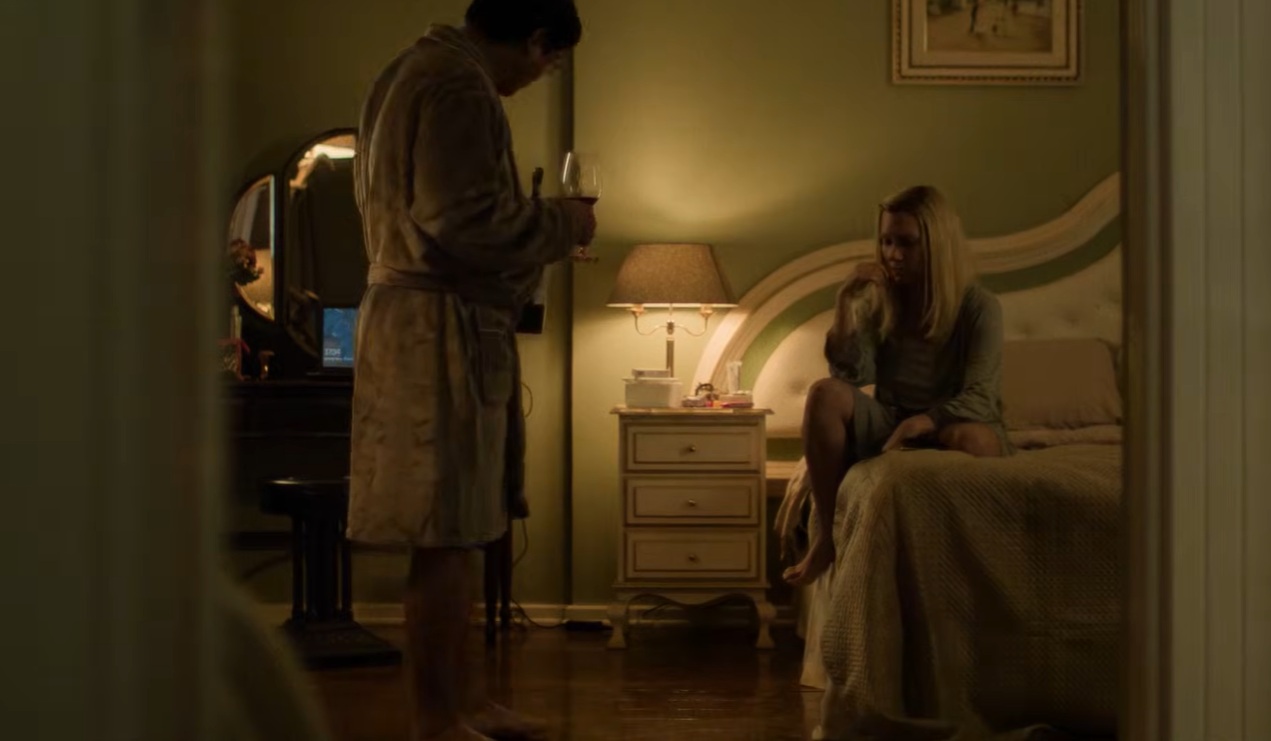
But she cannot completely escape the label attached to her.
That creates one of the movie’s most painful contradictions. The life that is supposed to save Elize from being treated as a commodity continues to define her value through possession. She is no longer being paid directly for her body, but the logic of ownership has not entirely disappeared.
She has simply been moved into a more luxurious version of the same system.
Why the Dismemberment Has Such Heavy Symbolic Weight
The film’s treatment of the murder and the dismemberment is obviously horrifying. There is no way around that. But the movie also gives the act a symbolic dimension that goes beyond the crime itself.
Marcos represents an enormous concentration of power in Elize’s life. He is wealthy, socially established, and accustomed to controlling the circumstances around him. He represents the world that has always seemed too large and too powerful for her to challenge.
Then the film presents the body as something that can be physically broken apart.
That image becomes a brutal inversion of the power structure that existed throughout the relationship. The man who seemed untouchable is no longer a complete, imposing figure. The power has been fragmented.
It is not a triumphant image. It is grotesque. And that is precisely why it works.
The movie is not suggesting that Elize has achieved some clean victory over the upper class. There is no satisfying revolution here. Instead, the metaphor feels more like the desperate destruction of a system that has become psychologically unbearable.
The wealthy, powerful, seemingly invincible figure is reduced to fragments.
That is not justice. It is the horrifying collapse of a relationship in which both people have become trapped in a system of possession, betrayal, and fear.
Infidelity Is the Moment the Fantasy Finally Dies
For me, the emotional center of Elize: Shadows of a Woman is not the murder itself. It is the destruction of the fantasy that Elize has finally found safety.
She has already made enormous sacrifices to enter Marcos’s world. She has changed her life, her identity, and her relationship with her own past. The marriage is supposed to be proof that all of that suffering was worth it.
Then she discovers that Marcos is still unfaithful.
That betrayal carries a much deeper meaning than simple jealousy. It destroys the story she has been telling herself about the marriage.
If Marcos can replace her so easily, then what was the point of everything she gave up?
The film understands that this is why the betrayal feels existential rather than merely romantic. Elize has been told, directly or indirectly, that her security depends on being chosen by a powerful man. Once she realizes that she can be replaced, the entire structure of her life begins to collapse.
The house no longer feels safe. The marriage no longer feels permanent. Her social position no longer feels secure.
Everything becomes temporary.
And the movie’s muted colors and increasingly claustrophobic framing make that emotional collapse almost physical. The domestic space becomes a horror setting because the supposed sanctuary is where the danger lives.
Elize Is Not a Hero — and That Is the Point
One of the reasons I found the film more interesting than a conventional true-crime adaptation is that it refuses to make the audience comfortable with a simple moral answer.
It is possible to understand the psychological environment that shaped a crime without approving of the crime itself.
Those two ideas can exist at the same time.
The movie spends a great deal of time showing how control, humiliation, class inequality, emotional manipulation, and betrayal can gradually destroy a person’s sense of reality. But it never turns that psychological destruction into a clean excuse.
That moral tension is where the film becomes much stronger than a standard “monster origin story.” Elize is neither presented as a flawless victim nor reduced to a one-dimensional killer. She is a deeply damaged person who commits an unforgivable act, and the movie is interested in the uncomfortable space between those two truths.
That space is where the audience is forced to sit.
And honestly, I think some viewers will hate the film for refusing to provide a comfortable answer. They will want to know whether Elize was a victim or a villain. The movie keeps saying: both labels are too simple.
Elize Shadows of a Woman Ending Scene & Timeline Breakdown Explained
How the 2026 Movie Differs from the Netflix Documentary
| Elize: Shadows of a Woman | Elize Matsunaga: Once Upon a Crime |
|---|---|
| Psychological and metaphorical | Focused on real-world facts and legal history |
| Uses symbolism and fragmented storytelling | Uses documentary interviews and testimony |
| Explores emotional perspective | Examines the crime and its consequences |
| Creates moral ambiguity | Provides a more factual true-crime framework |
The difference between the two productions is significant. The documentary is interested in the case as a real event. The 2026 feature film is interested in what the case can represent.
Felipe Vellas uses silence, glances, fragmented memories, darkness, and physical space to put the audience inside an increasingly unstable psychological world. The non-linear structure is particularly effective because Elize’s memory does not feel like a reliable timeline. It feels like a collection of broken images that she cannot escape.
That structure also makes the audience participate in the confusion. We are not simply watching events happen in chronological order. We are constantly trying to understand which version of Elize we are seeing and how much of her original identity is still present.
The Most Disturbing Idea in Elize: Shadows of a Woman
The movie’s most haunting idea is not that a “good person” can suddenly become violent.
It is that a person can spend so long adapting to an oppressive environment that they eventually become almost unrecognizable to themselves.
Elize spends years changing herself to survive. She hides her past. She adapts to Marcos’s world. She tries to become the person he wants. She attempts to find security inside a relationship built around an enormous imbalance of power.
But the version of herself that she keeps suppressing does not disappear.
It waits in the shadows.
That is what makes the title so effective. The “shadow” is not simply evil hiding inside Elize. It is everything she has been told she cannot be. Her anger. Her fear. Her instinct to survive. Her humiliation. Her refusal to remain completely powerless.
Of course, the film never suggests that these emotions make murder inevitable. That would be a deeply irresponsible reading. What it does suggest is that the destruction of a person’s identity can have consequences that are impossible to predict.
By the final scenes, the real tragedy is not simply that one person has died. It is that the woman Elize once was has also been destroyed somewhere along the way.
What remains is the shadow.
And that is why Elize: Shadows of a Woman stays in your head after the movie ends. It is not a comfortable true-crime thriller, and it is not supposed to be. The film takes a notorious case and turns it into a disturbing examination of what happens when love becomes ownership, security becomes surveillance, and a new identity is built on top of everything a person has been forced to bury.
My biggest takeaway is that the film is ultimately less interested in asking whether Elize was good or evil than in showing how dangerous it is to reduce a human being to a role. Wife. Escort. Victim. Killer. Rich man’s possession. Poor girl. Monster.
Every label in the movie becomes another kind of cage.
And when all those cages finally collapse, the result is not freedom. It is chaos.
That is the real meaning behind the shadows in Elize: Shadows of a Woman. They are not just the dark parts of one woman’s personality. They are the accumulated consequences of everything she was forced to hide until there was almost nothing left in the light.