
The Resident Evil movies have never had an easy relationship with the games. One film leaned hard into explosive action, another tried to pull things closer to Capcom’s survival-horror roots, and somehow the franchise kept finding new ways to split its audience down the middle. The Milla Jovovich movies became their own action series, while Resident Evil: Welcome to Raccoon City in 2021 made a much more obvious attempt to respect the games, only to disappear from the conversation far quicker than fans expected.
Now Hollywood is trying again. Resident Evil is scheduled for a wide theatrical and IMAX release on September 18, 2026, with Sony Pictures, Screen Gems, and Constantin Film behind the new reboot. This time, though, the approach feels noticeably different. There is no attempt to simply recreate Leon S. Kennedy’s or Claire Redfield’s most famous moments. Instead, director Zach Cregger, best known for Barbarian, is building a new story inside the same nightmare, with Shay Hatten, one of the writers associated with John Wick, working on the screenplay.
That choice has already made the movie a major talking point among horror fans. Reddit threads, gaming forums, YouTube breakdowns and early footage discussions have been picking apart practically every available detail. Some of the leaked material has reportedly changed during production, but enough of the central story has lined up with promotional material to make the rumors considerably harder to ignore.
Resident Evil Movie 2026: Release Date, Cast, Trailers, and Plot Speculation
The Story Begins With One Very Bad Delivery
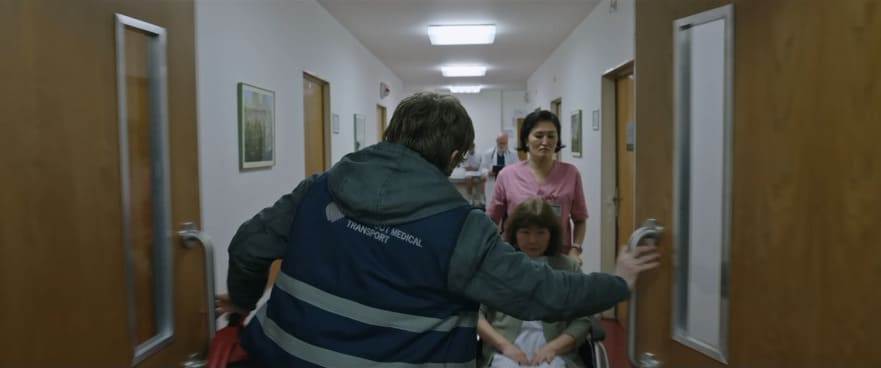
The protagonist is Bryan, played by Austin Abrams, and he is about as far removed from the usual Resident Evil hero as you can get. He is not a police officer, a soldier, a special forces operative or a trained monster hunter. Bryan is a medical courier. He is an ordinary guy doing an ordinary job, and he certainly has no interest in becoming the person responsible for saving Raccoon City.
His night goes wrong during a brutal snowstorm. The story takes place in a modern-day parallel timeline, with the T-Virus outbreak happening in the present rather than the late 1990s associated with the original games. Bryan has been given a late-night delivery to a remote hospital in Raccoon City, carrying a locked container that he believes contains organs or emergency medical supplies needed for a routine procedure.
That assumption does not last long. While driving along isolated, icy roads outside the city, Bryan suddenly hits a strange, disheveled woman standing in the middle of the road. He gets out to see what happened, only to discover that there is something seriously wrong with her. She does not behave like an injured pedestrian. Something biological has already taken hold.
A local police officer arrives and tries to help, but the situation collapses almost immediately. The infected woman attacks, the police cruiser flips, and Bryan is left alone in the freezing wilderness. His night has gone from unpleasant delivery job to full-blown survival nightmare: a dead police officer, a wrecked vehicle with a shot-out engine, and flesh-eating creatures beginning to close in around him.
What the Leaks Say About Bryan’s Mission
The leaked script material has generated plenty of noise online, and it is worth separating the more credible details from the usual internet speculation. Early drafts apparently went through changes during production, yet several of the major story beats have been reinforced by promotional footage and other official material. Horror creators and gaming channels have spent a surprising amount of time reconstructing the film’s structure from those fragments.
After abandoning the broken vehicle, Bryan eventually reaches a nearby farmhouse. This is where the film reportedly drops its title card, effectively signaling that the real survival-horror story is beginning. From there, his journey pushes him toward Raccoon City itself, a place already sliding into a massive biological disaster.
One of the most important encounters comes when Bryan meets a suspicious character played by Paul Walter Hauser. The character works for Umbrella Corporation, and his presence finally starts to explain why Bryan has been sent into this nightmare in the first place. The package is not what Bryan thought it was.
There are no ordinary organs waiting inside. Bryan is carrying a highly volatile antiviral cure, or a specialized compound connected to the outbreak, and getting it to its destination becomes the central objective. The target is the 28th floor of a major Umbrella-controlled facility or hospital skyscraper somewhere inside the infected city.
That simple delivery creates the film’s main engine. Bryan has to get across a Raccoon City that is rapidly becoming uninhabitable, reach the building, and somehow make it all the way to the 28th floor alive. It is a wonderfully cruel setup for a Resident Evil movie because the protagonist cannot simply shoot his way through everything. He is a courier trapped inside a disaster he barely understands.
The Survivors Joining Bryan
Bryan does not make the journey completely alone. Along the way, he becomes part of a strange group of survivors who each bring something different to the situation. The combination sounds intentionally messy rather than heroic, which fits the idea of putting an ordinary civilian at the center of the story.
- Zach Cherry plays a brilliant but deeply panicked scientist caught in the outbreak.
- Kali Reis plays a hardened former military figure who brings considerably more combat experience to the group.
- Paul Walter Hauser plays an Umbrella employee whose information about Bryan’s mysterious cargo changes the direction of the story.
Together, they have to move upward through the enormous Umbrella-controlled structure. That vertical progression is one of the more interesting ideas in the reported plot. Instead of simply moving from street to street or location to location, the characters are effectively climbing through a giant biohazard trap, with every floor potentially offering another creature, another mutation, or another reason to turn around.
And, of course, turning around is not really an option. The building is packed with bio-engineered monsters, while the city outside is becoming just as dangerous. The result is supposed to feel like a prolonged gauntlet rather than a conventional action-movie chase.
Zach Cregger’s Approach Is Very Different
This is probably the part of the new Resident Evil that interests me most. Cregger has said that he deliberately did not watch the previous live-action adaptations. Instead, his inspiration came directly from the games, particularly Resident Evil 2, Resident Evil 4, and Resident Evil 7: Biohazard.
That decision matters. The previous movies spent years establishing their own visual language and mythology, sometimes to the frustration of people who wanted to see the games treated more faithfully. Cregger appears to be approaching the material from a different direction. He is interested in the feeling of being trapped somewhere you absolutely do not want to be, rather than recreating a checklist of recognizable game scenes.
The director has described the movie as fast, chaotic and almost breathless in its momentum. Some early comparisons have pointed toward the frantic movement of Mad Max: Fury Road, only filtered through horror, while others have mentioned the manic physical energy of Evil Dead 2. Those comparisons sound extreme, but they make sense when paired with the reported structure.
The production design is also deliberately leaning into the language of the games. Doors and narrow corridors are everywhere, creating that familiar feeling that something horrible might be waiting just beyond the next corner. The movie is also expected to use first-person camera sequences, giving certain moments a direct visual connection to the way players experience a Resident Evil game.
That could either work beautifully or become a gimmick. The difference will come down to editing. First-person horror is effective when the camera makes you feel trapped with the character. If it is used simply to remind viewers that this is based on a video game, the effect will wear thin very quickly.
The Monsters Won’t Be Typical Movie Zombies
The infected creatures are another area where the film seems determined to move away from standard Hollywood zombie imagery. Regular infected humans are part of the outbreak, but the movie reportedly goes much further with practical creature effects designed by Legacy Effects.
The emphasis is heavily on body horror. That means mutations that look painful, biological and fundamentally wrong rather than clean digital monsters appearing for a quick jump scare. Behind-the-scenes mood boards and forum discussions have pointed toward tentacle-like mutations, parasitic growths that recall the Las Plagas infection, and aquatic creatures hiding inside Raccoon City’s sewer network.
That last detail is particularly fitting. Sewers are practically sacred ground in Resident Evil. They are cramped, filthy, difficult to navigate and perfect for something enormous to be hiding underneath the player’s feet. Turning that environment into a showcase for practical aquatic horrors could give the movie some of its nastiest scenes.
| Element | Reported Direction |
|---|---|
| Infection | T-Virus outbreak in a modern parallel timeline |
| Creature Design | Practical body horror, mutations and parasitic monsters |
| Visual Style | Narrow corridors, doors and first-person sequences |
| Primary Setting | Raccoon City and a large Umbrella-controlled facility |
| Central Objective | Deliver a specialized antiviral compound to the 28th floor |

Why Set Resident Evil in a Modern Raccoon City?
The modern setting has caused plenty of arguments among fans. The original outbreak is strongly tied to 1998 in the games, so moving it into a present-day alternative timeline changes the texture of the story immediately. Instead of CRT monitors, old radios and late-90s technology, characters can use smartphones and modern equipment while the city falls apart around them.
Personally, this is the kind of change that can work if the movie commits to it. Trying to recreate 1998 down to every last detail can be fun, but it can also turn a horror film into a museum piece. Cregger’s reported goal is to create a survival story that feels authentic to a modern audience rather than locking every detail to the franchise’s established chronology.
There is another practical benefit to the decision. Bryan is an entirely new character, which means the film does not have to squeeze Leon S. Kennedy, Jill Valentine or Claire Redfield into a story simply because audiences expect to see them. Those characters can remain associated with the games without another Hollywood adaptation attempting to redefine them on screen.
That also avoids another problem that has followed the movie franchise for years: casting backlash. Whenever a new actor is announced for a familiar Resident Evil character, a section of the fanbase immediately starts debating whether the person looks, sounds or behaves enough like the game version. Bryan sidesteps all of that. He is new, so the audience has to judge him on what the movie actually does with him.
Resident Evil 2026 Cast and Story at a Glance
| Cast Member | Character | Role in the Story |
|---|---|---|
| Austin Abrams | Bryan | Ordinary medical courier carrying the mysterious compound |
| Paul Walter Hauser | Unnamed Umbrella Employee | Reveals the real nature of Bryan’s delivery |
| Zach Cherry | Scientist | Brilliant but panicked survivor |
| Kali Reis | Former Military Survivor | Hard-edged fighter helping the group survive |
What Could Make This Resident Evil Work?
The biggest advantage here is the decision to make Bryan vulnerable. A character who already knows how to handle firearms, monsters and biological weapons can make survival horror feel strangely safe. Bryan does not have that luxury. He is a courier who gets dragged into something far bigger than himself, and every new piece of information makes his situation worse.
The vertical structure could also give the movie a strong sense of progression. If each section of the Umbrella building introduces a different threat while the characters slowly uncover what caused the outbreak, the setting itself can become part of the storytelling. The 28th floor then stops being just a destination and becomes the finish line of an increasingly brutal climb.
There is still a potential weakness, though. Cregger’s description of the film as a fast-moving roller coaster sounds exciting, but Resident Evil also needs moments where the audience can breathe. The best games know when to shut the door behind you, lower the music and let you wonder what is waiting outside. If the movie runs at full speed for two hours, some of the horror could disappear beneath the noise.
Still, the ingredients are unusually promising. Practical monsters, claustrophobic spaces, a protagonist who is not a trained killer, a city collapsing around him and a mysterious Umbrella delivery give the story a clear identity. It does not sound like another attempt to recreate the games shot for shot.
Release Date and What to Expect
Resident Evil is scheduled to arrive in theaters and IMAX on September 18, 2026. The film is being positioned as a fresh start for the cinematic franchise, with Zach Cregger directing and Shay Hatten involved in the screenplay.
If the reported plot holds together on screen, this could be the closest the movies have come to capturing the uncomfortable side of Resident Evil: being lost, under-equipped and completely out of your depth while something biological and horrible moves through the darkness nearby.
There is plenty of room for the movie to stumble. The modern timeline will not satisfy everyone, the first-person sequences could become distracting, and the relentless pace may work against the slower tension that made the games memorable. But at least this reboot appears to have a personality of its own.
And that matters. After years of adaptations trying to decide whether Resident Evil should be an action blockbuster or a faithful survival-horror story, Cregger seems to be taking another route. Bryan is not Leon. This is not 1998. Raccoon City is not being treated as a nostalgia prop. It is a living nightmare built around one terrified courier who simply has to get a package to the 28th floor before the city, and everything inside it, tears him apart.
September 18, 2026 is the date to watch. If Cregger gets the balance between speed, practical horror and genuine tension right, Raccoon City may finally feel dangerous again.


