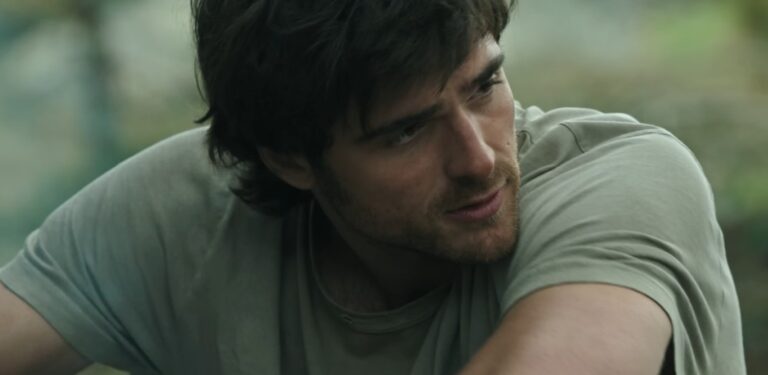
Martin McDonagh has never been particularly interested in making his characters comfortable. Give him two people with years of resentment between them, put them somewhere isolated, and let them talk until every buried insecurity starts crawling out. Wild Horse Nine takes that familiar McDonagh formula and drops it into one of the darkest political moments of the 20th century.
Set around the days leading up to the 1973 Chilean military coup, the movie follows two CIA operatives sent away from Santiago to the remote landscape of Rapa Nui, better known as Easter Island. What initially looks like a strange vacation from the chaos quickly becomes something much uglier. There are political dissidents, secret orders, buried family problems, and two partners who gradually realize that the organization they have served for years may have no use for them anymore.
And yes, there are plenty of spoilers ahead.
What makes Wild Horse Nine especially interesting to me is that it doesn’t seem to treat its spy story like a traditional spy movie. There are no glamorous gadgets or cool one-liners designed to make espionage look exciting. Instead, McDonagh appears much more interested in what happens after years of doing terrible things for supposedly important reasons.
A Very Different Martin McDonagh Movie
The first thing that caught my attention about Wild Horse Nine is the setting.
McDonagh is moving away from the familiar environments associated with films such as The Banshees of Inisherin and Three Billboards Outside Ebbing, Missouri. This time, the story begins in politically unstable Santiago before eventually moving to the huge, almost otherworldly landscapes of Rapa Nui.
That change matters because the island becomes more than a backdrop.
The characters are surrounded by enormous stretches of ocean, ancient Moai statues, wind, rocks and an almost overwhelming sense of isolation. Chris and Lee are already emotionally trapped before they even arrive. The island simply makes it impossible for them to hide from each other.
The result sounds like an unusual mixture of:
- Dark comedy
- Political thriller
- Historical drama
- Character-driven crime story
- Existential Western
That combination is probably what makes the movie feel so recognizably McDonagh while still being quite different from his previous work.
Chris and Lee Are the Real Story
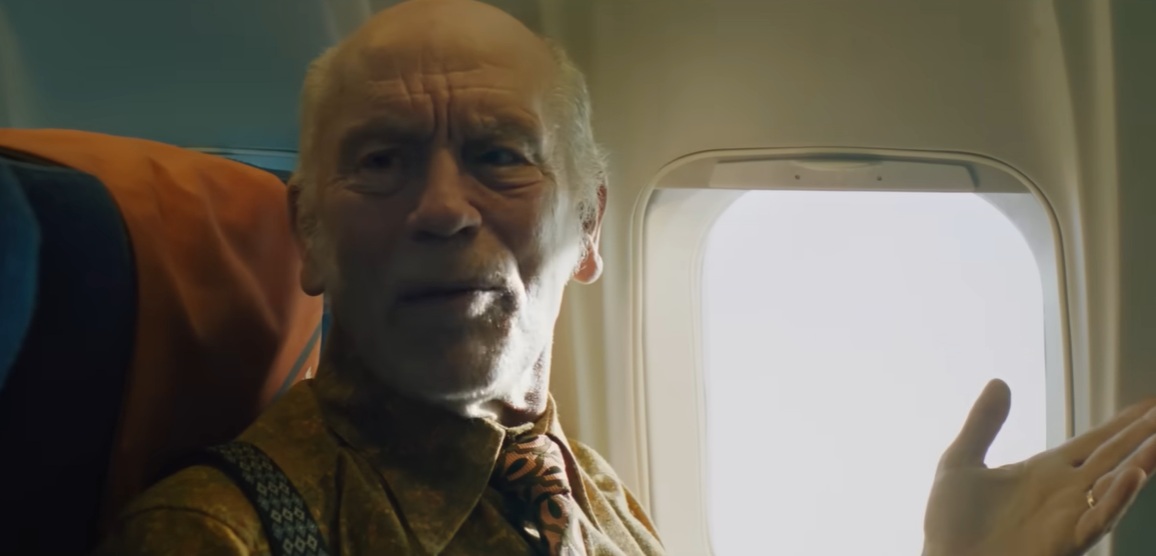
John Malkovich plays Chris, an aging CIA operative who has spent most of his adult life operating in the shadows. He’s cynical, tired and increasingly uncomfortable with the things he’s done.
Sam Rockwell’s Lee is almost his opposite.
Lee is younger, louder, more insecure and much more desperate to prove that he belongs in the world of intelligence operations. The relationship between the two men feels less like a professional partnership and more like a dysfunctional marriage that has lasted far too long.
Their conversations apparently provide much of the movie’s early comedy.
One of the funniest examples comes during their journey to Rapa Nui. Chris is constantly eating, which drives Lee insane. When Lee tells him to stop, Chris basically explains that the only times he isn’t eating are when he’s asleep or shooting somebody.
Lee then tries to establish his own reputation as a dangerous operative, claiming that he has killed people in countries Chris can’t even spell.
He chooses Czechoslovakia.
Chris immediately realizes what Lee is doing and points out that he picked the country precisely because he knew Chris would have trouble spelling it.
It’s exactly the sort of ridiculous argument that makes McDonagh’s dialogue work. These are supposedly hardened intelligence professionals involved in major geopolitical events, yet they can spend several minutes arguing like two exhausted brothers in the back seat of a car.
Underneath the jokes, though, there’s something much sadder happening.
Chris and Lee need each other.
Neither man really knows what his life looks like outside the CIA.
Why Are Chris and Lee Sent to Easter Island?
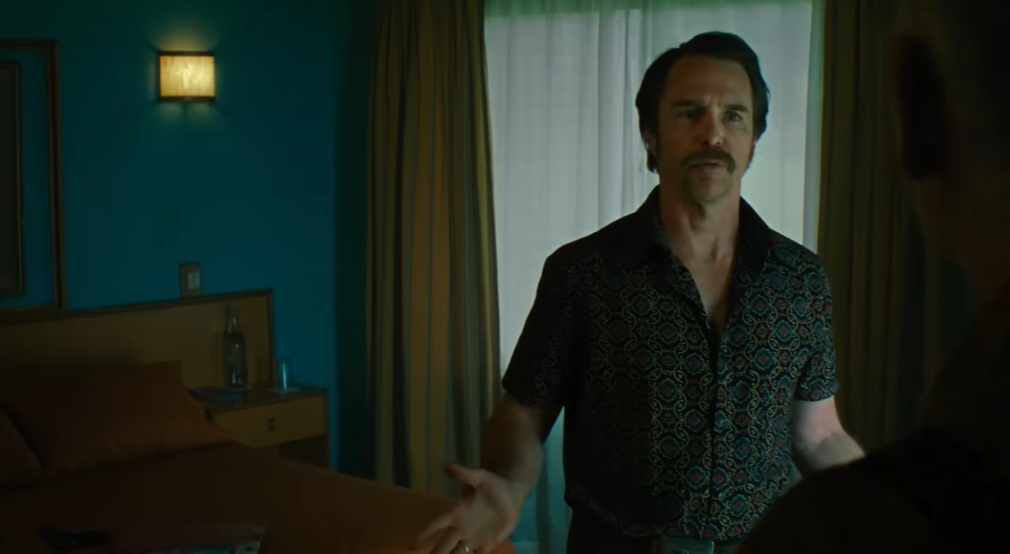
The assignment comes from MJ, played by Steve Buscemi.
Based in Santiago, MJ is the kind of bureaucratic intelligence boss who doesn’t need to personally pull a trigger to ruin somebody’s life. His orders are simple: Chris and Lee need to leave Santiago before the political situation becomes explosive.
They are sent to Easter Island, supposedly to stay out of the way.
That explanation doesn’t survive very long.
The island is connected to a larger network of surveillance and political activity. Local left-wing elements are being monitored, and Chris and Lee gradually discover that their supposedly minor assignment has a much darker purpose.
The timing makes everything even more disturbing.
The story takes place immediately before the September 1973 coup in Chile, meaning the audience knows where history is heading even while the characters are still trying to understand exactly what is happening.
That’s an effective dramatic trick because the movie doesn’t need to manufacture tension about whether the coup will happen.
We already know.
The suspense comes from discovering what these fictional characters will do once history catches up with them.
Marge and Chris’s Brother Add Another Layer
Parker Posey’s Marge, Lee’s wife, isn’t simply there to provide domestic comedy.
She seems to understand Lee better than Chris does. She recognizes his obsession with the CIA and his increasingly unstable personality, while also questioning the mythology surrounding the intelligence world.
Her presence makes Lee’s biggest weakness much clearer: he doesn’t just want to be a spy.
He needs to be one.
That becomes extremely important later.
Tom Waits also appears as Chris’s estranged brother, a man who has lived on the island for years and deliberately removed himself from the world Chris still inhabits.
Their relationship gives Chris a glimpse of another possible life.
It’s uncomfortable rather than sentimental. The brother knows exactly what Chris has become, and their conversations force Chris to confront the family history and guilt he has avoided for decades.
The contrast between the brothers is one of the movie’s more interesting ideas. One escaped society, while the other spent his life becoming part of its machinery.
The Students Change Everything
The story takes its biggest turn when Chris becomes involved with two young local students connected to the island’s political underground.
They are not portrayed as professional revolutionaries. That’s what makes Chris’s reaction to them so important.
They’re young, idealistic and convinced that something worth protecting still exists.
Chris sees himself in them, although probably not in the way he wants to.
After decades of working for an intelligence agency, he’s looking at people who still believe their choices matter. Their presence forces him to reconsider whether following orders can really excuse everything he’s done.
Chris begins quietly warning them about surveillance and the political danger approaching from the mainland.
For Lee, this is unforgivable.
From his perspective, Chris isn’t suddenly becoming a hero. He’s becoming reckless.
And worse, he’s putting both of them in danger.
Wild Horse Nine Spoilers: What Happens in the Final Act?
The situation becomes much more dangerous once the coup occurs.
MJ eventually gives Lee an order to deal with the student group before they can get incriminating documents off the island. Those documents could expose American involvement in the political events unfolding in Chile.
Lee accepts the assignment.
Chris refuses to let it happen.
The two men eventually meet near the coast, with the ancient Moai statues surrounding them.
This confrontation is essentially the emotional heart of the movie.
Chris finally admits that he’s tired.
Not tired in the ordinary sense. He’s tired of being part of a system that keeps creating victims while people like MJ sit safely behind desks and radio equipment.
Lee breaks down for a completely different reason.
He admits that without the CIA, and particularly without Chris, he doesn’t really know who he is.
That’s the tragic part of Lee’s character. For all his arrogance and aggression, he’s terrified of becoming nobody.
Chris isn’t simply his partner.
Chris is the person who gave his life meaning.
Then the situation explodes.
The Shootout at the Moai
A second CIA team arrives to carry out MJ’s orders.
The confrontation turns into a violent shootout.
Chris makes his final decision when he protects the students instead of protecting himself.
He puts his body between them and the gunfire, allowing one of the students to escape toward a waiting fishing boat with the documents.
Chris is mortally wounded.
It’s not a triumphant death. There is no grand speech that suddenly makes his entire career meaningless. He’s simply a man who finally makes one decision that belongs entirely to him.
Lee watches his partner fall.
And that’s where Lee’s entire worldview collapses.
Instead of following orders, he turns his weapon on the other CIA operatives and kills them.
For the first time, Lee isn’t acting because MJ told him to.
He’s acting because Chris is dead.
Wild Horse Nine Ending Explained
The ending is deliberately quiet after the violence.
Lee sits on the rocky shore beside Chris’s body as morning arrives.
The Pacific stretches behind him, while the Moai stand silently around the landscape.
Then MJ comes over the radio.
His voice is calm, professional and completely detached from what has just happened. He asks for a status report and confirms that the coup in Santiago has succeeded.
Salvador Allende is dead. The new regime is in control.
From MJ’s perspective, the operation has worked.
That’s what makes the ending so brutal.
Chris is dead. The students have barely escaped. Lee has killed his own colleagues. An entire country has entered a terrifying new political era.
And MJ still wants a report.
Lee doesn’t answer.
He lets the radio continue transmitting until the sound fades into silence.
For me, that’s the perfect ending for this kind of story. Lee doesn’t suddenly become a hero. He doesn’t ride away into freedom. He doesn’t receive redemption.
He’s simply left behind.
What the Ending Really Means
The final image works because history doesn’t care about Chris and Lee’s personal tragedy.
That’s one of the movie’s strongest themes.
Chris spends the story trying to convince himself that one good decision can somehow balance decades of bad ones. The film doesn’t completely accept that idea. Saving the students matters, but it doesn’t erase what came before.
Lee represents the opposite problem.
He has spent so long accepting orders that he doesn’t know how to exist without them.
When Chris dies, Lee isn’t liberated.
He’s stranded.
The island therefore becomes almost symbolic. Both men are sent there because they’re considered expendable pieces on a much larger political board. By the end, Chris is physically dead and Lee is emotionally destroyed.
The organization survives.
History moves on.
The individual disappears.
Why the McDonagh Humor Matters
I especially like the idea of keeping the comedy in the first half of the film instead of making everything relentlessly grim.
The petty arguments between Chris and Lee aren’t just there for laughs. They make the eventual ending hurt more.
When you’ve watched these two idiots bicker about food, spelling countries and their supposed killing records, you start to see the friendship underneath all the hostility.
That’s why Chris’s death affects Lee so violently.
They may hate each other.
They may constantly insult each other.
But they’ve spent years together.
In a strange way, their arguments are part of their relationship.
Remove that relationship, and Lee has almost nothing left.
Wild Horse Nine Review: Martin McDonagh Cold War Satire Is A Masterpiece
Wild Horse Nine Cast and Characters
| Character | Actor | Role |
|---|---|---|
| Chris | John Malkovich | Aging CIA operative questioning his past |
| Lee | Sam Rockwell | Unstable younger operative and Chris’s partner |
| MJ | Steve Buscemi | CIA bureau chief in Santiago |
| Marge | Parker Posey | Lee’s wife and sharp observer of his behavior |
| Chris’s Brother | Tom Waits | Chris’s estranged brother living on Rapa Nui |
| Student Dissidents | Mariana di Girolamo, Ailín Salas | Young political activists caught in the CIA operation |
Why I’m Looking Forward to This Movie
What makes Wild Horse Nine sound particularly promising isn’t the political conspiracy by itself.
It’s the character work.
McDonagh is at his best when characters say something funny and horrible in the same breath. His people can be pathetic, cruel, hilarious and strangely sympathetic without neatly fitting into hero or villain categories.
Chris seems to be a perfect example of that.
He’s not an innocent man discovering corruption for the first time. He’s someone who has participated in the machine for years and only begins questioning it when he’s old enough to understand what it has cost him.
Lee is even more tragic because he doesn’t have that distance.
He still believes the machine is the only thing holding him together.
The combination of John Malkovich and Sam Rockwell could be fantastic if the script gives them enough room to fight, joke, insult each other and occasionally reveal how much they actually care.
And then there’s Rapa Nui itself.
The ancient statues, enormous ocean horizons and isolated landscapes should give the movie a visual identity that separates it from conventional CIA thrillers. The setting makes the characters look tiny, which feels appropriate for a story about ordinary people getting crushed beneath events much bigger than themselves.
Wild Horse Nine appears to be less interested in asking whether Chris is a hero than asking a much nastier question:
How much good can one person do after spending a lifetime doing bad things for someone else’s cause?
Judging from the story, McDonagh doesn’t offer an easy answer.
And honestly, I wouldn’t want him to.