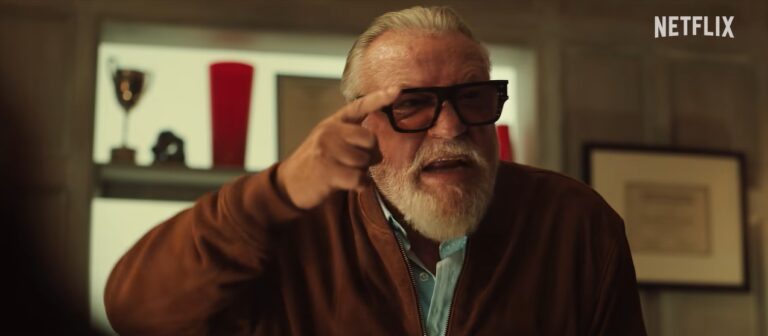
Martin McDonagh has never been particularly interested in making comfortable movies. Thankfully, Wild Horse Nine doesn’t suddenly find him becoming one.
His latest film takes the familiar ingredients of political thrillers — CIA operatives, Cold War paranoia, secret missions, government manipulation — and throws them onto one of the most visually extraordinary pieces of land imaginable. The result is strange, viciously funny, occasionally frustrating, and far more melancholy than I expected.
After The Banshees of Inisherin, McDonagh could have played it safe. Instead, he has gone considerably bigger while keeping the same nasty little obsession with damaged people who cannot stop making terrible decisions.
And yes, Wild Horse Nine is absolutely worth seeing. But it isn’t the flawless masterpiece some early reactions might have you believe.
A Cold War Thriller That Quickly Goes Off the Rails
Set in the politically explosive atmosphere of South America in the early 1970s, Wild Horse Nine begins with a premise that sounds almost conventional.
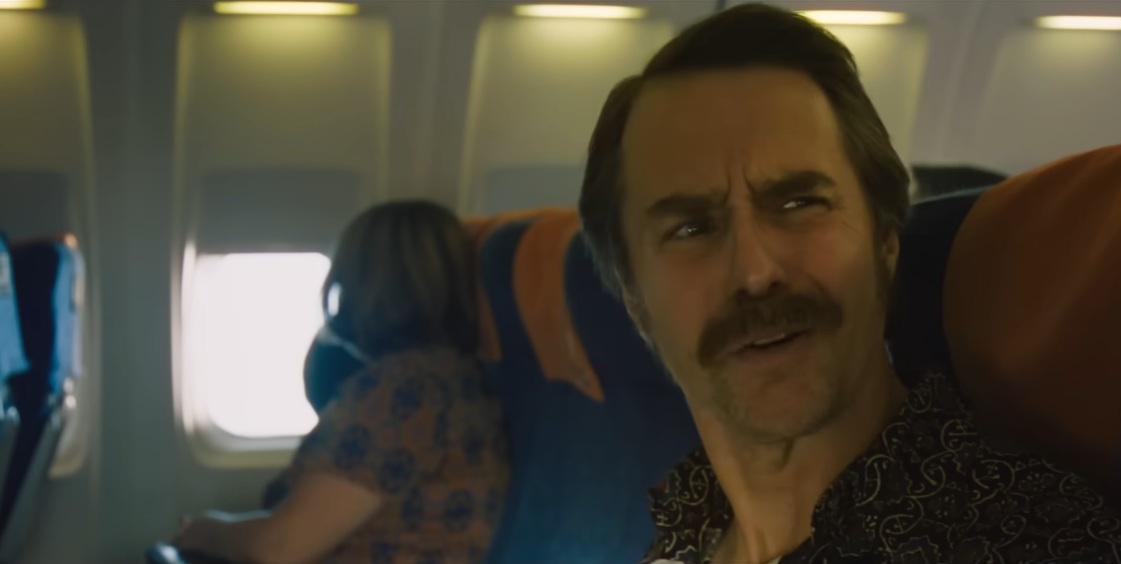
Chris and Lee are veteran CIA operatives stationed in Santiago. They’re experienced, cynical, and clearly exhausted by years of doing work that requires them to lie to virtually everyone around them. When their superior, MJ, sends them to Easter Island — Rapa Nui — for what appears to be a relatively minor assignment, neither man seems particularly impressed.
That changes quickly.
The island becomes more than a backdrop. It practically becomes another character.
The enormous Moai statues dominate the landscape while Chris and Lee stumble through increasingly ridiculous layers of espionage, political paranoia, cultural conflict, and personal resentment. McDonagh gets tremendous mileage from the contrast. These supposedly important American operatives arrive believing they’re controlling events, while the landscape around them quietly suggests that their little geopolitical games are insignificant.
That idea is hardly subtle.
It works anyway.
John Malkovich and Sam Rockwell Are the Real Reason to Watch
The biggest strength of Wild Horse Nine is its central pairing.
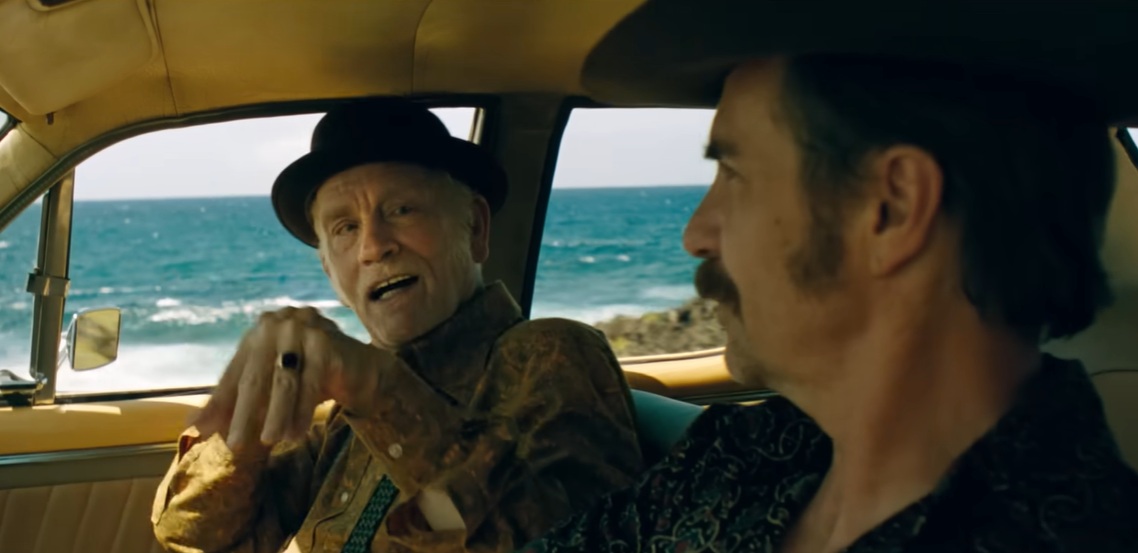
John Malkovich plays Chris, a veteran operative who has reached the point where professional cynicism is no longer enough to protect him from his own conscience. Malkovich doesn’t turn Chris into a conventional tortured hero. Thank God.
He’s unpleasant. He’s tired. He’s occasionally pathetic. And underneath all that is a man who seems increasingly unable to convince himself that what he’s doing has any moral justification.
Malkovich is terrific.
There are moments when his expression does more work than the dialogue. Chris doesn’t suddenly become an idealist. Instead, he starts questioning whether he can continue pretending that none of this matters.
Then there’s Sam Rockwell as Lee.
If Chris is slowly coming apart internally, Lee is determined to keep everything moving. He’s more aggressive, more loyal to the machinery around him, and considerably less interested in philosophical questions. Rockwell plays him with exactly the kind of manic unpredictability you’d expect from another McDonagh collaboration.
Their chemistry is fantastic.
The two men argue like an old married couple who happen to have spent decades working for an intelligence agency. One minute they’re discussing an international crisis; the next they’re squabbling over something completely ridiculous.
That’s where McDonagh is at his best.
He understands that people rarely behave according to the importance of the situation around them. Sometimes history is collapsing and somebody is still furious about an argument from three days ago.
Steve Buscemi’s MJ Is Deliciously Unpleasant
Steve Buscemi takes over the role of MJ after Mark Ruffalo was originally attached to the project, and he fits McDonagh’s world almost suspiciously well.
MJ is the kind of bureaucrat who can discuss catastrophic political consequences with the emotional enthusiasm of someone ordering lunch.
Buscemi doesn’t overplay him. That’s what makes the character work.
There’s something deeply unsettling about MJ’s detachment. Chris and Lee are the ones physically dealing with the consequences of the operation, while MJ remains safely removed from the mess. He represents the machinery behind the people who actually pull the trigger.
Tom Waits and Parker Posey add even stranger energy to the supporting cast, while Mariana di Girolamo and Ailin Salas bring much-needed weight to the local perspective.
That last part matters.
A movie about foreign intervention set against Chilean political history could easily turn local characters into background scenery for an American spy story. Wild Horse Nine is considerably more interested in letting Mariana and Ailin challenge Chris and Lee’s worldview.
Their presence gives the film some of its sharpest confrontations.
The Easter Island Setting Is Stunning — and Occasionally Too Obvious
Visually, this is probably McDonagh’s most ambitious film.
Working again with cinematographer Ben Davis, McDonagh uses the volcanic terrain of Rapa Nui alongside footage shot in Monument Valley. The combination creates an unusual visual identity: part political thriller, part Western, part existential nightmare.
There are wide shots here that genuinely deserve to be seen on a big screen.
The characters look tiny against the landscape. The Moai appear enormous and almost judgmental. The sunlight is beautiful, but the beauty never feels particularly comforting.
The problem is that the symbolism occasionally hits you over the head.
The ancient statues representing permanence while CIA agents represent temporary political power? Yes, I understand.
The endless landscapes emphasizing isolation? Got it.
The contrast between indigenous history and foreign political interference? McDonagh makes sure nobody misses it.
Still, I’d rather watch a filmmaker occasionally overstate an idea than make a movie too timid to have one.
Carter Burwell Gives the Film Its Uneasy Pulse
Carter Burwell returns to provide the score, and his work fits the film beautifully.
The music avoids turning every scene into a dramatic announcement. Instead, Burwell uses restrained arrangements and regional influences to create an atmosphere that feels increasingly uncomfortable.
The score becomes especially effective when McDonagh’s comedy begins disappearing.
Because Wild Horse Nine starts as something surprisingly funny.
Then it gets darker.
Then darker again.
By the final stretch, you’re no longer laughing at the same things you were laughing at an hour earlier.
That tonal transition is one of the film’s greatest achievements.
The Humor Is Brutal, but the Film Eventually Leaves You With a Bad Taste
If you’ve seen In Bruges or Three Billboards Outside Ebbing, Missouri, you know McDonagh’s particular brand of comedy.
He likes putting horrible people into horrible circumstances and allowing them to say something unbelievably stupid at exactly the wrong moment.
Wild Horse Nine has plenty of that.
Chris and Lee’s relationship produces some genuinely hilarious exchanges, especially when their professional competence collides with their personal bitterness. The dialogue has the rhythm you’d expect from McDonagh: sharp, profane, uncomfortable, and often funny precisely because nobody behaves appropriately.
But the movie isn’t interested in keeping the audience comfortable.
As the 1973 Chilean coup approaches, the jokes begin feeling less harmless. The characters’ decisions acquire greater consequences, and the film gradually shifts from absurd political satire toward something much more mournful.
That transition isn’t perfectly smooth.
There are sections where the pacing feels slightly uneven, particularly when the film pauses to make a thematic point it has already made rather effectively.
At 1 hour and 58 minutes, though, McDonagh shows admirable restraint. This could easily have become a bloated prestige drama.
It doesn’t.
What Wild Horse Nine Gets Right — and Where It Stumbles
| Strength | My Take |
|---|---|
| Malkovich & Rockwell | Easily the film’s strongest asset |
| McDonagh’s Dialogue | Sharp, nasty and frequently hilarious |
| Visuals | Gorgeous and unusually ambitious |
| Historical Themes | Heavy-handed at times, but compelling |
| Supporting Cast | Excellent, particularly Buscemi |
| Pacing | Strong overall, with a few slower stretches |
| Tone | Bold, but deliberately uncomfortable |
The film’s biggest weakness is also connected to its biggest ambition.
McDonagh wants Wild Horse Nine to function as a political satire, character drama, historical tragedy, spy thriller, and Western. Most of the time, he pulls it off.
Not always.
Some supporting characters feel like they were designed primarily to serve the movie’s themes rather than exist as fully developed human beings. A few political conversations sound more like McDonagh making an argument than characters naturally talking.
And yes, some of the symbolism is painfully obvious.
But I’d much rather watch something this ambitious and occasionally heavy-handed than another anonymous prestige thriller designed by committee.
The film has a voice.
It has something to say.
And, crucially, it has characters I actually wanted to keep watching.
Wild Horse Nine 4K Trailer Breakdown: Theories, Cast, and Martin McDonagh Easter Eggs Explained
Is Wild Horse Nine a Masterpiece?
I’m going to push back slightly on that label.
It’s an excellent film. I’m not convinced it’s a perfect one.
There are moments where Wild Horse Nine feels like McDonagh firing on every cylinder: two brilliant actors insulting each other against an extraordinary landscape while a historical catastrophe approaches in the background.
Those scenes are phenomenal.
Other moments feel more calculated. You can practically see the screenplay underlining its own themes.
But I’d much rather watch something this ambitious and occasionally heavy-handed than another anonymous prestige thriller designed by committee.
What I won’t forgive easily is a boring movie, and Wild Horse Nine is anything but boring.
Final Verdict
Wild Horse Nine gets a strong 8.5/10 from me.
John Malkovich is outstanding. Sam Rockwell is having an absolute blast. Steve Buscemi is perfectly cast. The cinematography is gorgeous, Carter Burwell’s score adds exactly the right amount of unease, and McDonagh’s dialogue remains wickedly entertaining.
The film isn’t always subtle, and occasionally it seems almost desperate to remind you how significant its historical parallels are.
I can live with that.
What I won’t forgive easily is a boring movie, and Wild Horse Nine is anything but boring.
It begins as a strange Cold War comedy, gradually mutates into a paranoid espionage story, and eventually becomes a bleak examination of people discovering that their actions have consequences far beyond whatever little mission they thought they were completing.
That’s McDonagh territory.
Only this time, the stage is enormous.
And those Moai are watching.