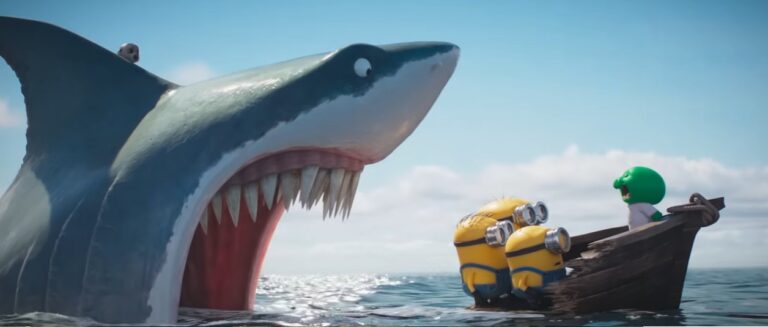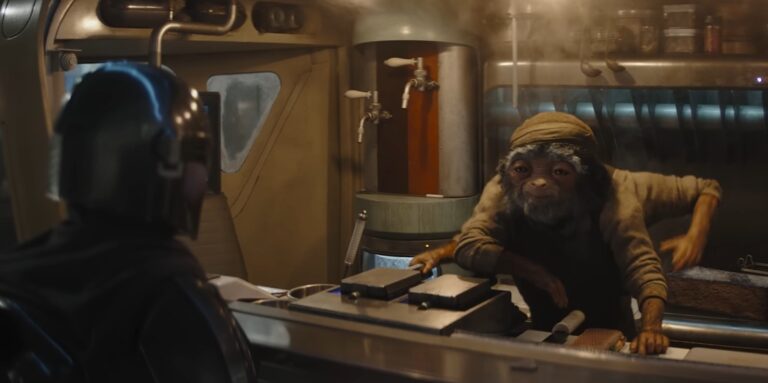
If there is one thing I love about the Despicable Me franchise, it is how willing these movies are to turn complete nonsense into surprisingly clever comedy. Minions & Monsters takes that idea and pushes it much further than I expected. Instead of giving us another straightforward Minion adventure, the movie jumps back to 1927 Hollywood, throws a bunch of giant monsters into the middle of silent-film history, and then pulls the rug out from under the entire story.
At first, it looks like a strange but fairly simple prequel. By the time the credits arrive, though, you realize the movie has been playing with the audience the whole time.
The result is easily one of the strangest entries in the franchise, but also one of the most interesting. The ending, especially, gives the whole movie a completely different meaning.
Why Minions & Monsters Goes Back to 1927
The story begins with a modern-day framing sequence featuring Olivia, a Hollywood tour guide voiced by Allison Janney. She takes visitors through a studio museum filled with old props and movie memorabilia, including the wonderfully bizarre appearance of George Lucas inside a glass display.
Olivia introduces James and Henry as two figures who supposedly changed Hollywood and even helped save the world. From there, the movie jumps back to the 1920s.
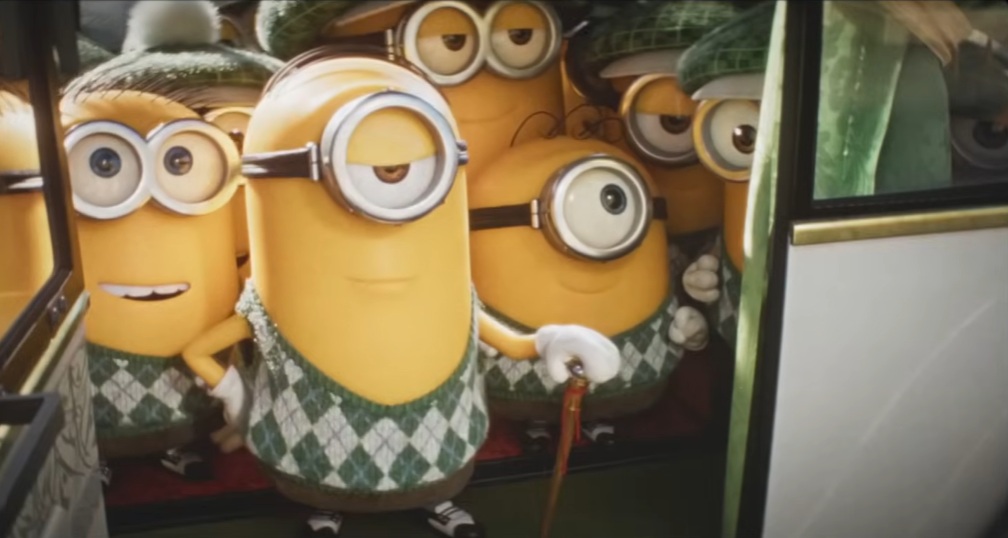
This particular group of Minions isn’t Kevin, Stuart, and Bob. They’re another faction of the endlessly wandering yellow tribe, still looking for somebody suitably evil to serve.
That search eventually leads them onto a Hollywood film set.
And honestly, this is where the movie starts having fun.
The Minions are naturally perfect for silent cinema. Their physical comedy needs no translation, their accidents become spectacular set pieces, and audiences become obsessed with them. Soon enough, Minion Mania has taken over America.
There is merchandise. There is celebrity status. There is fame.
Then sound arrives.
The introduction of talkies destroys their careers almost overnight. Studio executives can’t understand Minionese, the stars are fired, and their film career crashes spectacularly.
For James, however, this isn’t the end of the dream.
It is the beginning of something much stranger.
James Doesn’t Want a Villain. He Wants a Movie.
James is probably the most interesting Minion in the film because his motivation isn’t simply finding a master.
He wants to make a movie.
While Dick, the group’s leader, wants everyone to return to their traditional search for an evil boss, James becomes obsessed with creating a monster film. Henry and Ed join him, and eventually the trio approaches eccentric producer Max, played by Christoph Waltz.
Max gives James a real movie camera.
The problem is obvious: if you’re going to make a monster movie, you need monsters.
The solution is pure Minions chaos.
Ed remembers a magical spellbook taken from an old warlock. James and his friends use it to perform a summoning ritual, expecting to create something terrifying enough for their film.
Instead, they get Goomi the Deceiver.
And this little green creature is fantastic.
Voiced by Trey Parker, Goomi looks like a deliberately ridiculous cousin of Lovecraft’s Cthulhu. He is tiny, strange, and far more dangerous than his appearance suggests.
Goomi understands exactly what James wants. He promises to find enormous creatures for the movie.
That promise turns out to be a terrible idea.
Goomi’s Real Plan and the Monster Problem
Goomi leads James, Henry, and Ed to a frozen fortress where they discover two enormous creatures named Phillips and Howard. The names are an obvious joke aimed at H.P. Lovecraft.
But those monsters are only the beginning.
Goomi eventually reveals his full identity: Gary Orkam Oliver Magma Ichabod the Deceiver. He uses the spellbook to summon Irene, the Devourer of Worlds, a gigantic orange creature covered in eyes.
At this point, James’ movie has stopped being a movie.
It has become a real disaster.
While this is happening, Dick’s Minion faction has found its own potential master: Dort, a futuristic alien robot played by Jesse Eisenberg. Dort claims to be preparing an invasion of Earth, but he is far less intimidating once his cowardly personality becomes obvious.
The two storylines eventually collide when Irene arrives in Hollywood and begins devouring everything around her.
Henry even gets swallowed.
Because apparently, the movie wasn’t going to let the stakes remain remotely reasonable.
Naturally, the Minions respond with the only strategy they know: complete chaos.
The Final Battle Is Bigger Than James’ Movie
The final battle turns 1920s Los Angeles into a ridiculous monster playground.
James refuses to put down his camera. He keeps filming while everyone else tries to survive. Debbie, a suffragette played by Zoey Deutch, joins the fight, while Dort uses his technology to equip the Minions with retro-futuristic spaceships.
The action is intentionally ridiculous.
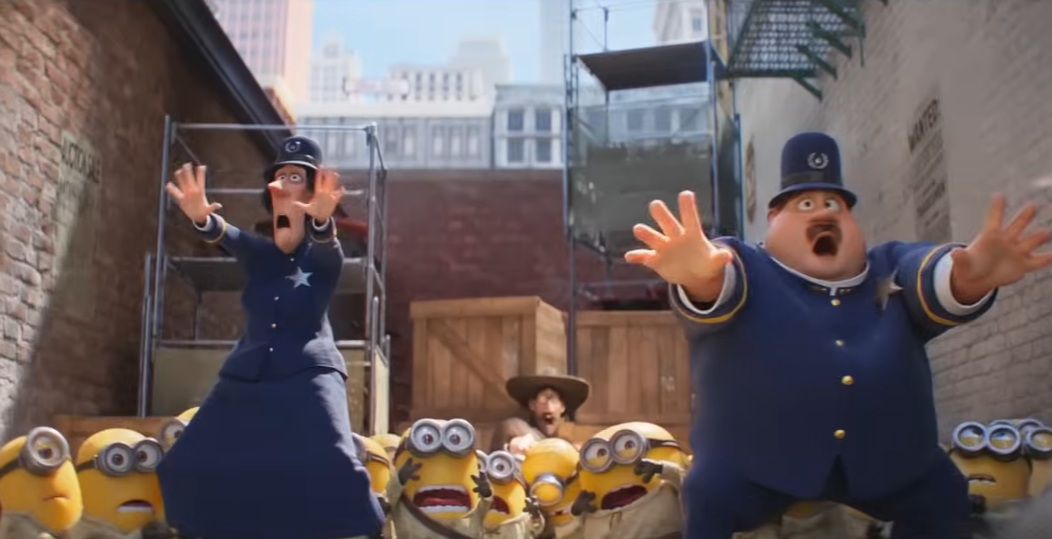
There are studio props, frying pans, spaceships, giant monsters and a spellbook flying around at once.
Then, almost completely by accident, the Minions discover the solution.
The magical ritual is reversed.
A portal opens and begins pulling the monsters back toward their respective dimensions. Irene disappears. Phillips and Howard are dragged away. Goomi is sucked back through the portal as well.
And Henry?
He gets coughed back up alive.
Because apparently even being swallowed by a cosmic monster isn’t enough to kill a Minion.
With the crisis over, James finally finishes his footage.
The movie he wanted to make becomes Minions & Monsters, a massive Hollywood success. James receives an Academy Award, and the Minions publicly announce that their days of searching for evil masters are finished.
Their new profession?
Making movies.
That sounds like a perfect ending.
It isn’t.
The Movie-within-a-Movie Twist Explained
This is the part that completely changes how you should look at everything that came before it.
The camera pulls away from the 1920s theater.
Then it keeps going.
Eventually, we discover that the entire story we have just watched was itself a movie being filmed on a modern Hollywood set.
That’s the big twist.
The monsters weren’t actually destroying Hollywood. The historical setting wasn’t really happening in the way we had been led to believe. The dramatic battles, the magical creatures and even the apparent deaths were all part of the production.
Characters who seemed to have been killed or banished are suddenly hanging around together between takes.
Goomi is there.
Irene is there.
Dort is there.
The human characters are there.
Everyone is basically an actor waiting for the next scene.
And I think this is the smartest joke in the entire film.
The movie spends so much time pretending to expand the Despicable Me mythology, only to admit that it is really making fun of the entire idea of franchise continuity.
Nothing has to fit perfectly because it was all a movie inside the movie.
That gives the filmmakers an excuse to play with history, monsters, alternate timelines and ridiculous Minion lore without permanently rewriting everything established in the earlier films.
What the Ending Means for the Despicable Me Timeline
The meta ending also helps explain why the story can take place in 1927 while still connecting to characters who obviously belong to much later periods.
The movie isn’t necessarily saying that Gru was alive during the main events of the 1920s story.
Instead, the fictional film exists inside the broader world of the franchise.
That’s a clever escape hatch.
Rather than creating a complicated new timeline where Gru somehow exists decades before his birth, Minions & Monsters essentially tells us to stop treating every scene as literal history.
The Minions can make a movie about themselves.
That movie can exaggerate their adventures.
And the franchise can continue without having to explain every impossible detail.
For a series this chaotic, that approach makes a surprising amount of sense.
The Five Mid-Credits Scenes Are Where Things Get Weird
The movie isn’t finished playing with continuity once the main credits begin. There are several animated mid-credits sequences, and these are much more important than they initially appear.
| Mid-Credits Moment | What It Suggests |
|---|---|
| Kyle’s transformation | Kevin, Stuart and Bob accidentally transform an ordinary dog into Kyle using the magical spellbook. |
| Young Gru appears | The Minions are already connected to different periods of Gru’s life. |
| Adult Gru appears | The franchise deliberately plays with time and continuity. |
| The Minions’ role | Their relationship with Gru remains the central thread beneath the chaos. |
| The timeline joke | The film treats continuity as something flexible rather than completely literal. |
The Kyle reveal is probably the funniest of the bunch.
Fans have wondered for years where Gru’s strange, spike-toothed dog came from. Apparently, the answer involves Minions, magic and a spell that goes very wrong.
That feels completely appropriate.
The Two Grus Problem
Then we get the genuinely confusing part.
A young Gru appears in one sequence, followed later by an adult Gru.
Since the main story is set in 1927, this obviously doesn’t work as straightforward chronology.
But that’s exactly the joke.
Once the movie has revealed that its central adventure is fictional filmmaking, the credits can treat time like a toy. The Minions are essentially jumping around different eras of their relationship with Gru.
So I wouldn’t read the two Gru appearances as evidence that the franchise has secretly rewritten Gru’s birth date.
They’re much more likely a meta gag about the Minions’ eternal relationship with their future master.
And honestly, I prefer that explanation.
Trying to build a serious timeline around every single Minion joke would probably be more complicated than the movies themselves.
Why the Hollywood Setting Actually Works
The 1920s setting isn’t just decoration.
The transition from silent films to talkies gives the movie a real historical backdrop for its comedy. The Minions are perfect silent-film performers because their humor is visual. Their downfall when sound arrives is therefore more than a random gag.
It also gives James a believable reason to become obsessed with filmmaking.
He doesn’t simply want fame.
He wants to create something.
That makes his storyline stand out from the usual Minion formula. James starts the film looking for a place in the world and ends it as a filmmaker who has discovered what he actually wants to do.
That small character arc gives the absurd monster story a surprisingly human center.
Minions & Monsters (2026) Review: Does Illumination’s Old Hollywood Prequel Actually Deliver?
My Take on the Ending
I went into Minions & Monsters expecting another loud Minion adventure, and I was genuinely surprised by how aggressively the movie plays with its own mythology.
The movie-within-a-movie reveal won’t work for everyone. If you want the franchise to take its continuity seriously, the ending can feel like a giant cheat. It basically gives the writers permission to say, “Yes, all of this happened, but also none of it happened exactly like that.”
Personally, I think that’s why it works.
The Despicable Me universe has become so enormous that adding another perfectly serious layer of mythology would probably make things unnecessarily complicated. Instead, the film turns that problem into the joke.
The Minions have spent their fictional existence following villains, surviving impossible disasters and somehow stumbling into major historical events.
Now they are actors.
And the monsters are actors too.
Even the apocalypse was just another day at the studio.
That’s a much better punchline than another carefully constructed timeline explanation.
The Biggest Things to Take Away
- James’ dream of filmmaking drives the main story.
- Goomi accidentally turns a movie idea into a real monster crisis.
- Irene and the other creatures are ultimately part of the film’s staged reality.
- The final Hollywood reveal means the 1927 adventure isn’t a literal rewrite of franchise history.
- Kyle’s origin is tied to Minion magic.
- The two Grus are part of the movie’s deliberate timeline joke.
- The Minions’ eventual connection to Gru remains untouched.
What I especially like is that Minions & Monsters doesn’t pretend the franchise needs a perfectly clean timeline. It embraces the mess.
And for a series about immortal yellow creatures who have apparently spent thousands of years chasing evil people, that’s probably the most honest choice the filmmakers could have made.
Minions & Monsters may look like a prequel on the surface, but its ending reveals something much more entertaining: it is really a movie about the Minions making a movie about themselves. The monsters, the historical chaos and the impossible timeline are all part of the joke.
The yellow guys didn’t just survive Hollywood.
They became Hollywood.