
There are true-crime movies that simply recreate a crime. Then there are films that make you sit through the uncomfortable years, arguments, silences, betrayals, and tiny warning signs that came before it.
Elize: Shadows of a Woman belongs firmly to the second category.
The new Brazilian Netflix thriller, released globally on July 22, 2026, takes the real-life case of Elize Matsunaga and Marcos Matsunaga and turns it into something far more claustrophobic than a standard crime retelling. Directed by Felipe Vellas and written by Raphael Montes and Mariana Torres, the film is less interested in delivering a simple “here is what happened” account and more focused on the psychological pressure building inside a relationship that initially looks almost impossibly perfect.
And honestly, that is what makes the movie so unsettling.
You already know that this is not going to end well. The real question is how a relationship that begins with wealth, romance, security, and the promise of a fresh start gradually becomes something poisonous.
This is a spoiler-free plot summary and review of Elize: Shadows of a Woman, so I will avoid the specific narrative turns and major revelations that the movie deliberately wants you to experience for yourself.
What Is Elize: Shadows of a Woman About?
At the center of the film is Elize, played by Lorena Comparato, a woman who has fought hard to escape a difficult past and build a more secure future. Her life changes dramatically when she meets Marcos Matsunaga, portrayed by Henrique Kimura, a wealthy heir connected to one of Brazil’s most powerful food empires.
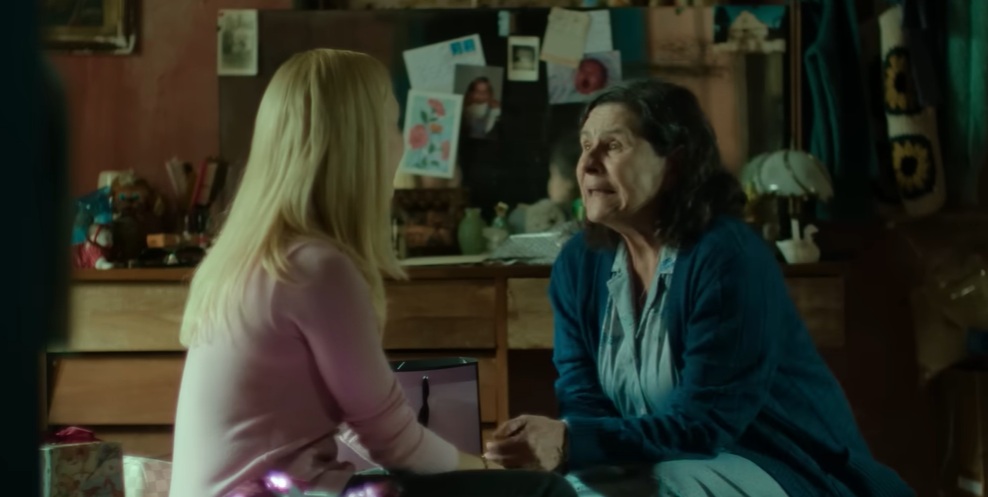
On paper, their relationship looks like a modern fairy tale.
Elize moves from a life defined by uncertainty into a world of luxury, expensive homes, private security, wealth, and elite social circles. Marcos offers her something she has spent much of her life chasing: stability. Together, they build what appears to be a comfortable family life behind the walls of a sophisticated São Paulo residence.
But the film is smart enough not to treat luxury as happiness.
The expensive apartment becomes one of the movie’s most important locations. It is beautiful, controlled, and almost completely sealed off from the outside world. The more the relationship begins to fracture, the more that home starts to feel like a trap.
The central conflict begins when Elize discovers evidence of Marcos’s infidelity. From there, the story becomes increasingly tense and psychologically uncomfortable. Betrayal is only the starting point. What follows is a destructive cycle involving mistrust, emotional manipulation, insecurity, power, and the fear of losing the life Elize fought so hard to create.
What I liked most about this setup is that the movie does not reduce the relationship to a simple argument between a victim and a villain. The film is interested in the messy middle ground where people lie, hide things, manipulate one another, make terrible choices, and still remain emotionally connected.
That makes the tension feel much more personal.
A True-Crime Story That Refuses to Move in a Straight Line
One of the strongest creative choices in Elize: Shadows of a Woman is its structure.
The movie opens close to the end of the story. You are immediately dropped into an atmosphere of dread, with the collapse of the relationship already hanging over everything. Then the film moves backward and begins showing how Elize and Marcos met, how their relationship developed, and how their seemingly perfect life began to deteriorate.
That approach completely changes the viewing experience.
You are not sitting there asking, “What happens next?”
Instead, you are watching the early romance while knowing that something is fundamentally wrong beneath the surface. A happy dinner becomes uncomfortable. A casual conversation suddenly feels loaded. A seemingly harmless detail starts to look like a warning sign.
This is where the film’s non-linear storytelling works particularly well. It turns the audience into detectives, but not in the usual true-crime sense. You are not trying to solve the crime. You are trying to understand the relationship.
The movie’s chapter-based structure also gives the story a slightly literary quality. Each section feels like another stage in the transformation of a relationship, from romantic fantasy to emotional battlefield.
The Real Case Behind the Netflix Movie
The film is inspired by the infamous 2012 criminal case involving Elize Matsunaga and Marcos Matsunaga, which shocked Brazil and attracted international attention.
The story had already been explored in the Netflix documentary series Elize Matsunaga: Once Upon a Crime, produced by Boutique Filmes. That documentary took a factual approach, using interviews, trial material, archival footage, and direct testimony.
The 2026 feature film takes a completely different route.
Rather than trying to reproduce the case like a courtroom timeline, Elize: Shadows of a Woman uses fictionalized drama to explore the emotional world surrounding the relationship. It focuses heavily on the social environment, the marriage, the isolation, and the psychological pressure that gradually builds behind the image of a wealthy and successful family.
That distinction matters.
If you are expecting a documentary-style reconstruction with every event presented in chronological order, this movie may surprise you. It is much more interested in atmosphere and character than in checking off every factual detail.
Class, Wealth, and the Feeling of Being an Outsider
The class divide is one of the film’s most effective themes.
Elize enters a world that was never truly designed for her. Marriage gives her access to wealth, but it does not automatically give her acceptance. The movie repeatedly suggests that social status can be inherited, purchased, or borrowed, but belonging is much harder to obtain.
There is a constant sense that Elize is being watched and judged.

The old-money environment surrounding Marcos carries its own rules. Some of those rules are never spoken aloud. That makes the social tension even more uncomfortable. A glance, a comment, or a polite conversation can carry more hostility than an open confrontation.
For me, this is where the film becomes more than a standard relationship thriller. Elize is not simply fighting with her husband. She is also fighting against the fear of losing the life she has built and returning to a world she worked desperately to escape.
That creates an ugly and very human question:
How much can a person tolerate when security and emotional pain become impossible to separate?
The Apartment Is Practically a Character
The film’s visual language is built around confinement.
Security cameras, mirrors, locked doors, hallways, and reflective surfaces appear again and again. These details are not just there to make the movie look stylish. They reinforce the idea that the characters are constantly observing one another while never truly understanding each other.
The home is supposed to be a place of safety.
Instead, it gradually becomes a space filled with surveillance and suspicion.
The cold modern architecture works perfectly with this idea. Wide shots make the apartment feel enormous, yet the characters often seem emotionally trapped. Tight close-ups create the opposite effect, forcing the audience into uncomfortable proximity with the couple.
The overall visual style is dark and muted without becoming completely colorless. The movie feels expensive, polished, and controlled on the surface. Underneath, everything is slowly becoming unstable.
Lorena Comparato Carries the Film
The performance at the center of the movie is Lorena Comparato as Elize.
This is a difficult role because the real-life case already carries enormous cultural baggage. A weaker performance could easily turn the character into a sensationalized true-crime stereotype.
Comparato avoids that trap.
Her Elize is vulnerable, defensive, ambitious, frightened, and often difficult to understand. Those contradictions are exactly what make the performance work. She does not play the character as someone who can be easily categorized.
There are moments when you feel sympathy for her. There are moments when you question her decisions. There are also moments when the movie makes you uncomfortable with how closely you are being pushed into her emotional perspective.
That is the kind of performance that stays with you.
Henrique Kimura is equally effective as Marcos. His performance does not rely on exaggerated villainy. Instead, Marcos is presented as a man who appears comfortable with control and accustomed to getting his way.
That makes his interactions with Elize feel more dangerous than a traditional “evil husband” performance would have.
The tension between the two actors is the real engine of the movie.
Is Elize: Shadows of a Woman Worth Watching?
If you are looking for a straightforward crime movie with constant twists and a fast pace, this may not be the right choice.
Elize: Shadows of a Woman is slower, more psychological, and much more interested in emotional deterioration. The film spends time showing how a relationship changes when trust disappears. It examines how wealth can coexist with loneliness and how a beautiful home can become a place where nobody feels safe.
The movie works best when it allows the audience to sit with that discomfort.
You should watch it if you enjoy:
- Psychological true-crime dramas
- Brazilian crime stories and international Netflix thrillers
- Non-linear storytelling
- Character-driven relationship dramas
- Movies about class, wealth, obsession, and emotional control
- True stories adapted with creative liberties
The film also works particularly well for viewers who already know something about the Matsunaga case. Familiarity with the real story adds another layer of tension, because you begin noticing how the movie chooses to frame certain moments.
For viewers who know nothing about the case, the experience is arguably even more unpredictable.
What to Watch After Elize: Shadows of a Woman
If the film leaves you wanting more, Netflix has several related titles worth checking out.
| Title | Why It Fits |
|---|---|
| Elize Matsunaga: Once Upon a Crime | The factual documentary series that explores the real case through interviews and investigative material. |
| An Invisible Victim: The Eliza Samudio Case | Another Brazilian true-crime story involving crime, media attention, and public fascination. |
| Woman of the Hour | A tense psychological thriller exploring vulnerability, predatory behavior, and the darker side of true crime. |
| Lover, Stalker, Killer | A documentary built around deception, obsession, online relationships, and escalating danger. |
Final Thoughts
Elize: Shadows of a Woman is not the kind of true-crime movie that simply wants to shock you.
Its real strength is the uncomfortable journey toward the tragedy. The film asks you to watch a relationship change piece by piece and forces you to think about the difference between love, dependence, security, control, and fear.
The result is a dark, stylish, emotionally heavy Brazilian thriller that should generate plenty of discussion.
Personally, I think the movie works best when you stop trying to treat it as a puzzle and start watching it as a portrait of a relationship slowly losing its shape. The opening structure tells you that the destination is already waiting. The real horror comes from watching the road that leads there.
Elize: Shadows of a Woman is a strong Netflix pick for anyone who prefers their true crime with atmosphere, complicated characters, and a psychological edge rather than a simple crime-recreation formula.