
Hope is the kind of movie that practically dares you to misunderstand it. On the surface, Na Hong-jin’s 2026 return looks like an enormous alien survival movie: a remote South Korean town, a mysterious massacre, military hardware, terrified civilians, impossible creatures and enough explosions to make a conventional monster movie look embarrassingly timid. But that description barely scratches the surface.
Na Hong-jin has never been particularly interested in giving audiences comfortable genre experiences. The Chaser was vicious, The Yellow Sea was brutally chaotic, and The Wailing turned uncertainty itself into a weapon. Hope takes those instincts and throws them into science fiction. The result is louder, stranger and considerably more ambitious, but underneath all that destruction is the same question Na keeps asking: what happens to ordinary people when the world stops making sense?
Set in the late 1980s, the movie follows the isolated mining community of Hope Harbor, located dangerously close to the heavily fortified DMZ. When a mutilated cow is discovered by a hunting party led by Sung-ki (Zo In-sung), the locals immediately start looking for an explanation they understand. Maybe it is a wild animal. Maybe it is a North Korean infiltrator. Maybe someone in the community is responsible.
Is the Movie Hope a Sequel to The Wailing? Na Hong-jin’s New Sci-Fi Universe Explained
That instinct turns out to be catastrophically wrong.
The truth comes crashing down from somewhere far beyond Earth. The creatures from Gh’ertu are not another human enemy, and they certainly aren’t a problem that a few rifles and nervous police officers can solve. Once the alien presence reveals itself, Hope Harbor becomes a slaughterhouse.
And this is where the movie gets considerably more interesting than its ridiculous-sounding premise suggests.
The Hope Ending Explained: Why the Movie Changes Perspective
One of the smartest choices in Hope is also one of the easiest to overlook. Na Hong-jin deliberately changes the way the audience sees the story. For roughly the first part of the movie, everything feels trapped inside the perspective of Bum-seok (Hwang Jung-min), the local police chief.
That limitation matters. Bum-seok isn’t some brilliant investigator who understands the bigger picture. He’s a frightened, exhausted small-town cop trying to make sense of increasingly horrific events. His world is built around familiar problems: suspicious strangers, political paranoia, family obligations, local gossip and the ever-present fear of North Korean infiltration.
Then the movie rips that perspective apart.
Once the alien threat becomes undeniable, Na pulls the audience away from the narrow human viewpoint and begins presenting the catastrophe from something much closer to a god’s-eye perspective. Suddenly, the town’s little assumptions feel almost laughable. The people of Hope Harbor have been obsessing over threats they can name while something completely incomprehensible has arrived above them.
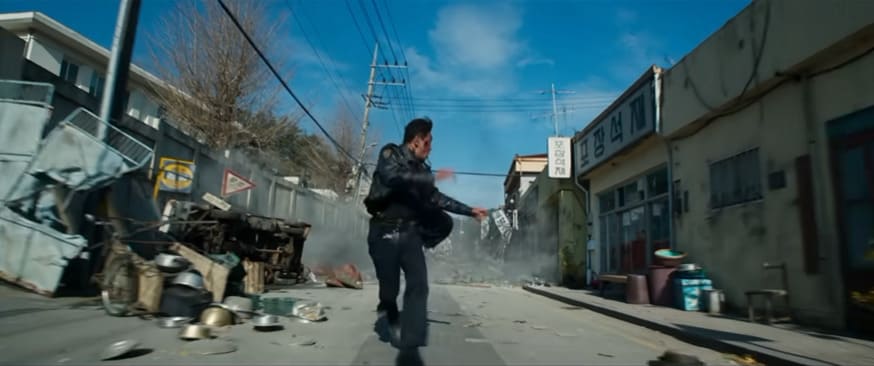
I think this is one of the film’s strongest ideas, even if the transition is intentionally jarring. Na isn’t simply showing us that the characters were wrong. He’s showing how desperately humans need familiar explanations when confronted with something they cannot understand.
Humans Keep Looking for the Wrong Enemy
There is a particularly nasty joke buried inside the movie’s setting. Hope Harbor is surrounded by the visual language of Cold War paranoia. Signs warn about infiltration. The DMZ is nearby. Suspicion is practically part of the architecture.
Then an alien invasion happens.
And the residents still try to interpret it through the same old framework.
That’s not accidental. Na turns the traditional invasion movie upside down. Usually, humanity faces an extraterrestrial threat and eventually discovers the courage, technology or scientific trick necessary to fight back. In Hope, the first human response is much messier: people blame the wrong targets, misunderstand what they are seeing and retreat into the social divisions they already know.
The aliens aren’t simply invading a town. They are exposing how badly equipped humans are to recognize a threat that doesn’t fit their existing worldview.
Why Is the Movie Called Hope?
This is probably the question most viewers will have after the credits. Honestly, if you judged the title purely by what happens on screen, Hope sounds almost sarcastic.
The town is devastated. People die. Buildings burn. Families are torn apart. Conventional weapons accomplish very little against an enemy that seems practically impossible to kill. Bum-seok and Seong-ae (Jung Hoyeon) throw themselves into increasingly desperate confrontations, but bravery doesn’t magically repair a collapsing world.
Na Hong-jin even plays with this contradiction himself. The joke is that something like Nothing Works Out might actually describe the movie better.
And yet Hope is the title.
That contradiction is the point.
Na’s idea of hope isn’t the glossy Hollywood version where someone gives an inspirational speech, the hero discovers a secret weakness and humanity survives until the credits roll. There is no promise that everything will be okay. There isn’t even a guarantee that the characters’ sacrifices will accomplish anything measurable.
Hope exists because people keep acting as though their actions matter even when the universe gives them absolutely no reason to believe that.
That makes the title much darker than it initially appears.
Hope Isn’t Optimism
Bum-seok is a great example. He’s hardly the archetypal action hero. He’s nervous, overwhelmed and frequently looks like a man who desperately wants somebody else to take responsibility for what’s happening. He isn’t suddenly transformed into an unstoppable killing machine because the aliens arrive.
That’s precisely why his struggle works.
The same goes for Sung-ki and the other locals. Their courage isn’t clean or elegant. People panic. They swear. They make stupid decisions. They joke at inappropriate moments. They argue while the world is literally collapsing around them.
Yet they continue trying to protect people they care about.
That is the film’s version of hope: not confidence that you will win, but the refusal to stop caring when winning becomes almost impossible.
What Do the Gh’ertu Aliens Represent?
The extraterrestrials from Gh’ertu could have been nothing more than enormous cinematic monsters. Thankfully, Na gives them considerably more texture than that.
The creatures are not presented as a perfectly unified hive mind. They have distinct physical characteristics, expressions and indications of their own social structure. Their differences suggest that the alien civilization has hierarchies and divisions of its own.
That detail becomes important because Hope isn’t really interested in creating a simple “humans versus aliens” conflict.
The aliens are another mirror.
Human beings divide themselves according to nationality, class, politics, geography and social status. The Gh’ertu apparently do much the same thing. The horrifying implication is that humanity’s problems may not be uniquely human at all.
Class conflict isn’t some strange accident of Earth. Power structures aren’t necessarily limited to our species. Hierarchy, violence and exploitation may be patterns that appear wherever intelligent societies develop.
The Infiltration Metaphor
This makes the repeated imagery of infiltration much more effective.
For the people of Hope Harbor, infiltration traditionally means an enemy crossing the border. The signs and warnings around town reinforce the idea that danger comes from somewhere else and that the solution is to identify the outsider.
Then the actual enemy arrives from another planet.
Suddenly, the old political fears look absurdly small.
But there is another layer here. The aliens don’t just destroy the physical town. Their arrival reveals the fractures that were already there. Suspicion, fear and social division don’t disappear when humanity faces a common enemy. If anything, they become more obvious.
That is one of the nastier observations in Hope: give people an incomprehensible disaster and they may still waste precious time fighting over the explanations they already understand.
Why Daylight Makes the Horror Worse
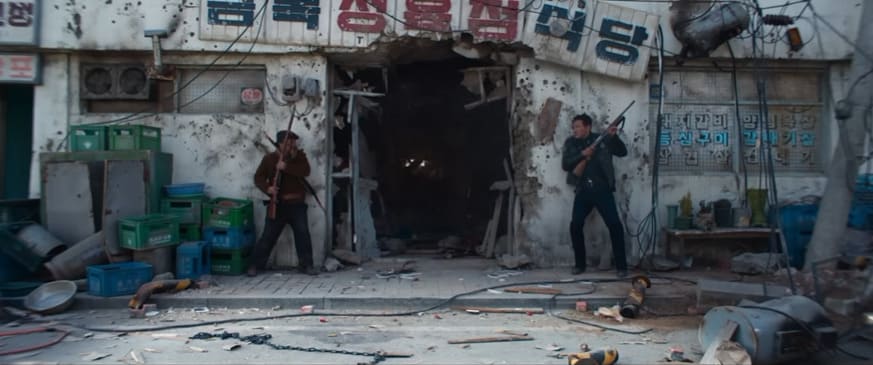
Another decision I absolutely love is the movie’s use of daylight.
Na could have hidden the aliens in darkness, fog or rain. That would have been the easy route. Instead, Hope frequently lets the audience see the destruction clearly. Mountains, roads, buildings and bodies aren’t swallowed by shadows. The horror sits right there in front of you.
It makes the violence feel strangely physical.
There is no comforting visual barrier between the audience and the disaster. You can see the scale of the destruction, but you can also see how ordinary the environment remains. This isn’t some distant planet or abstract nightmare dimension. It’s a recognizable community being ripped apart in broad daylight.
The effect is brutal, especially when Na mixes the carnage with crude local humor. The tonal shifts can be outrageous. One moment characters are facing something genuinely terrifying, and the next they’re behaving like stressed-out people who have completely lost control of the situation.
Personally, I think that makes the movie more convincing rather than less serious. Real people don’t respond to disaster with perfectly calibrated cinematic dignity. Sometimes they panic. Sometimes they swear. Sometimes they laugh because the alternative is losing their minds.
What the Ending Really Says About Humanity
The ending of Hope isn’t designed to reassure you that humanity has everything under control. If anything, it does the opposite. The movie strips away the comforting idea that intelligence, weapons, institutions or courage will always be enough to solve a crisis.
Sometimes the threat is simply too large.
Sometimes your plans fail.
Sometimes the people you expected to save you don’t know what they’re doing either.
That sounds nihilistic, but Na refuses to let the movie become completely hopeless. His characters continue making choices for one another even when those choices don’t guarantee survival.
| Element | What It Represents |
|---|---|
| Hope Harbor | A closed human community built around familiar fears and relationships |
| The Gh’ertu | An incomprehensible threat that exposes human limitations |
| The DMZ imagery | Human obsession with borders, enemies and political division |
| The title “Hope” | Defiance rather than optimism |
| The perspective shift | The difference between human panic and a larger cosmic reality |
My Take on Hope
What I find most interesting about Hope is that it refuses to behave like the alien blockbuster its marketing might suggest. If you’re expecting a clean military-versus-monster spectacle where every character eventually figures out the rules, this movie can be maddening. Na deliberately withholds the kind of emotional and narrative safety net that mainstream sci-fi usually provides.
And yes, that can be frustrating.
Some of the movie’s ideas are so ambitious that they threaten to overwhelm the characters themselves. The cosmic metaphor, political subtext and shifting perspective aren’t always perfectly balanced with the raw survival story. There are moments when I wanted the film to slow down and let the human drama breathe instead of immediately throwing another piece of chaos at the screen.
But I’d take that messiness over a sanitized alien invasion movie any day.
Hope is at its best when it is uncomfortable, funny, violent and completely unwilling to explain itself in the usual Hollywood language. The aliens matter, but they aren’t really the final subject. The explosions matter, but they’re not the point. Even the mystery of Gh’ertu matters less than what the arrival of those creatures reveals about the people already living in Hope Harbor.
The title ultimately becomes almost cruelly simple. Hope isn’t a reward. It isn’t proof that everything will work out. It isn’t even rational.
Hope is what remains when everything else has failed.
That’s why the movie can spend so much time destroying its own world and still carry that particular title. Na Hong-jin isn’t promising that humanity will defeat the unknown. He’s asking something much more uncomfortable: when defeat is already staring you in the face, what kind of person are you going to be?
For me, that’s what makes the ending stick. Long after the aliens, gunfire and burning buildings fade from memory, the real image left behind is a group of flawed people continuing to choose each other in a situation where the universe clearly doesn’t care.
And honestly, that’s a much harsher definition of hope than most movies are willing to offer.