There’s a moment in The Dog Stars when you realize the movie has been lying to you.
Not in the cheap “everything you saw was a dream” way. Ridley Scott doesn’t need that trick. The film spends hours making you believe Hig’s journey is about finding a place where civilization somehow survived. Then Grand Junction finally appears, glowing with electricity, clean floors, stocked shelves, music, booze, and people acting like the apocalypse was just an awkward vacation.
And somehow, that’s more frightening than the wasteland outside.
Based on Peter Heller’s 2012 novel, The Dog Stars turns a familiar post-apocalyptic setup into something much stranger. Jacob Elordi’s Hig spends years surviving at an isolated Colorado airstrip with his dog Jasper and the brutally practical Bangley, played by Josh Brolin. Hig still wants to believe people are worth saving. Bangley has basically buried that idea along with the rest of civilization.
Then comes the radio signal from Grand Junction.
For Hig, that transmission becomes the one thing keeping his imagination alive. Maybe there are still decent people out there. Maybe there’s a functioning community. Maybe the world didn’t completely end.
After Jasper’s death, Hig finally stops listening to Bangley’s warnings.
He leaves.
And that decision is what carries him straight into the movie’s strangest trap.
Grand Junction Was Hig’s Fantasy Made Real — And That’s the Problem
Hig’s life before Grand Junction is deliberately repetitive.
He flies his 1956 Cessna. He hunts and fishes. He watches the horizon. He remembers Melissa, his dead wife. He worries about the nearby Mennonite settlement and the children there. And he puts up with Bangley, whose philosophy can basically be summarized as: trust nobody, shoot first, survive another day.

It’s bleak, but Hig still has one foot in the old world.
That’s why the mysterious radio transmission matters so much.
The signal coming from Grand Junction isn’t just a practical clue. To Hig, it becomes proof that there might still be something resembling normal human life. A functioning community could mean medicine, safety, companionship, maybe even a reason to stop living like every sunrise is just another extension of the same terrible day.
After Jasper’s death, Hig finally stops listening to Bangley’s warnings.
He leaves.
And that decision is what carries him straight into the movie’s strangest trap.
Pops and Cima Are the First Real Sign That Hig Wasn’t Completely Wrong
Before Grand Junction reveals its ugly side, Hig encounters Pops and Cima.
Guy Pearce’s Pops and Margaret Qualley’s Cima are almost the opposite of the people Hig has been conditioned to expect. They aren’t screaming raiders or paranoid survivalists. They’ve built a quiet existence away from the worst remnants of civilization.
That matters because Cima gives Hig something Grand Junction never can: an actual human connection.
Their relationship develops slowly, which I honestly appreciated. The movie doesn’t suddenly turn into a conventional apocalypse romance. Hig is carrying years of grief, and Cima has her own scars. Their bond feels tentative because it should.
For the first time in years, Hig has a reason to imagine a future rather than simply surviving the present.
Naturally, that’s exactly when the movie starts setting the trap.
Darlene’s Grand Junction Is One of the Weirdest Apocalypse Ideas I’ve Seen
Then we get Grand Junction.
And wow.
The movie practically changes genres.
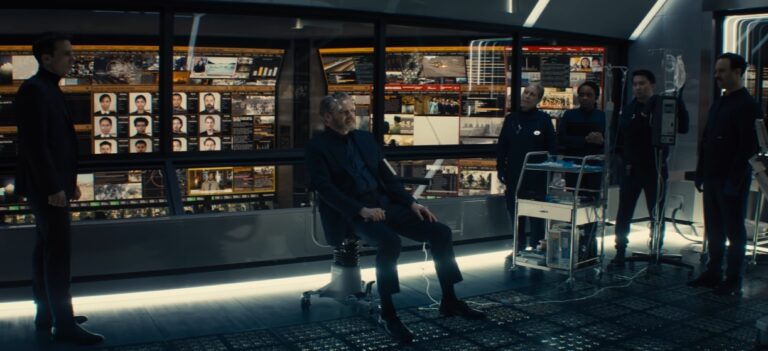
Instead of a ruined airport filled with starving survivors, Hig, Cima, and Pops walk into a functioning pocket of the old world. There’s electricity. Running water. Food. Alcohol. Clean surroundings. Music. People dressed and behaving as though civilization never collapsed.
It should feel like winning the apocalypse lottery.
It doesn’t.
At the center of this bizarre little kingdom is Darlene, played by Allison Janney, who absolutely goes for it. She’s cheerful, theatrical, unsettling and just slightly too comfortable with the situation. Her martini-soaked retro performance gives Grand Junction the atmosphere of a luxury resort operated by someone who has completely lost the plot.
And that’s where the movie gets genuinely creepy.
The radio signal that Hig interpreted as a message of hope is actually bait.
Grand Junction uses the promise of safety to attract outsiders. Once people arrive, they lose control of their situation. Their weapons and possessions are taken, their freedom disappears, and the supposedly civilized community reveals the machinery underneath its polished surface.
That’s the twist.
Grand Junction didn’t preserve civilization. It preserved the worst parts of it.
The hierarchy. The obsession with status. The need to control outsiders. The idea that comfort is worth almost any human cost.
The apocalypse didn’t destroy that system.
It simply removed the laws that used to restrain it.
Why the Grand Junction Reveal Changes the Whole Movie
This is the part I think works best.
Bangley spends the first half of the film looking like the paranoid asshole who is going to be proven wrong.
Hig is the optimist.
Bangley is the cynic.

So naturally, you expect Hig to eventually discover that people are still good.
Instead, the movie gives him something much nastier.
Bangley was right about the danger.
But he was wrong about what survival had to look like.
That distinction becomes crucial.
Grand Junction proves that civilization itself isn’t automatically good. A functioning airport, electricity and full shelves don’t make a society humane. You can rebuild the furniture of civilization without rebuilding its soul.
Darlene’s world is basically a nightmare version of normality.
Everything looks comfortable.
Everything feels wrong.
The Escape Turns the Movie Into a Full-Blown Thriller
Once Hig realizes what Grand Junction really is, the slow western atmosphere disappears.
The escape is messy, violent and desperate.
Hig, Cima and Pops aren’t simply trying to find the exit. They’re trying to get away from people who have built an entire system around controlling anyone unlucky enough to walk through the door.
The contrast is fantastic.
Outside Grand Junction, the world is visibly destroyed.
Inside, everything looks perfect.
Yet the supposedly ruined world offers Hig more freedom than the perfect one.
That’s a pretty brutal joke.
Hig eventually manages to get his group out, rejecting Grand Junction’s version of “safety.” But the movie isn’t finished punishing him for chasing the dream.
Because when they return to Erie, another nightmare is waiting.
The Final Battle: Bangley Was Never Going to Give Up the Airstrip
The return to the airstrip brings the movie back to its roots.
The Reapers attack in force.
Bangley has been left behind, and he has turned the homestead into a fortress. He’s exhausted, armed to the teeth, and fighting with the kind of ruthless precision you would expect from a man who has spent nearly a decade preparing for exactly this situation.
Then Hig comes back.
Only this time, he isn’t alone.
Cima and Pops join the defense, and the meaning of the airstrip changes completely.
Earlier, it was basically a bunker shared by two men with radically different ideas about the future. Now it has become something closer to a family.
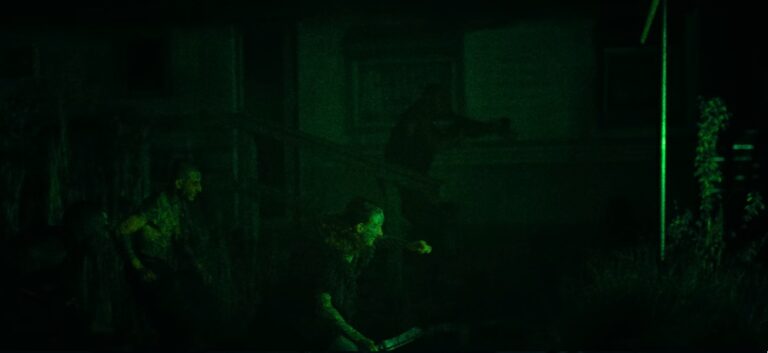
The night-vision combat sequence is particularly nasty, and Scott makes the battle feel less like a heroic victory lap and more like a desperate fight to protect the tiny piece of life these people have managed to build.
The Reapers are defeated, but the important victory isn’t really the body count.
It’s the fact that Hig finally has people worth fighting for.
So What Does the Ending of The Dog Stars Actually Mean?
The easiest interpretation is that Grand Junction represents the false haven while the Erie airstrip becomes the real one.
I think that’s right, but there’s another layer to it.
Hig spends years looking toward the horizon because he’s convinced that somewhere out there is the answer to his grief. Grand Junction becomes the physical version of that obsession. He believes another place can fix him.
It can’t.
The place was never the answer.
The people were.
Cima gives Hig a reason to stop living entirely in the past. Pops represents the kind of trust and cooperation Hig feared he might never find again. Even Bangley changes, albeit in the most Bangley way possible.
He doesn’t suddenly become warm and cuddly.
He simply lets people in.
For a character like Bangley, that’s enormous.
The Dog Stars Ending Explained: The Post-Apocalyptic Twist and Book vs. Movie Differences Analysis
| Character | What Grand Junction Teaches Them |
|---|---|
| Hig | A better future can’t be found by chasing an illusion |
| Cima | Survival doesn’t have to mean isolation |
| Pops | Trust can exist even after civilization collapses |
| Bangley | Protecting people can matter as much as protecting yourself |
| Darlene | Rebuilding the old world without its humanity creates another kind of disaster |
The Dog Stars Ending Is Really About Letting Go
The final mountain imagery and Hozier’s melancholy “Like Real People Do” push the movie into a much quieter emotional space after all that violence.
And that’s exactly where it should go.
Hig has spent years trapped by Melissa’s memory and by the guilt of surviving when so many others didn’t. His obsession with Grand Junction was partly an obsession with finding proof that the world could become meaningful again.
He finally gets that proof.
Just not where he expected.
The old world isn’t coming back.
There won’t be some magical airport where everything is restored to normal. There isn’t a secret button that brings civilization back. Grand Junction is the fantasy of returning to the old world, and Darlene demonstrates exactly how ugly that fantasy can become.
The future has to be something different.
Something smaller.
Something built around people rather than possessions.
And that makes the final image of Hig, Cima, Pops and Bangley beneath the night sky hit harder than a traditional Hollywood victory speech ever could.
They haven’t fixed the world.
They’ve simply found a reason to keep living in it.
That’s what makes The Dog Stars ending work for me. It doesn’t pretend the apocalypse is secretly beautiful. It doesn’t erase the horror, the grief or the violence. Instead, it argues that human connection can survive alongside all of that.
Grand Junction had electricity.
It had food.
It had music, cocktails and the illusion of luxury.
But it didn’t have freedom.
The Erie airstrip has none of those guarantees.
It has something much rarer.
People who actually give a damn about each other.