Warning: major spoilers for Fall and Fall 2: Deadpoint ahead.
There are movies that make you nervous about heights, and then there is Fall 2: Deadpoint, a movie that somehow makes a wooden plank, a piece of rope, and a few meters of empty space feel like the most terrifying things on Earth.
I went into the sequel expecting more of the same formula: beautiful landscapes, impossible climbs, sweaty palms, and characters making decisions that would have me yelling at the screen. What I didn’t expect was just how heavily Fall 2: Deadpoint leans into psychological horror.
The mountain is dangerous, obviously. But the real threat is what happens inside Jax Hunter’s head.
And once the movie reveals what actually happened to Luce, practically every scene before that revelation starts looking different.
A New Mountain, A Different Kind of Nightmare
The first Fall turned a gigantic television tower into one of the most memorable horror locations of recent years. Deadpoint wisely refuses to simply copy that setup.
This time, the nightmare takes place on Mount Kwan in Thailand, where the environment itself feels alive and hostile.
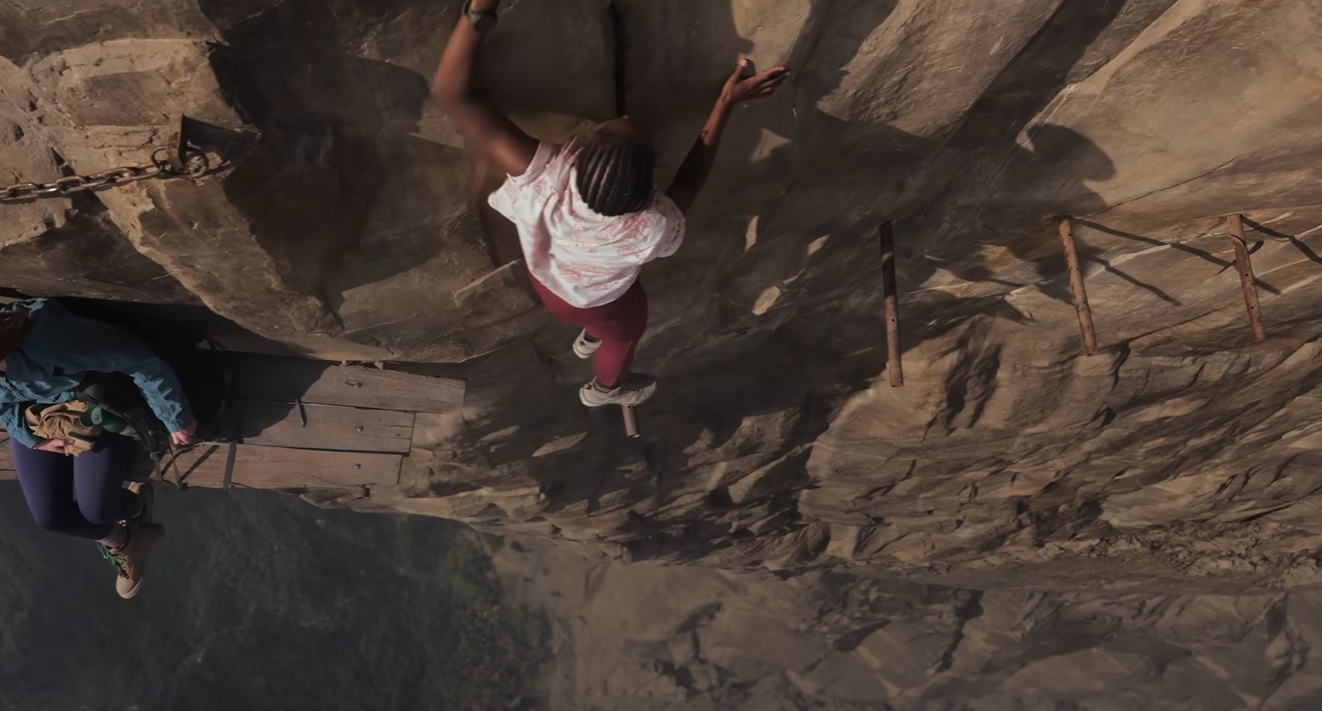
Jax Hunter, played by Harriet Slater, arrives on the mountain carrying far more emotional baggage than climbing equipment. She is still devastated by the death of her older sister, Hunter, and clearly hasn’t found a way to live with what happened.
Then comes Luce.
Played by Arsema Thomas, Luce knew Hunter and appears to offer Jax something she desperately needs: a way to reconnect with her sister’s memory.
The plan sounds almost peaceful on paper. Climb the mountain, reach the legendary Death Dragon statue, and turn the expedition into a tribute to Hunter.
Of course, this is a Fall movie.
Peace was never really on the menu.
| Element | What Makes It Dangerous |
|---|---|
| Mount Kwan | Extreme altitude and unpredictable weather |
| Wooden walkways | Old, unstable and suspended above huge drops |
| Suspension cables | Limited opportunities for escape |
| Hypoxia | Increasing confusion and impaired judgment |
| Jax’s trauma | Makes reality increasingly difficult to trust |
| Luce’s secrets | Destroy the fragile relationship between the survivors |
That combination gives Deadpoint a different flavor from the original. The first film was about being trapped. The sequel is about not knowing whether the person beside you is actually there.
And honestly, that’s much creepier.
The Rockslide That Changes Everything
The expedition goes catastrophically wrong when a massive rockslide tears through the mountain.
Their route is destroyed. Their equipment is lost. Jon Platt, their guide, is killed.
Suddenly Jax and Luce are stranded thousands of feet above the ground on a narrow wooden structure with nowhere safe to go.
This is where the movie starts piling on the physical misery.
Rain turns into freezing conditions. The altitude makes breathing increasingly difficult. Supplies disappear faster than expected. Every movement becomes a calculation because one wrong step means falling into the clouds.
The film repeatedly reminds us that oxygen deprivation isn’t just a physical problem.
It’s a mental one.
At extreme altitude, hypoxia can cause confusion, poor judgment, memory problems and hallucinations. That detail becomes absolutely crucial later because the movie quietly gives itself permission to make us question almost everything we’re seeing.
The clever part is that Jax doesn’t immediately appear obviously delusional.
She still seems functional.
She still argues.
She still climbs.
She still makes plans.
That’s what makes the eventual reveal hit so hard.
Luce Isn’t Telling Jax Everything
Even before the big twist, something feels wrong about Luce.
Her relationship with Hunter clearly goes deeper than Jax initially understands. There are conversations that feel strangely loaded, particularly when the subject turns toward Hunter’s final months.
Luce carries guilt.
Jax senses it.
And because Jax is already emotionally wrecked, every secret becomes another reason to distrust the person who is supposed to be keeping her alive.
This creates one of my favorite aspects of Deadpoint: survival and emotional conflict become the same problem.
Sharing water isn’t simply sharing water anymore.
Trusting someone with a rope isn’t just a practical decision.
Every action carries emotional weight because Jax desperately wants to believe Luce is there for the right reasons.
At the same time, Luce constantly pushes Jax to keep moving, keep climbing and stop surrendering to fear.
That makes her seem like a tough but necessary survival partner.
Until the movie pulls the rug out.
The Fall 2: Deadpoint Twist Explained
Here is where the movie goes completely off the rails—in the best possible way.
During an early attempt to cross a broken section of the suspension route, Luce loses her footing.
She falls.
She dies.
Jax is alone.
That is the reality the film eventually forces us to confront.
The Luce we have been watching for a huge portion of the story was never physically there.
Jax’s mind created her.
And this is not presented as a simple “she imagined her friend” twist. The hallucination becomes an elaborate psychological survival mechanism.
Jax cannot accept that she has once again watched someone close to her fall to their death.
She already lost Hunter.
Her mind simply refuses to experience the same trauma again.
So Luce remains beside her.
She talks to Jax.
She argues with her.
She encourages her.
She helps her make decisions.
She becomes the voice that keeps Jax moving when the real Jax has every reason to give up.
The horrifying implication is that Jax has effectively been surviving alone while believing she had a partner.
And suddenly all those earlier conversations take on a completely different meaning.
Why the Hallucination Works
This is where I think Deadpoint gets more interesting than a standard survival sequel.
The hallucinated Luce isn’t just there to surprise the audience. She represents something Jax desperately needs.
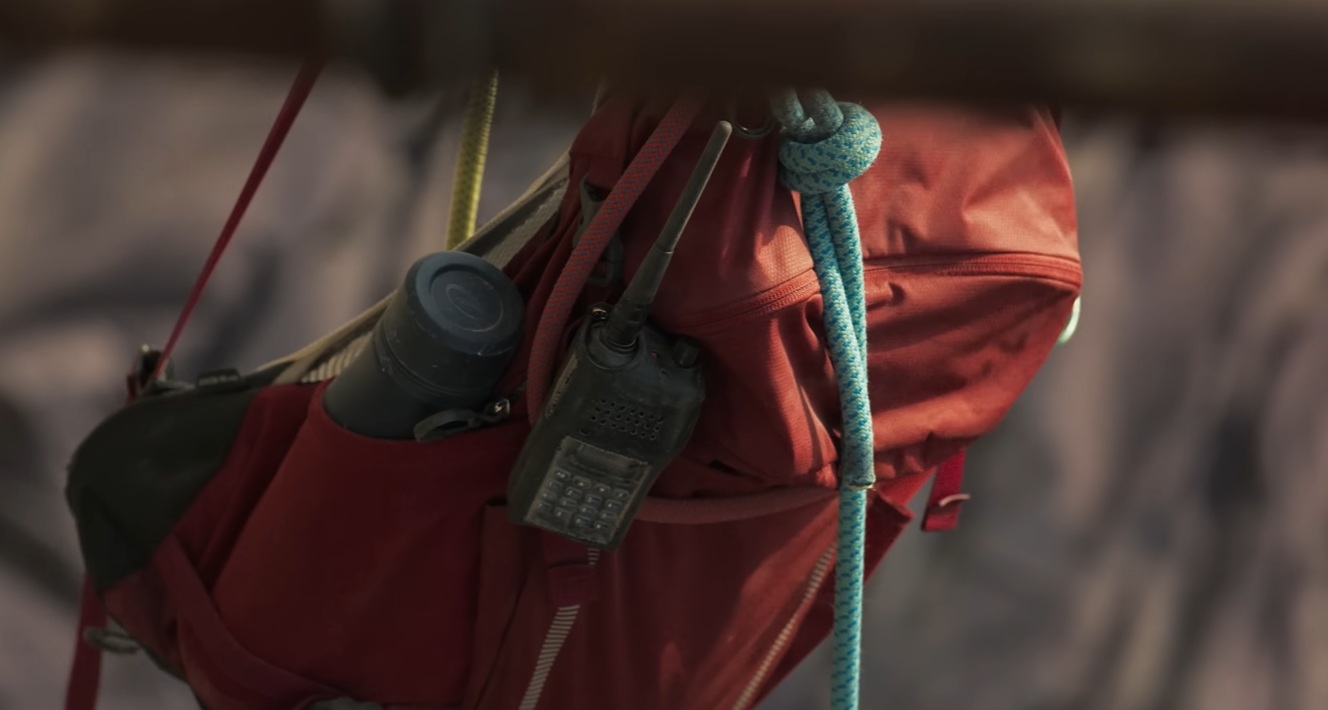
Luce is confidence.
Luce is aggression.
Luce is courage.
Luce is the part of Jax that refuses to die.
That’s why she constantly pushes Jax forward.
When Jax is terrified, Luce isn’t.
When Jax wants to stop, Luce keeps going.
When Jax questions whether she can survive, Luce essentially becomes the answer.
The cruel irony is that Jax’s imaginary companion is more useful than many real movie sidekicks.
But the psychological cost is enormous.
Once Jax realizes the truth, she doesn’t just lose Luce. She loses the mental support system that has kept her alive.
For a moment, she is truly alone.
No imaginary partner.
No guide.
No rescue team.
Just a damaged woman sitting on a collapsing mountain path.
That’s brutal.
The Death Dragon Isn’t Really About the Statue
The Death Dragon becomes one of the movie’s most interesting symbols.
On the surface, it’s simply the destination of the climb. A legendary statue waiting at the summit.
But thematically, it represents Jax’s relationship with fear.
She spends much of the movie trying to defeat fear.
The ending suggests that this is the wrong approach.
Fear isn’t something Jax can simply destroy.
She has to acknowledge it.
Accept it.
Move while feeling it.
That distinction matters because Jax’s survival isn’t presented as her suddenly becoming an action hero. She survives because she finally understands that fear and survival can exist at the same time.
That feels much more convincing than the usual Hollywood transformation where a terrified character suddenly becomes an action hero.
Jax is still terrified.
She’s just moving anyway.
How Jax Escapes Mount Kwan
Once the hallucination breaks apart, Jax has to rely on whatever remains around her.
Using damaged cables and the remaining anchor points, she manages a controlled descent down the mountain.
It’s one of those sequences where I found myself thinking, There is absolutely no way this works.
And that’s exactly why it works.
Every movement feels dangerous because Jax isn’t operating from a position of strength. She’s exhausted, dehydrated, hypoxic and psychologically destroyed.
Eventually, she reaches a safer lower route where rescue teams can find her.
The helicopters arrive, bringing the movie’s physical nightmare to an end.
But emotionally?
Jax is nowhere near okay.
The final imagery deliberately echoes the emotional aftermath of the original Fall. Survival doesn’t erase trauma.
It creates another layer of it.
What the Ending Really Means
The simplest interpretation is that Fall 2: Deadpoint is about grief turning into a survival mechanism.
Jax loses Hunter.
Then she loses Luce.
Her mind refuses to accept another unbearable loss, so it invents a companion capable of carrying the emotional burden she cannot carry herself.
That means Luce is both a hallucination and a representation of Jax’s own survival instinct.
This also explains why Luce is so relentless.
She’s not really another person anymore.
She’s the part of Jax that refuses to die.
And when Jax finally survives without her, she proves that she no longer needs that psychological crutch.
At least, that’s the hopeful reading.
The darker reading is that Jax’s mind has already demonstrated how easily it can rewrite reality under extreme stress. Surviving the mountain doesn’t necessarily mean she’s escaped the psychological damage.
That ambiguity is one of the reasons the ending sticks with you.
Fall 2 Deadpoint 2026 Trailer Review: Plot, Cast, and Vertical Terror Revealed
How Fall 2 Sets Up Fall 3
The sequel also clearly has bigger plans.
The next chapter is expected to connect Jax with Becky Connor, the survivor from the original Fall.
That is a genuinely interesting direction because these aren’t just two random characters who happen to have survived dangerous climbs.
They have experienced remarkably similar psychological trauma.
Both have watched someone close to them die.
Both have been pushed to the edge at extreme heights.
And both have experienced hallucination-like manifestations connected to the people they lost.
Putting Becky and Jax together could turn Fall 3 into something much more psychologically complicated than another giant-location survival movie.
Imagine these two women trying to decide whether they can trust what they see.
Imagine one of them hallucinating and the other not knowing whether to believe her.
After Deadpoint, the franchise has essentially changed its own rules.
We can no longer automatically trust the frame.
That’s dangerous territory for a thriller.
My Take on Fall 2: Deadpoint
I honestly think Fall 2: Deadpoint works because it understands that simply making the mountain bigger wouldn’t have been enough.
The original movie gave us an enormous tower.
The sequel gives us something more unpredictable: a landscape where weather, altitude, unstable structures and the human brain can all turn against the protagonist at once.
The hallucination twist is the biggest gamble, and I can already imagine viewers being divided over it. Some people will love the psychological angle. Others will probably argue that the movie cheats by hiding Luce’s death for so long.
Personally, I’m on the side of the twist.
Not because it’s perfectly realistic in every detail, but because it gives the sequel an identity of its own.
The most frightening moment isn’t Jax hanging thousands of feet above the ground.
It’s the moment she realizes she has been alone.
That’s the image I walked away with.
Not the mountain.
Not the Death Dragon.
Not even the helicopters.
Just Jax sitting there, finally understanding that the voice keeping her alive was coming from inside her own broken mind.
And if Fall 3 really brings Becky and Jax together, that psychological baggage could make the next climb even nastier.
After all, we’ve already learned the biggest lesson of this franchise:
The most dangerous thing at the top isn’t always the fall. Sometimes it’s what your mind does when there’s nowhere left to run.