Mayday is the kind of movie that starts out looking like a straightforward Cold War adventure and gradually turns into something much more personal. Released by Apple TV on September 4, 2026, Jonathan Goldstein and John Francis Daley’s film throws Ryan Reynolds and Kenneth Branagh together as two men who should have absolutely no reason to trust each other. Somehow, that unlikely pairing becomes the entire point of the movie.
Set in 1987, the story follows U.S. Navy pilot Lieutenant Troy “Assassin” Kelly after his reconnaissance aircraft is shot down over Soviet territory. Troy is stranded, hunted and very much out of his element. His situation changes when he encounters Nikolai “Nick” Ustinov, a former KGB operative living away from Soviet society. Nick is fascinated by America, especially its movies, music and mythology, while Troy initially sees the Soviet Union in much simpler terms: enemy territory, enemy people, get home alive.
That difference in worldview gives Mayday much more personality than a conventional spy comedy. The explosions are fun, the action gets increasingly ridiculous, and Reynolds is clearly having a great time, but the movie’s emotional core belongs to the friendship between Troy and Nick. The ending works because both men eventually realize that the other one is no longer just a means of survival.
Why Troy and Nick’s Friendship Matters So Much
Troy enters the story with the confidence of someone who has spent his entire life believing that being American automatically puts him on the right side of history. His swagger is entertaining, but there is insecurity underneath it. His father, Harold Kelly, is seriously ill back home, and Troy carries the pressure of being the family member who is supposed to succeed, serve his country and come home as a hero.
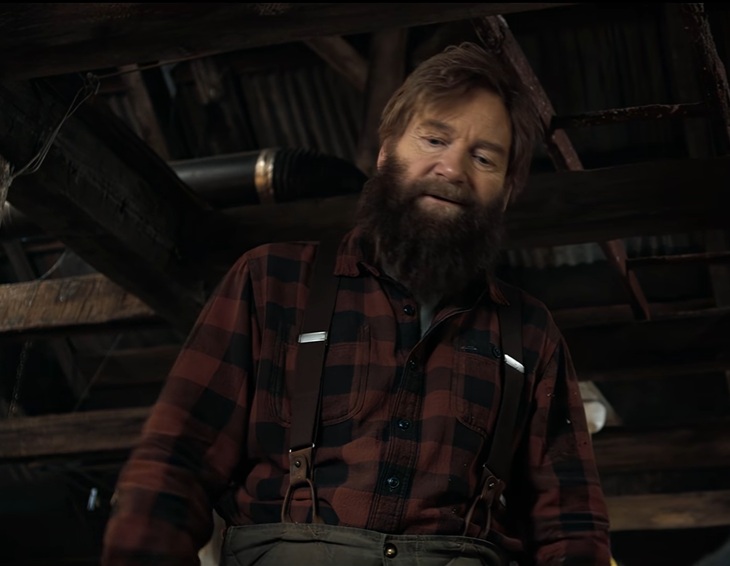
Nick is almost his complete opposite. He has already lived through the consequences of blindly serving an institution. His former KGB career left him estranged from his daughter Anna and deeply ashamed of the person he became. His decision to abandon that life was not some glamorous act of rebellion. It was an admission that he could no longer recognize himself.
One of the film’s strongest ideas is that Troy and Nick are both running away from systems that have defined them. Troy is trying to prove that the American military will always protect one of its own. Nick desperately wants to believe that the America he has imagined for years actually exists.
That makes their original deal deceptively important. Troy promises to help Nick reach America and secure a future there. Nick, in return, uses his knowledge of Soviet territory and intelligence operations to keep Troy alive. At first, this is basically a transaction. By the finale, neither man is willing to treat it that way anymore.
Did Nick Really Betray Troy?
This is where the Mayday ending gets interesting. Nick appears to turn against Troy when their escape is getting close, and for a moment the movie makes it look as though his old loyalties have resurfaced.
They haven’t.
Nick’s apparent betrayal is really a reaction to what he discovers about Troy’s own government. The documents he encounters suggest that American command is prepared to sacrifice Troy if doing so protects the classified mission. That discovery completely changes the situation for Nick.
He has spent years believing that America represents freedom, opportunity and basic human decency. Now he is confronted with the possibility that the American government may regard both him and Troy as disposable pieces on a much larger board.
There is also a more personal problem. Nick needs to know whether Troy actually means what he said about helping him. His fear is not simply that Soviet authorities will catch him. He is terrified that he will survive the journey only to discover that America has no place for a former KGB officer.
The question Nick asks earlier about whether an American would open the door to someone asking for help becomes especially important here. Troy’s answer sounds confident, but there is enough hesitation to expose the gap between the idealized America they talk about and the complicated country that actually exists.
Nick also has Anna to worry about. His daughter’s situation makes his escape more complicated and gives his decisions a much greater emotional weight. He isn’t simply chasing the American dream for himself anymore.
Personally, I think this is one of the better choices in the movie. A less ambitious version of Mayday could have turned Nick into the lovable Russian sidekick who simply wants hamburgers and American movies. Instead, the film gives him genuine reasons to distrust both sides.
The Final Escape: Troy Makes His Choice
The movie eventually goes completely off the rails in the best possible way.
Troy and Nick find themselves at a heavily guarded Soviet airfield, and their escape involves an aircraft, military forces and the sort of escalating chaos that makes it obvious this is not trying to be a historically restrained Cold War thriller.
After surviving the confrontation with Alexander Volkov and getting airborne, Troy finally sees what should be the finish line: an American aircraft carrier waiting across the ocean.
Except there is one enormous problem.
The carrier wants Troy to land, but Nick is a former KGB operative. From the military’s perspective, that means Nick is not simply a refugee who can walk onto American soil. He is an intelligence asset and potential enemy who needs to be detained and interrogated.
Troy refuses to accept that.
Instead of following orders, he turns the entire situation into an outrageous high-stakes negotiation. He shuts down the aircraft’s engines and tells the carrier command that he will not land until someone with the proper authority guarantees Nick permanent asylum.
It’s completely reckless. It’s also the moment Troy finally proves that his patriotism means something beyond slogans.
For most of the movie, Troy talks about America as though it is a perfect system. Here, he finally challenges that system when it fails to live up to the ideals he has been shouting about. He is no longer protecting his own reputation. He is putting everything on the line for Nick.
The standoff eventually reaches Assistant Director Meadows, who has the authority to make the decision. Nick is granted permanent asylum, and Troy finally agrees to bring the aircraft in.

| Character | What They Want | What They Learn |
|---|---|---|
| Troy Kelly | Return home and prove himself as a hero | Loyalty means challenging the system when it is wrong |
| Nikolai Ustinov | Escape the Soviet Union and reach America | Freedom is more complicated than the fantasy he created |
| Anna Ustinov | Safety away from Soviet control | Her father’s decision gives her a chance at a different future |
Why Troy Risks Everything for Nick
The carrier sequence is more than a flashy action finale. It completes Troy’s character arc.
At the beginning, Troy believes being a good American means following the rules, winning the mission and coming home. By the end, he understands that institutions can be wrong and that loyalty to a friend can sometimes require disobeying orders.
That’s why his decision to stop the aircraft matters. He has finally stopped talking about American ideals and started acting on them.
There is also a nice bit of irony here. Nick came to America believing it was the ultimate symbol of freedom. Troy, the American, discovers that freedom isn’t something a government simply hands to people. Sometimes someone has to fight for it.
What Happens to Troy After the Rescue?
You might expect Troy to be celebrated as a perfect military hero after pulling off the impossible escape. Mayday takes a much more amusing route.
Instead of quietly returning to normal service, Troy uses the classified information collected during the ordeal to confront the American government. He testifies before Congress and uses his newfound leverage to force attention onto his father’s medical and financial situation.
It is a wonderfully Troy-like move. He doesn’t suddenly become a different person. He simply learns how to use the system’s own machinery against it.
The consequences still catch up with him. Troy is placed on permanent leave, effectively bringing his active military career to an end. But considering everything he has just survived, he seems more than ready for a life outside the cockpit.
Nick Finally Gets His American Dream
Nick’s ending is much warmer.
After spending years imagining America from the other side of the Iron Curtain, he finally gets to experience the real thing. Naturally, that includes American fast food, road trips and a van.
There is a deliberate joke running through these scenes. Nick has spent much of his life romanticizing America, only to discover that the reality is considerably messier. He doesn’t seem disappointed, though. If anything, he enjoys the absurdity of finally getting what he wanted.
Most importantly, Nick remains connected to Anna. She is safe, and he no longer has to choose between his daughter and the life he wants.
The Final Bar Scene Explained
The last major scene brings Troy and Nick together again in a bar. Troy is enjoying his newfound freedom when Nick arrives with an offer: join him on a road trip across America.
Troy doesn’t give him an immediate answer. Instead, he takes his time finishing his drink and suggests that he will decide afterward.
It’s a small joke, but it fits the entire relationship perfectly. These two men began their journey as complete strangers from opposing sides of the Cold War. By the end, Nick doesn’t need a dramatic speech to convince Troy to come with him.
They have already survived the impossible together.
The wide shot of Washington, D.C. as the movie closes reinforces that the story has moved far beyond the original mission. Troy wanted to get home. Nick wanted to get to America. What they actually found was friendship.
Mayday Mid-Credits Scene: Where Did “Assassin” Come From?
And then the movie gets one last joke in.
Troy’s call sign, “Assassin,” sounds exactly like the sort of nickname a legendary fighter pilot would earn after an incredible act of military heroism. The movie spends enough time letting Troy act proud of it that you naturally start wondering what happened.
The mid-credits scene reveals that the truth is considerably more embarrassing.
Troy didn’t earn the name because he was some terrifyingly effective combat pilot. His nickname came from a ridiculous accident during an earlier training exercise. His lack of awareness and a spectacular technical mistake resulted in him destroying something that absolutely did not deserve to be attacked.
The “Assassin” title was essentially a joke at his expense.
It’s exactly the kind of punchline that suits Ryan Reynolds’ version of Troy. The character spends the entire movie presenting himself as an unstoppable military badass, only for the final joke to remind us that his legendary reputation is mostly self-confidence and questionable judgment.
What the Mayday Ending Is Really Saying
For all its aircraft stunts and Cold War spectacle, Mayday 2026 isn’t really interested in telling us which country is the hero. The movie is more interested in what happens when ordinary people stop seeing each other as representatives of opposing systems.
Troy starts by seeing Nick as a Soviet problem. Nick initially sees Troy as his ticket to America. Neither relationship is particularly noble at first.
But the journey changes them.
Troy learns that patriotism without empathy is empty. Nick learns that his fantasy of America was never quite the same thing as the real country. And both discover that trust can exist even between people raised to think of each other as enemies.
That is why the ending works better as a buddy-comedy payoff than as a traditional espionage conclusion. The movie doesn’t need another villain, another secret Soviet conspiracy or a sequel hook. It simply leaves Troy and Nick with the possibility of a road trip, which feels surprisingly appropriate.
The final joke about the “Assassin” nickname seals the deal. After all the politics, military orders and Cold War paranoia, Mayday ultimately chooses to end on two flawed guys who survived an absurd adventure and became friends along the way. For me, that’s much more satisfying than another obligatory franchise setup.
Mayday’s ending is ultimately about choosing people over institutions. Troy chooses Nick when the military would rather classify him as a problem. Nick chooses Troy when trusting an American becomes more frightening than trusting his former enemies. Neither man gets the perfect version of the world he imagined, but both walk away with something better: a genuine second chance.
And if that second chance includes an old van, terrible fast food and an aimless drive across America, Nick seems perfectly happy with the deal.