If there’s one thing I didn’t expect from The Dog Stars, it was to come away thinking about Jacob Elordi more than Ridley Scott.
This is, after all, Ridley Scott doing post-apocalyptic science fiction. The man has spent decades building worlds where humanity gets crushed under impossible circumstances, from Alien to Blade Runner to The Martian. Then you throw Jacob Elordi into the middle of a dead America, give him a battered plane, a dog, a toolbox, a grief problem the size of Colorado, and basically tell him: keep going.
And honestly? He does.
The Dog Stars, adapted from Peter Heller’s 2012 novel and released in theaters on August 28, 2026, is a strange beast. It’s gorgeous. It’s lonely. It can be genuinely moving. It can also be painfully slow, occasionally awkward, and weirdly unsure what kind of movie it wants to become.
But Elordi gives it a pulse.
Jacob Elordi Gets a Very Different Kind of Leading Role
Elordi has spent the last few years building a pretty fascinating career. He’s been arrogant, damaged, unsettling, romantic, ridiculous and downright monstrous depending on the project.
Hig is none of those things.
He’s just a guy trying to stay alive.
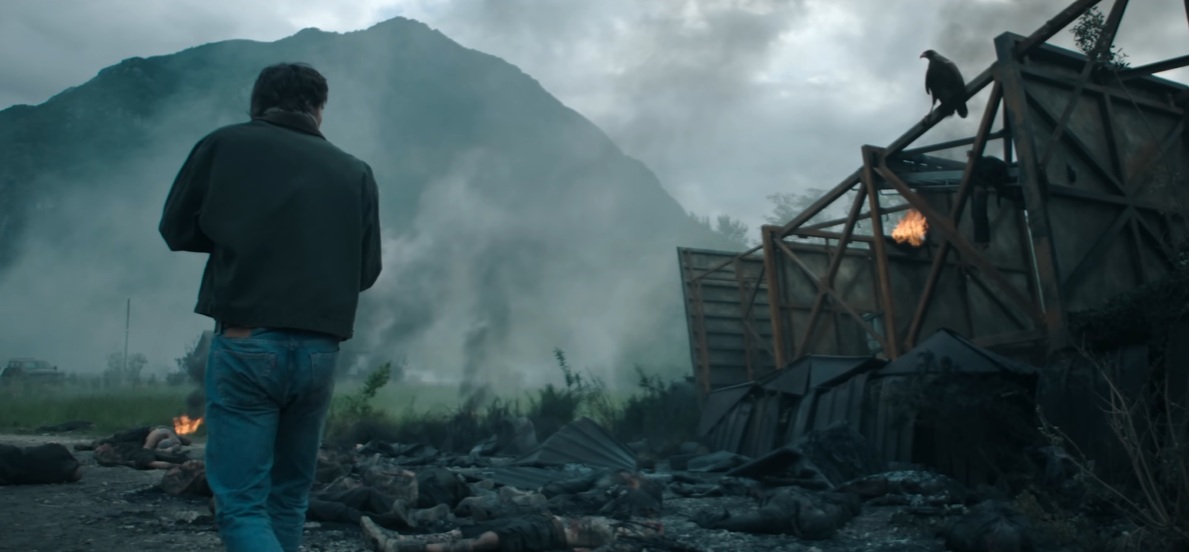
That sounds simple, but it’s actually a surprisingly difficult role. There’s no flashy transformation, no big villain monologue, no constant stream of heroic one-liners. Hig spends huge stretches of the movie alone, fixing machinery, flying his Cessna, remembering his dead wife and talking to his dog Jasper.
That puts almost everything on Elordi.
And I think this is where The Dog Stars becomes most interesting.
He doesn’t play Hig like an action hero. He plays him like someone who has already lost the life he wanted and is now moving through the wreckage because stopping would mean confronting everything he has buried.
There’s something almost painfully gentle about him.
The beard, worn work clothes and baseball cap make him look like he belongs in this environment, but Elordi never turns Hig into some macho survivalist fantasy. His physical size is actually used against the usual Hollywood image of the towering leading man. He often looks exhausted rather than intimidating.
That works.
Especially when he’s with Jasper.
Those scenes are some of my favorites because they don’t feel like the movie is desperately trying to tell us, LOOK, THIS MAN HAS A SOUL. Elordi simply lets the relationship breathe. A glance at the dog. A quiet touch. A few words. That’s enough.
The Apocalypse Actually Feels Empty
One of Scott’s smartest decisions is refusing to make this another apocalypse where every five minutes something explodes.
The world has already ended.
Now people are living in the leftovers.
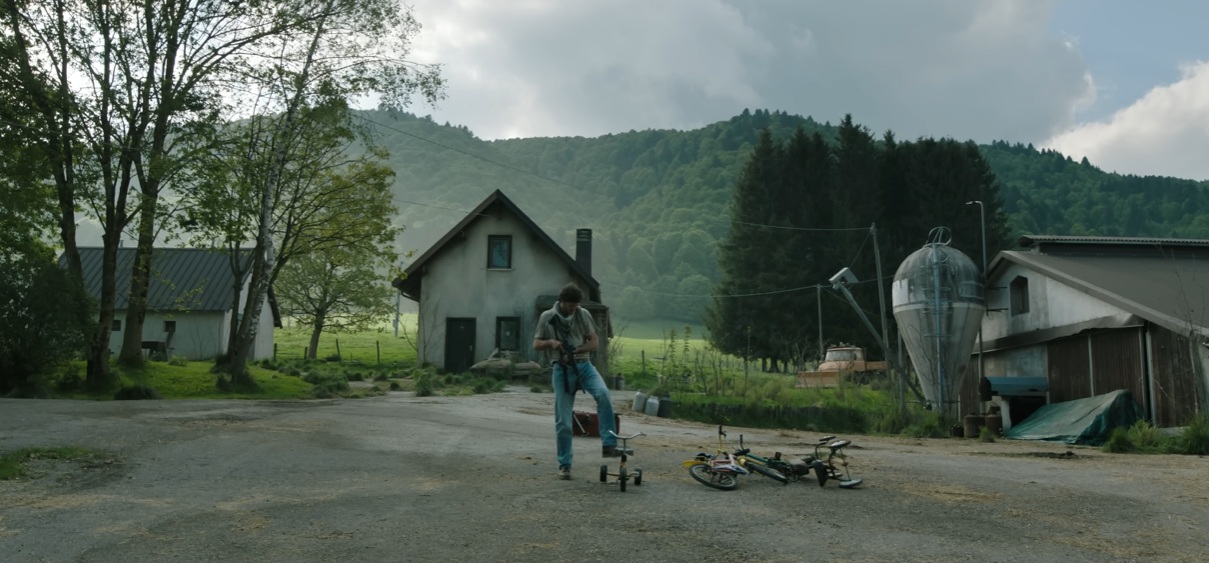
Hig’s home is an abandoned airplane hangar in Erie, Colorado, surrounded by an overgrown landscape that looks beautiful and completely wrong at the same time. Civilization hasn’t disappeared entirely, but it has been pushed into the background.
Nature is taking over.
Buildings are rotting.
Roads are empty.
And somewhere out there are the Reapers, violent survivors who have turned desperation into a lifestyle.
The cinematography from Erik Messerschmidt gives the whole thing an almost dreamlike quality. There’s a lot of space in these images. Too much space, sometimes. That’s clearly intentional, but I’ll admit there were moments when I wanted Scott to just move the story along.
Still, the atmosphere sticks with you.
This isn’t an apocalypse built around spectacle. It’s built around absence.
And that makes Hig’s loneliness feel much more believable.
Hig and Bangley Are the Movie’s Secret Weapon
If Elordi carries the emotional side of the movie, Josh Brolin carries the entertainment.
His Bangley is basically the human embodiment of absolutely not trusting anybody.
He’s an ex-Marine survivalist with guns, paranoia and enough bad attitude to power the entire hangar. Hig wants to believe there’s still something worth saving in humanity. Bangley assumes everyone outside their little bubble is one bad decision away from killing them.
Naturally, they work brilliantly together.
Their relationship feels less like the standard “two mismatched survivors” setup and more like two guys who have accidentally become brothers because the end of the world left them with nobody else.
Brolin gets the louder material, but Elordi knows exactly when to push back and when to let Bangley rant himself into a wall.
The contrast is fantastic:
| Character | Survival Philosophy |
|---|---|
| Hig | Survival means protecting what remains of your humanity |
| Bangley | Survival means assuming everyone is a threat |
| Cima | Survival means finding reasons to trust again |
That triangle gives the movie its emotional foundation.
Then Margaret Qualley Shows Up
The second half changes the movie considerably.
After a devastating event tears Hig away from the routine he has built, he follows a mysterious radio signal beyond his usual boundaries. That takes him toward Pops and Cima, played by Guy Pearce and Margaret Qualley.
Qualley immediately changes the energy.
I liked this section a lot more than I expected.
The relationship between Hig and Cima isn’t rushed into some glossy post-apocalyptic romance. Both characters have suffered. Both are cautious. Neither has much reason to trust another person.
So their connection develops slowly.
That restraint is important.
Elordi is particularly good here because Hig finally gets someone to react to rather than simply remember. You can see him becoming more open without the performance suddenly turning into a giant emotional speech.
There’s still grief underneath everything.
But now there’s also possibility.
And for a movie obsessed with loneliness, that matters.
Where The Dog Stars Loses Me
Here’s the problem: I’m not convinced the movie always understands the difference between slow and dragging.
The opening is deliberately quiet. I get it.
Hig flies.
Hig scavenges.
Hig fixes things.
Hig watches the horizon.
Hig remembers.
Then he flies some more.
There are sequences where the emptiness is genuinely powerful. There are others where I found myself thinking, Okay, Ridley, I get it. The world is empty.
At around 118 minutes, The Dog Stars isn’t even particularly long. Somehow, parts of it feel longer than movies that run three hours.
The screenplay by Mark L. Smith doesn’t always help.
Hig is supposed to be an understated character, but sometimes “understated” slips into “not enough character.” This is where the divided critical reaction makes sense. Some viewers will see Elordi’s quietness as vulnerability. Others will see a blank canvas.
I landed somewhere in the middle.
I think Elordi is doing more than the script gives him credit for, but I also think the script occasionally leaves him stranded.
Elordi’s Biggest Challenge Is Playing a Nice Guy
This sounds ridiculous, but I think it’s the key to understanding the performance.
Elordi is extremely good at playing people who make you uncomfortable.
Give him a morally questionable character and suddenly there’s tension in every little movement. He knows how to make unpleasant people fascinating.
Hig doesn’t have that luxury.
He’s compassionate. He’s practical. He wants to help people. He loves his dog. He misses his wife.
That’s harder to make interesting than it sounds.
And yes, there are moments when Elordi’s performance feels too closed-off. The lowered gaze and hat hiding his eyes can create emotional distance rather than intimacy. Some of the dialogue lands with a shrug instead of a punch.
But I don’t think that makes him miscast.
If anything, it makes The Dog Stars an interesting test of what kind of leading man Elordi wants to become.
He doesn’t need to dominate every scene.
He needs to make us care when nothing is happening.
Sometimes he succeeds beautifully.
Sometimes the movie asks him to carry silence for too long.
The Weird Third Act
Then comes the part where I basically stopped knowing what movie I was watching.
The quieter character drama suddenly collides with a much more exaggerated action sequence involving Allison Janney. The tonal shift is… rough.
Not disastrous.
Just strange.
You spend so much time watching Hig and Cima cautiously rebuild a tiny piece of human connection, and then the movie suddenly remembers it is supposed to be a Ridley Scott sci-fi thriller.
The visual effects don’t always help either. Some sequences look appropriately huge and cinematic, while others have that slightly unfinished quality that pulls you out of the moment.
It feels like two different movies fighting over the same ending.
And unfortunately, neither one completely wins.
Is The Dog Stars Movie Faithful to Peter Heller’s Novel? Chapter Accuracy Analysis
So, Does Jacob Elordi Actually Nail It?
Mostly, yes.
I wouldn’t call Hig Elordi’s most technically impressive performance. His darker roles give him more obvious material to work with. But The Dog Stars proves something more useful: he can hold a movie together without constantly demanding attention.
That’s a different skill.
His best scenes aren’t the big dramatic moments. They’re the tiny ones. Hig looking at Jasper. Hig working on an engine. Hig listening to a radio transmission. Hig cautiously talking to Cima.
There’s a sadness underneath him that never completely disappears.
And that’s what stayed with me.
My Take
| Category | Rating |
|---|---|
| Jacob Elordi | 8/10 |
| The Dog Stars | 6.5/10 |
| Atmosphere | 9/10 |
| Elordi & Qualley Chemistry | 8.5/10 |
| Elordi & Brolin Chemistry | 9/10 |
| Pacing | 5/10 |
The Dog Stars isn’t the flawless sci-fi comeback some people may have hoped for from Ridley Scott. It’s messier than that. The pacing drags, the screenplay occasionally struggles to define Hig, and the final act doesn’t quite belong to the movie that came before it.
But I’d still recommend it.
Mostly because there’s something oddly refreshing about watching an enormous Hollywood production care about small things: a dog, an old airplane, a meal, a radio signal, a person deciding whether another person is worth trusting.
And Jacob Elordi fits that world better than I expected.
He doesn’t turn Hig into a superhero. He doesn’t need to.
He plays him as a wounded guy who keeps getting out of bed because there might still be somebody out there worth finding.
For me, that’s the heart of The Dog Stars.
Not the plague.
Not the Reapers.
Not the guns or the ruined cities.
The idea that after almost everything has been taken away, being human still has to mean something.
That’s a pretty good reason to watch.