Ridley Scott has spent decades moving between enormous historical epics, vicious thrillers, and science fiction that loves to stare directly into humanity’s worst instincts. The Dog Stars is his latest swing at the genre, but this time the apocalypse is frighteningly familiar. There are no aliens invading Earth, no radioactive monsters crawling out of underground bunkers, and no convenient miracle waiting around the corner.
There is a pandemic. Empty roads. Abandoned buildings. Armed survivors. Hunger. Isolation. And people who have decided that civilization is dead, so apparently basic decency should die with it.
Based on Peter Heller’s 2012 novel, The Dog Stars stars Jacob Elordi as Hig, alongside Josh Brolin, Margaret Qualley, Guy Pearce, Allison Janney, and Benedict Wong. Mark L. Smith, who previously worked on The Revenant, handles the screenplay.
And honestly? The movie works best when it remembers that this isn’t really a story about the apocalypse.
It is a story about what kind of person you become after the world stops rewarding you for being a good one.
A World That Already Lost
The film takes place in a devastated near-future United States after a catastrophic influenza pandemic wipes out most of the population. Civilization hasn’t simply collapsed. It has been stripped down to scattered pockets of survivors trying to keep themselves alive one more day.

The setting around Erie, Colorado, gives the movie a particularly grim visual identity. Nature is reclaiming roads and buildings, abandoned commercial spaces sit empty, and the remains of Denver loom nearby like a monument to everything humanity managed to lose.
Scott doesn’t need to throw constant destruction at the screen. Some of the most unsettling images are quiet ones.
An empty road.
A dead shopping district.
An abandoned airfield.
A radio that suddenly comes alive.
That restraint is one of the film’s biggest strengths. The world feels dangerous because it feels empty.
Hig and Bangley: Two Ways to Survive
At the center of The Dog Stars is Hig, a former civilian pilot and mechanic played by Jacob Elordi. He has already suffered the kind of loss that could turn almost anyone bitter. His pregnant wife died during the pandemic, leaving him emotionally stranded even before society completely disappeared.
His closest companion is Jasper, his loyal dog, and the pair live at an abandoned airport hangar.
Well, technically Hig doesn’t live alone.
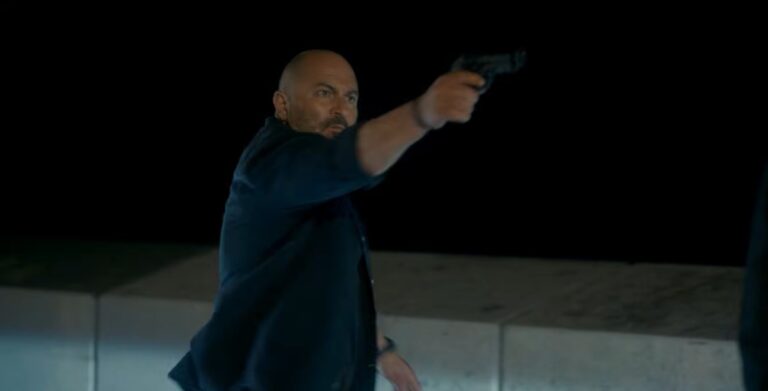
He shares the place with Bangley, played by Josh Brolin, a former Marine and heavily armed survivalist who looks at every unfamiliar person as a potential executioner.
Their relationship is one of the movie’s best ideas.
Hig still wants to believe people can be decent.
Bangley thinks that belief will get them killed.
Neither man is completely wrong.
Hig flies his Cessna across the surrounding territory, searches for supplies, repairs equipment, and occasionally helps a nearby Mennonite community. Bangley handles the ugly business of keeping their compound secure.
Their basic philosophies can be reduced to this:
| Character | Survival Philosophy |
|---|---|
| Hig | Humanity is still worth protecting |
| Bangley | Trust is a luxury that gets people killed |
| Cima | Survival requires knowledge, adaptability, and connection |
| Pops | Protect your family first, question everyone else later |
That tension gives the first half its personality. Hig and Bangley aren’t exactly friends in the conventional sense. They’re two damaged men who have discovered that they need each other.
And Scott wisely refuses to make Bangley a simple villain. He’s harsh, paranoid, and frequently terrifying, but his paranoia isn’t completely irrational.
The apocalypse has proven him right more than once.
Then the Radio Speaks
The plot finally kicks into motion when Hig is flying his Cessna and catches a mysterious radio transmission.
Someone is out there.
The signal appears to originate near Grand Junction, Colorado, far beyond the comfortable boundaries of Hig and Bangley’s little world.
It’s a tiny moment, but it changes everything.
For Bangley, the transmission is practically an invitation to disaster. Why search for strangers when strangers might be exactly what killed everyone else?
Hig hears something completely different.

Hope.
Maybe there’s a functioning community somewhere. Maybe there are people rebuilding. Maybe the world isn’t entirely gone.
That difference is what drives Hig toward the film’s central decision.
He needs to find out.
Jasper’s Death Changes Everything
The movie becomes much darker when the Reapers enter the story.
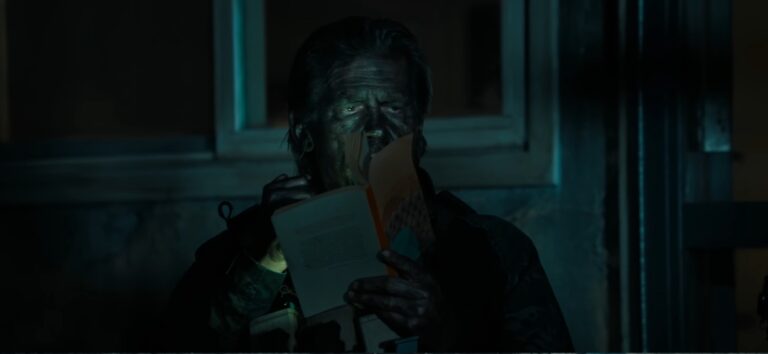
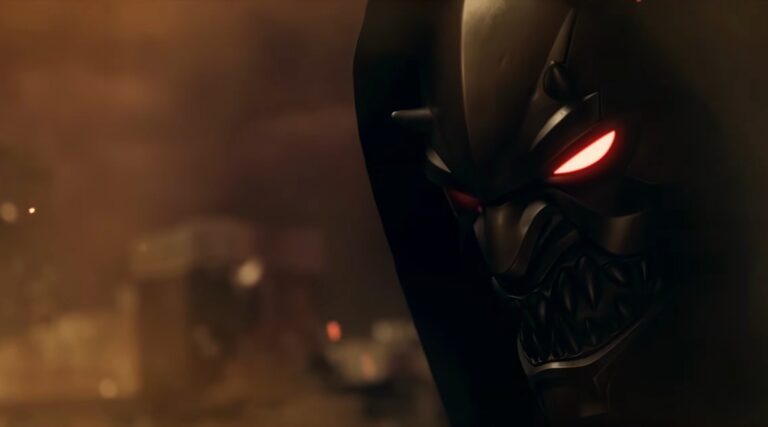
These roaming scavengers aren’t interested in rebuilding society. They’re interested in taking what other survivors have managed to keep. Their presence turns the airport from a fragile refuge into a target.
During one of the violent confrontations, Jasper is killed.
This is where the emotional stakes become personal in a way that the movie’s broader apocalypse material sometimes can’t quite match.
Hig has already lost his wife. Now he loses the one companion who represented unconditional affection and the life he still remembered.
And suddenly the airport doesn’t feel like home anymore.
So Hig makes a reckless choice.
He takes his Cessna west.
There is limited fuel. There is no guarantee the radio signal represents anything good. He knows the journey could leave him stranded or dead.
He goes anyway.
I liked this decision because it isn’t framed as some heroic adventure. Hig isn’t chasing treasure or trying to save the world. He’s trying to prove that there is still something worth finding.
Cima and Pops Bring the Humanity Back
Hig eventually encounters Cima, played by Margaret Qualley, and her father Pops, played by Guy Pearce.
Their existence offers something Hig hasn’t had in a long time: a glimpse of ordinary human connection.
Cima is resourceful and has medical knowledge, while Pops is fiercely protective and understandably suspicious of outsiders. He isn’t exactly thrilled to have a stranger wandering into their lives.
That makes the developing relationship between Hig and Cima feel much more believable.
There isn’t an instant romantic transformation.
There is grief.
Awkwardness.
Suspicion.
Small moments of trust.
Then something resembling affection.
That slower development is essential because The Dog Stars is far more convincing when it allows characters to breathe. The film understands that after years of violence and isolation, simply sitting beside another person can carry more emotional weight than another shootout.
Cima and Pops also challenge Hig’s increasingly bleak understanding of survival. Maybe survival isn’t only about ammunition, fuel, food, and defensive walls.
Maybe having someone to come home to is part of survival too.
Grand Junction Gets Weird
The story takes a much more chaotic turn once Hig gets closer to the source of the radio transmission.
This is where The Dog Stars shifts gears.
The quiet survival drama starts colliding with stranger, more unstable communities. The movie becomes more violent and unpredictable, and the Reapers once again become a major threat.
One of the film’s strangest additions is Allison Janney’s character, whose retro Pan Am-style flight-attendant appearance feels almost surreal against the ruined American landscape.
And that’s deliberate.
The further Hig travels from the controlled environment of the airport, the more bizarre the remnants of civilization become.
Some people are rebuilding.
Some are hiding.
Some have completely abandoned normal morality.
Others seem to be pretending that the old world never ended.
The result isn’t always perfectly balanced. I’ll be blunt about that. The third act can feel like the movie suddenly remembers it has an action-movie budget and starts spending it. After the patient character work, the escalation can be jarring.
But when it lands, it lands hard.
The Reapers Turn Survival Into War
The final confrontations put every major character’s survival philosophy under pressure.
Bangley’s weapons and military experience suddenly become invaluable.
Hig’s flying skills and mechanical knowledge matter.
Cima’s medical expertise becomes essential.
Pops’ determination to protect his family is pushed to its limit.
The action gets nasty, too. There are brutal encounters with raiders, heavy weapons, aircraft-related danger, and sequences where Bangley’s carefully prepared defenses finally erupt into outright violence.
Scott clearly knows how to stage this material.
The problem is that some of the spectacle threatens to overwhelm what made the story interesting in the first place.
I wanted more of Hig sitting in silence with Cima.
More of the strange little details of their survival.
More of Bangley revealing the person hiding underneath all that armor.
The action is effective, but the quieter material is where The Dog Stars has its teeth.
What The Ending Is Really Saying
The ending ultimately returns to the question that has been hanging over Hig since the beginning:
What is survival actually for?
Bangley has one answer. Stay alive. Secure the perimeter. Never trust anyone. Shoot first.
And to be fair, his methods work.
Hig has another answer.
You survive so that you can eventually live again.
That’s the difference between them.
The movie doesn’t completely reject Bangley’s worldview. That would be dishonest. His caution keeps people alive. His preparation matters. His willingness to do horrible things protects the people around him.
But Hig’s philosophy gives those sacrifices meaning.
The surviving characters aren’t simply trying to avoid death anymore. They’re trying to build something resembling a home.
That gives The Dog Stars a surprisingly hopeful ending without turning it into sentimental nonsense.
The world is still broken.
The old civilization isn’t magically coming back.
There is no clean reset button.
But Hig, Cima, Pops, and the others have something that matters more than another pile of supplies.
They have each other.
My Take on The Dog Stars
What surprised me most about The Dog Stars is how much I preferred its uncomfortable, quiet stretches to its biggest action sequences.
Ridley Scott obviously knows how to make a violent post-apocalyptic thriller look enormous. That’s not the question.
The more interesting achievement is the film’s depiction of loneliness.
Hig isn’t simply lonely because there are fewer people around. He’s lonely because the world that gave his life meaning disappeared. His wife is gone. His old routine is gone. His country is barely recognizable. Even his memories feel like something he can’t safely touch anymore.
That’s why the radio transmission matters so much.
It’s not just a signal.
It’s proof that the human story might not be over.
There are moments where the movie gets messy, especially once the final act starts throwing increasingly strange characters and explosive confrontations into the mix. I wanted the screenplay to trust its quieter instincts a little more.
Still, the core works.
The Dog Stars is a survival thriller wrapped around a character drama, not the other way around. Its strongest weapon isn’t the Cessna, Bangley’s arsenal, or the Reapers.
It’s the uncomfortable question sitting underneath all of it:
If the world ended tomorrow, would staying alive be enough?
Scott’s answer is pretty clear.
No.
You need someone to share the silence with.