Outlander: Blood of My Blood was never going to get away with treating time travel as a simple gimmick. The entire Outlander universe has always been obsessed with the strange relationship between history, family, love, and fate. So when the phrase “The Veil of Time” entered the conversation around the second season, fans immediately started pulling it apart.
And honestly, I get it. The phrase sounds almost too perfect for Outlander. It suggests something fragile separating one era from another, something that can be crossed under the right circumstances. Put next to “Blood of My Blood,” it becomes even more interesting because the prequel is ultimately asking whether time travel is simply an ability — or something woven into a family’s history.
That question could become one of the most important pieces of the prequel’s mythology.
Outlander Blood of My Blood Season 2 Time Travel Rules: How the Prequel Rewrites Franchise Lore
Why “Blood of My Blood” Means More Than Family
The phrase “Blood of My Blood” carries obvious emotional weight for longtime Outlander viewers. In the original series, Jamie and Claire’s famous vow, “blood of my blood, bone of my bone,” represents a bond that goes far beyond marriage. It is physical, spiritual, almost primal.
Blood of My Blood changes the emphasis.
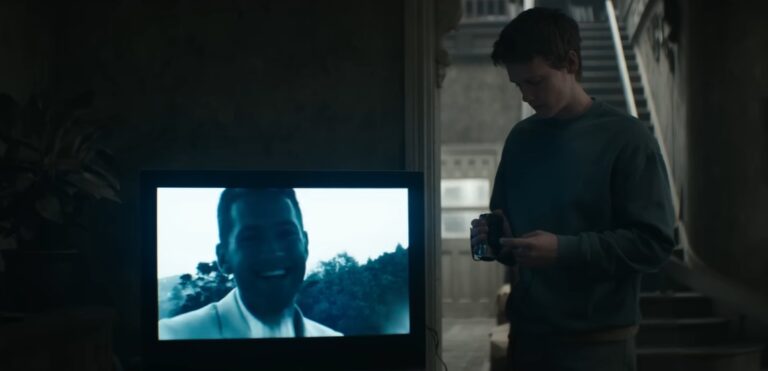
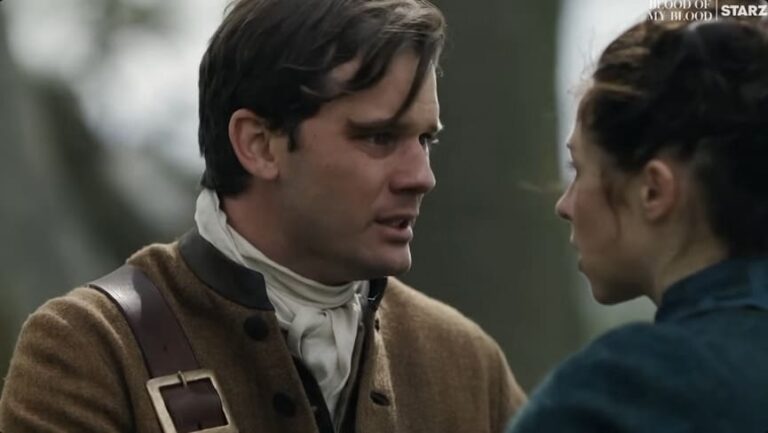
Instead of focusing on Jamie and Claire as a couple, the prequel turns the phrase toward their parents. Brian Fraser and Ellen MacKenzie belong to one timeline, while Henry Beauchamp and Julia Moriston live through a very different and far more dangerous period surrounding World War I.
That creates an obvious question: how much of Jamie and Claire was already written into their family histories?
Not literally written, of course. Outlander has never been particularly interested in making destiny completely rigid. Its characters make choices, screw things up, take risks, and sometimes pay brutally for them. But the series clearly enjoys the idea that certain emotional patterns survive from generation to generation.
Jamie inherits more than a surname. Claire inherits more than memories of a mother she barely knew. Their parents’ experiences give the audience another way to understand why these two people are capable of such extraordinary loyalty, stubbornness, and sacrifice.
So What Exactly Is the “Veil of Time”?
This is where things get properly interesting.
The word “veil” implies a barrier, but not an impenetrable one. A wall would suggest that the past and future are completely separate. A veil suggests the opposite. You can see something on the other side. You may even be able to reach through it.
That idea fits Outlander almost suspiciously well.
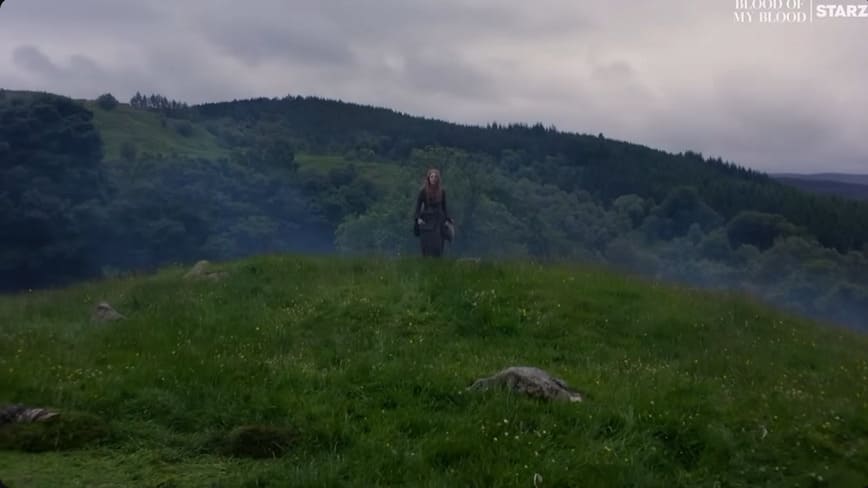
The standing stones have always functioned as the most recognizable gateway between eras, with Craigh na Dun sitting at the center of the mythology. But the stones are not merely sci-fi machinery. Their connection to ancient Celtic beliefs gives the whole concept a mystical quality that makes the rules deliberately feel incomplete.
That ambiguity is one of the reasons the time travel works. If the show explained every mechanism with a neat scientific diagram, half the magic would disappear.
The Veil of Time can therefore be read on two levels. It can describe the literal boundary between centuries, but it also works as a metaphor for the emotional distance separating people who should never have been able to find each other.
Julia Moriston Changes the Conversation
One of the biggest reasons fans became so interested in this idea is Julia Moriston.
Claire’s mother is not simply a background figure anymore. Her connection to time travel forces viewers to rethink Claire’s own journey. Claire did not necessarily stumble into the past as some completely isolated accident. There appears to be a family history behind her ability to interact with the stones.
And that changes the emotional meaning of Claire’s story.
For years, her arrival in the 18th century could be viewed as an extraordinary event that happened to one woman. If time travel follows a hereditary line, however, Claire becomes part of something much older.
That does not mean every member of her family can casually walk through a stone circle whenever they feel like it. The Outlander mythology has never suggested such a simple rule. But the possibility of inherited sensitivity to time makes the franchise’s mythology considerably richer.
Three Fan Theories That Make the Most Sense
1. Time Travel Is Connected to Family Bloodlines
This is probably the theory that gets the most attention because it fits what viewers already know about Claire and Julia.
If Julia can cross time and Claire can do the same, the family connection becomes difficult to ignore. It raises the possibility that certain bloodlines are more closely connected to the stones than others.
That would make “Blood of My Blood” more than a poetic title. Blood could literally be part of the mythology.
I like this theory, although I hope the show does not reduce everything to a simplistic “magic gene.” Outlander is at its best when the supernatural remains mysterious. Give us clues. Give us patterns. Just don’t turn it into a genetics lecture.
2. The Two Timelines Could Come Dangerously Close
The dual structure of Blood of My Blood is already one of its strongest ideas. Brian and Ellen are living in 18th-century Scotland while Henry and Julia experience the chaos of the early 20th century.
The temptation is obvious: what happens if those timelines stop behaving like completely separate stories?
A journey through the stones could potentially place characters from different periods in the same historical setting. Even if Jamie and Claire’s parents never directly interact, the possibility creates a strange circularity. Two generations that should be separated by centuries could suddenly become connected in a way nobody expected.
That is exactly the sort of complication Outlander loves.
3. The Veil Represents Separation, Not Just Time Travel
This is actually my favorite interpretation.
Fans often focus on the mechanics of time travel because they are easier to discuss. How does it work? Who can do it? Where does someone end up? What changes?
But the emotional side is much more interesting.
Jamie and Claire’s relationship has repeatedly been defined by separation. War separates people. Politics separates them. Time separates them. Circumstances keep putting enormous obstacles between two people who refuse to let those obstacles have the final word.
The parents in Blood of My Blood reflect that same emotional pattern.
The veil is distance. It is the thing standing between people who desperately want to remain together.
That makes the phrase far more powerful than a simple reference to a magical portal.
The Two Eras Are Supposed to Feel Different
Another detail I appreciate about the prequel is the contrast between its timelines. The Scottish storyline carries the familiar atmosphere of Outlander: rural landscapes, political tension, clan loyalties, and the constant threat of violence surrounding Highland life.
The World War I-era storyline feels completely different. The technology is newer, the social environment has changed, and the psychological scars of war are much closer to the modern world.
Yet the emotional problems remain remarkably similar.
People still lose each other. People still lie to protect the people they love. People still make decisions based on fear. And people still risk everything for someone else.
That contrast is exactly what makes the concept work. The centuries change. The human problems don’t.
Bear McCreary’s Music Makes the Theme Hard to Miss
The production does not leave the connection between time and emotion entirely to the script. Bear McCreary’s score plays a major role in establishing the relationship between the two eras.
The opening theme, “Blood of My Blood – For My Love That’s Lost,” uses Julie Fowlis’ vocals alongside arrangements that draw on traditional Scottish sounds while still feeling cinematic and modern.
That combination matters.
The music can move between eras without making either one feel completely detached from the other. Traditional instruments and modern orchestration become another version of the veil — different sounds occupying the same emotional space.
Some viewers may not pay much attention to the score while watching, but it does a lot of heavy lifting. The visual language and music constantly remind us that these stories are separated by history but connected by feeling.
What “The Veil of Time” Could Mean for Season 2
| Possibility | What It Could Mean |
|---|---|
| Inherited time travel | Claire’s abilities may be part of a longer family history. |
| Timeline convergence | The two periods could become more directly connected. |
| Emotional symbolism | The veil represents separation between people who refuse to give up on each other. |
| Expanded mythology | The prequel could reveal more about why certain people can cross through time. |
The danger here is obvious. Outlander can become too obsessed with explaining its own mythology. The mystery surrounding time travel is part of the appeal, and there is a point where answers become less satisfying than questions.
I would much rather see the series leave a few doors open than explain every strange detail.
Why Fans Are So Invested in This Mystery
There is something unusually satisfying about watching a prequel reveal that the original story was connected to a much larger family history all along.
Blood of My Blood is not simply saying, “Here are Jamie and Claire’s parents.” It is asking viewers to reconsider the people they already know.
Why are Jamie and Claire the way they are?
Why does love seem to survive impossible circumstances in this family?
Why does time repeatedly bring certain people together when logic says they should never meet?
Those questions are much more compelling than simply finding out who will walk through the stones next.
My Take: The Mystery Works Better When It Stays a Little Uncomfortable
I’ll admit that I am more interested in “The Veil of Time” as an idea than as a technical explanation of Outlander’s time-travel rules.
The franchise has always had a strange, slightly unsettling quality when it deals with time. People don’t completely control where they belong. History can be changed, but not without consequences. Memories, bloodlines, relationships, and places seem to have a pull of their own.
That is the part I want Blood of My Blood to protect.
If the series turns the veil into nothing more than a clearly defined supernatural mechanism, I think it loses something. But if it uses the concept to connect Julia, Claire, Ellen, Brian, Jamie, and the wider Fraser and Beauchamp histories, then there is real potential here.
The best version of this story is not about proving that time travel is possible.
It is about asking why certain people seem destined to find each other despite time doing everything it can to keep them apart.
And that is where “Blood of My Blood” becomes more than a title. It becomes the emotional argument of the entire prequel: families inherit scars, instincts, memories, and perhaps even impossible connections. The past does not simply disappear because a century has passed.
Sometimes it waits.
Sometimes it comes looking for you.
And in the world of Outlander, there is always a chance that the veil between then and now is much thinner than anyone realizes.