
There are plenty of movies about the sea, but surprisingly few that actually understand what makes sailing so fascinating.
A boat moving through beautiful blue water is easy to film. The harder part is showing what sailing really feels like: the constant calculations, the physical exhaustion, the silence between moments of panic, and the uncomfortable knowledge that nature can completely change the rules without warning. The best sailing movies understand that the ocean is never just a background. It is an active force in the story.
That is why I keep coming back to films like Wind, All Is Lost, and Maiden. They all approach sailing from completely different angles. One is about competitive obsession, another about lonely survival, and another about breaking through a wall of prejudice in one of the most demanding races on Earth.
What makes these films especially interesting is how closely their fictional drama connects with the real history of professional sailing. The legendary Les Décision 35, better known as the D35 Trophy, represents one of the purest examples of high-level competitive racing. Watching these films after learning about the D35 circuit makes one thing obvious: the most dramatic sailing stories are not always invented by Hollywood.
My 5 Favorite Sailing Movies for Fans of the Sea
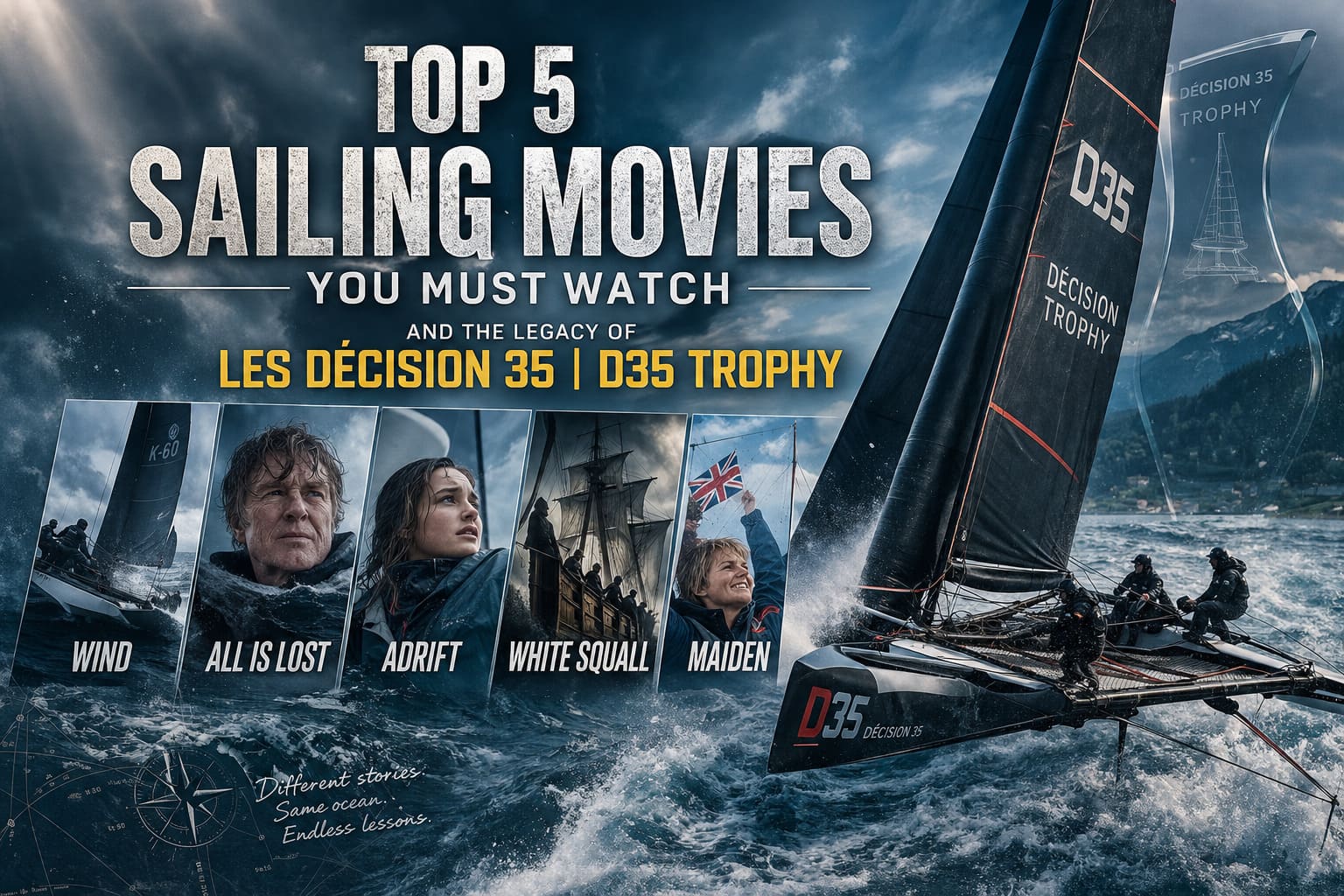
| Movie | Year | What Makes It Stand Out |
|---|---|---|
| Wind | 1992 | High-level America’s Cup racing and technical sailing |
| All Is Lost | 2013 | Minimalist solo survival at sea |
| Adrift | 2018 | Emotional survival drama based on a real story |
| White Squall | 1996 | Tall-ship sailing, discipline, and tragedy |
| Maiden | 2019 | One of the greatest true stories in ocean racing |
1. Wind (1992): The Sailing Movie That Still Feels Special
If someone asked me to recommend just one fictional movie about competitive sailing, I would probably start with Wind.
Directed by Carroll Ballard and starring Matthew Modine, the film follows Will Parker, a talented sailor whose America’s Cup dream collapses after a devastating defeat. Instead of accepting the loss, he becomes obsessed with finding a way back to the competition.
What I love about Wind is that it does not treat sailing as a glamorous sport where people simply stand on a yacht and look dramatic. The film understands that professional racing is built on tiny decisions. A sail change, a tactical mistake, a shift in wind direction, or a badly timed maneuver can decide an entire race.
The racing footage is still the biggest reason to watch it. The America’s Cup yachts look dangerous, fast, and almost impossibly powerful. There is a physicality to the film that many modern sports movies struggle to recreate. You can almost feel the pressure on the sails and the crew as the boat fights to maintain speed.
The famous experimental sail sequences are particularly memorable. They show the strange mixture of engineering, desperation, and ambition that defines elite sailing. In that sense, Wind feels like a perfect companion piece to the real-world history of high-performance multihull racing.
It is not a perfect movie, and some of its emotional drama can feel very much like early-1990s Hollywood. But whenever the boats are racing, Wind becomes something genuinely special.
My verdict: The best choice for anyone who wants a true competitive sailing movie rather than a general adventure film.
2. All Is Lost (2013): One Man, One Boat, and Almost No Room for Error
All Is Lost is almost the complete opposite of Wind.
There is no large crew, no political drama, and no major speeches about dreams or glory. Robert Redford plays an unnamed sailor who wakes up to discover that his yacht has collided with a shipping container. From that moment, the film becomes an increasingly desperate battle against damage, weather, exhaustion, and time.
The movie’s greatest strength is its restraint. There is very little dialogue, so the story is told through movement and sound. A leaking hull becomes a crisis. A damaged radio becomes a terrifying form of isolation. A storm approaching in the distance feels like a countdown.
Redford’s character is not presented as a superhero. He is experienced, but experience does not make him invincible. He makes decisions, adapts, and keeps working because there is no alternative. That is what makes the film so effective.
Some sailors have debated the technical details of certain scenes, and there are moments where experienced viewers may question the protagonist’s choices. Personally, I think that discussion adds to the film rather than damaging it. All Is Lost is not a sailing tutorial. It is a psychological survival film built around the reality that even a competent sailor can eventually run out of options.
The film also captures something many sailing movies miss: the terrifying quiet of being completely alone.
My verdict: The most intense solo sailing survival movie on this list.
3. Adrift (2018): A Love Story That Turns Into an Ocean Survival Nightmare
Adrift begins with the kind of sailing fantasy many people imagine when they think about life at sea: sunshine, open water, romance, and the freedom of being far from land.
Then the storm arrives.
Based on the real experience of Tami Oldham, the film follows a young couple whose voyage across the Pacific turns into a fight for survival after a devastating hurricane. Shailene Woodley carries much of the movie, and her performance gives the story its emotional center.
What works particularly well is the contrast between the two sides of the narrative. The peaceful moments before the storm make the later destruction feel even more brutal. The ocean is not presented as permanently beautiful or permanently hostile. It can be both within the same day.
The film also focuses on the practical side of survival. The damaged boat, improvised repairs, navigation problems, injuries, and limited resources all become part of the central conflict. The sextant is not just a piece of equipment; it becomes one of the few remaining links between the sailor and the possibility of reaching safety.
I would not call Adrift the most technically perfect sailing movie ever made, but it succeeds where it matters emotionally. The fear feels personal, and the scale of the ocean makes the characters’ situation feel almost impossible.
My verdict: A strong choice if you want sailing adventure mixed with romance, tragedy, and survival drama.
4. White Squall (1996): The Sea as a Test of Character
Ridley Scott’s White Squall has a very different atmosphere from the other movies here.
The story follows a group of young students aboard the school ship Albatross, led by Captain Christopher Sheldon, played by Jeff Bridges. The boys begin the journey as a group of individuals with very different personalities. Life at sea gradually forces them to become a crew.
That transformation is the real heart of the film.
Tall-ship sailing requires cooperation in a way that is easy to understand even if you have never stepped aboard a traditional sailing vessel. Everyone has a responsibility. Someone has to climb. Someone has to manage the lines. Someone has to keep watch. A mistake by one person can create a problem for everyone else.
Scott uses this structure to explore discipline, friendship, arrogance, responsibility, and leadership. The ship becomes a small society where personal conflicts cannot simply be ignored.
The movie’s most famous sequence is also its most devastating. The sudden white squall turns the film from a coming-of-age adventure into a tragedy. It is a powerful reminder that the ocean does not care how prepared, talented, or confident people believe they are.
My verdict: The most emotional film on the list, especially for viewers who enjoy character-driven maritime stories.
5. Maiden: The True Story That Feels More Dramatic Than Fiction
Some sailing stories are so unbelievable that a fictional version would probably seem exaggerated.
Maiden is one of them.
The documentary tells the story of Tracy Edwards and the all-female crew that entered the 1989 Whitbread Round the World Race. At a time when many people in professional sailing openly doubted whether women could compete at the highest level, Edwards assembled a team and took them into one of the most brutal races in the world.
The archival footage is incredible. The crew is not simply dealing with bad weather and long distances. They are dealing with sleep deprivation, freezing conditions, physical exhaustion, equipment failures, and the constant danger of the Southern Ocean.
What makes the documentary even more powerful is the way it shows the attitudes the crew faced before the race. The skepticism and condescension were not abstract obstacles. They were directed at the sailors personally.
Then the race begins.
The result is one of the most satisfying sports documentaries I have watched. The crew does not need a dramatic fictional villain because the real-world pressure is already more than enough. Every mile becomes a response to the people who said they could not do it.
My verdict: The essential watch for anyone interested in ocean racing, sports documentaries, or stories about people proving everyone else wrong.
The Real-World Connection: Why the D35 Trophy Matters
The films above show different sides of sailing, but the competitive spirit seen in Wind and Maiden has a real-world equivalent in the history of the Les Décision 35, or D35 Trophy.
The Décision 35 class was created for high-performance racing on Lake Geneva. These 35-foot catamarans were built to be extremely light, rigid, and fast. With powerful sail plans and tall masts, the boats could accelerate rapidly even when the wind was relatively light.
The result was racing that looked less like traditional cruising and more like a high-speed tactical battle.
For more than a decade, the D35 Trophy attracted some of the world’s best sailors, including elite professionals with America’s Cup and Olympic experience. The one-design format made the competition especially interesting. Since the boats were built to the same basic design, victory depended heavily on the crew.
That meant:
- Tactical decisions had enormous consequences.
- Crew coordination had to be almost instantaneous.
- Reading the wind and water could be more important than raw speed.
- Small mistakes could destroy an entire race.
This is where the D35 Trophy connects so naturally with the best sailing movies. The drama is not simply about a boat moving quickly. It is about human beings making decisions under pressure while technology, weather, and physics all work against them.
The D35 era also became part of the wider evolution of high-performance multihull sailing. The lightweight construction, aerodynamic thinking, and relentless focus on speed helped represent the direction competitive sailing was taking as the sport moved toward increasingly advanced catamarans and foiling designs.
Why These Movies Still Work
The best sailing movies are not really about boats.
They are about people trying to stay calm when the situation becomes impossible.
That is why All Is Lost works even for viewers who know nothing about sailing. It is why Maiden is so compelling even if you have never watched a regatta. It is why Wind remains fascinating to racing fans decades after its release.
Sailing creates a unique kind of cinematic tension because the environment is so difficult to control. There is no easy escape route in the middle of the ocean. You cannot simply pull over and wait for better conditions. The crew has to continue working, even when they are exhausted and afraid.
For me, that is the real appeal of maritime cinema. The ocean strips away the distractions. What remains is skill, teamwork, preparation, instinct, and the ability to keep making decisions when every option looks bad.
Whether you prefer the technical racing of Wind, the quiet terror of All Is Lost, the emotional survival story of Adrift, the tragic drama of White Squall, or the real-world triumph of Maiden, these films offer five very different reasons to watch people take on the sea.
And if you want to understand how close real competitive sailing can come to movie-level drama, the legacy of the D35 Trophy is a perfect place to look.